1. Airbnb depreciation lets property owners recover the cost of income-producing rental property over time, but land is not depreciable.
2. Most residential rental buildings are depreciated over 27.5 years under IRS MACRS rules, while furniture, appliances, and certain improvements may use shorter lives.
3. Bonus depreciation can accelerate deductions for qualified property, but short-term rental owners should work with a CPA before using it.
Airbnb depreciation is a common tax topic for short-term rental owners because it can reduce taxable rental income without requiring a new cash expense. If your property produces rental income, the IRS generally allows you to recover part of the cost over time.
But Airbnb depreciation is not a simple "write off the house" rule. You need to separate land from building value, track the placed-in-service date, classify assets correctly, and understand recapture when you sell.
This guide is educational, not tax advice. Short-term rental tax rules are fact-specific, especially when personal use, material participation, and bonus depreciation are involved.
What Is Airbnb Depreciation?
Airbnb depreciation is the tax process of deducting the cost of a rental property or rental business asset over its useful life. Instead of deducting the full building cost in one year, you spread the deduction across the IRS recovery period.
For a residential rental property, the building is usually depreciated over 27.5 years. Land is not depreciable because it does not wear out in the same way a building, appliance, mattress, or improvement does.
If you rent only part of your home on Airbnb, depreciation usually applies only to the business-use portion. For example, if one bedroom and shared space represent 20% of the home used for rental activity, only that portion may be relevant for depreciation and expense allocation.
Can You Depreciate an Airbnb Property?
In many cases, yes. You may depreciate property used in an income-producing rental activity if it has a determinable useful life, lasts more than one year, and is placed in service.
Placed in service means the property is ready and available to rent, not necessarily the first date a guest books. IRS Publication 527 uses this same availability concept for rental property.
Airbnb owners should document:
- Date the property became available for short-term rental
- Purchase price and closing costs
- Land value versus building value
- Furniture, appliance, and equipment costs
- Improvements versus repairs
- Personal-use days and rental-use days
That documentation matters because depreciation depends on basis, asset class, business-use percentage, and timing.
Airbnb Depreciation Life: What Gets Depreciated and How Long?
The building portion of a residential rental is generally depreciated over 27.5 years. This often applies to an Airbnb house, condo, cabin, or apartment.
Other assets may have shorter recovery periods. Furniture, appliances, linens, electronics, and certain equipment may fall into shorter MACRS classes. Some improvements are depreciated over longer periods, while repairs may be deductible as current expenses instead of capitalized.
Common examples:
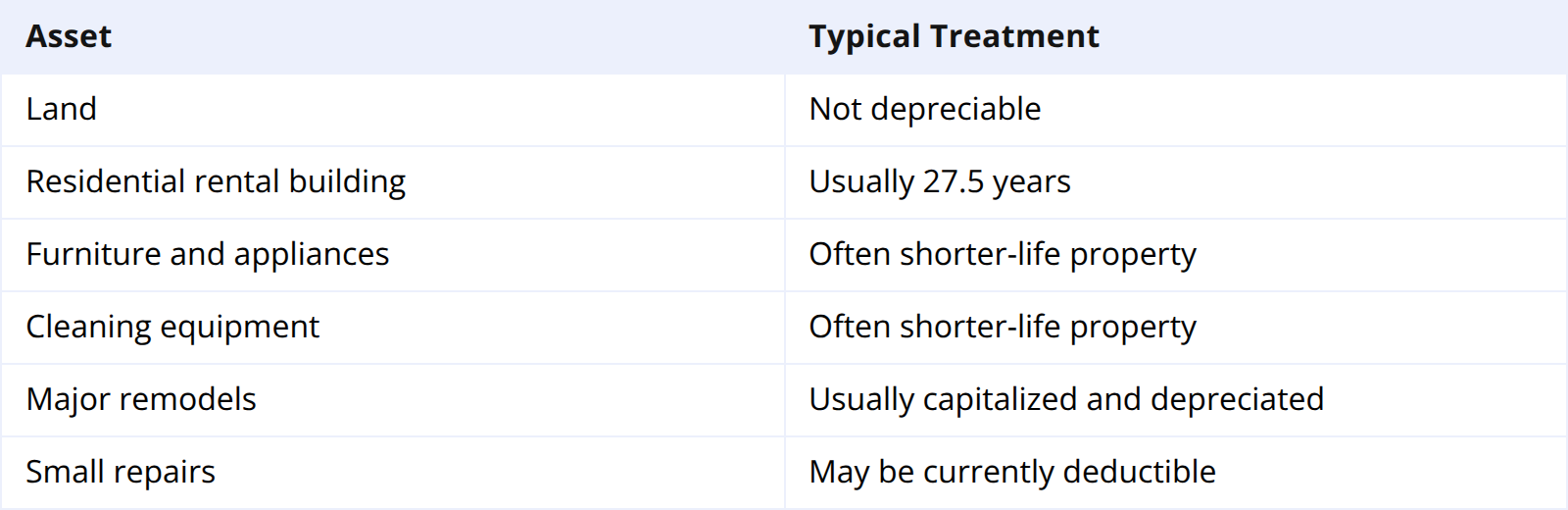
Classification is where many owners make mistakes. A new sofa is not the same as a new roof. A broken doorknob repair is not the same as a kitchen renovation. Ask a tax professional before placing large items into a depreciation schedule.
Simple Airbnb Depreciation Example
Assume you buy a short-term rental property for $500,000. The land value is $150,000, and the building value is $350,000.
Only the building portion is depreciable:
$350,000 / 27.5 years = $12,727 annual depreciation
That deduction can reduce taxable rental income, even though you did not spend $12,727 in cash that year. If the property also includes $20,000 of furniture and appliances, those items may be depreciated separately or may qualify for accelerated treatment.
This is why depreciation can materially change an Airbnb investment analysis. Cash flow and taxable income are not the same thing.
What About Airbnb Bonus Depreciation?
Bonus depreciation allows qualifying property to be deducted faster, sometimes in the first year. Current IRS guidance under the One Big Beautiful Bill states that 100% additional first-year depreciation generally applies to qualified property acquired after January 19, 2025, if the property meets the rules.
For Airbnb owners, the key point is that bonus depreciation generally does not apply to land or the 27.5-year residential building itself. It may apply to qualifying assets with a recovery period of 20 years or less, such as certain furniture, appliances, equipment, or components identified through cost segregation.
That is why "Airbnb bonus depreciation" is often discussed alongside cost segregation. A cost segregation study separates parts of the property into shorter-life assets where allowed. The result can be a larger first-year deduction, but also more complexity and audit risk.
Do not use bonus depreciation just because a spreadsheet looks attractive. Confirm placed-in-service date, asset class, business-use percentage, passive activity treatment, and whether losses can offset other income.
The Short-Term Rental Loss Issue
Depreciation can create a tax loss even when the property is cash-flow positive. Whether that loss can offset W-2 or other active income is a separate question.
Short-term rentals are often discussed under the "STR loophole" because certain properties with average guest stays of seven days or less may be treated differently from traditional long-term rentals for passive activity purposes. But this is not automatic. Owners may need to materially participate, track hours, and satisfy IRS tests.
This is one of the most important areas to discuss with a CPA. The depreciation deduction may be valid, but the ability to use the loss against other income depends on passive activity rules, personal use, participation, and filing facts.
Common Mistakes Airbnb Owners Make
- The first mistake is depreciating land. Land must be separated from building value.
- The second mistake is starting depreciation too early. The property must be placed in service for rental use.
- The third mistake is ignoring personal use. If you use the home personally and rent it part of the year, depreciation and expenses may need to be allocated.
- The fourth mistake is confusing repairs with improvements. Repairs may be current expenses, while improvements are usually capitalized.
- The fifth mistake is forgetting depreciation recapture. When you sell, depreciation claimed or allowable can affect taxable gain. Skipping depreciation does not necessarily avoid this issue.
Why Clean Records Matter
Depreciation is only as reliable as the records behind it. Keep purchase documents, closing statements, property tax assessments, invoices, receipts, guest stay records, and income reports by channel.
Smart Order helps short-term rental operators centralize reservations, OTA channels, direct bookings, payments, and revenue reporting. When bookings come from Airbnb, Booking.com, Agoda, or a direct booking engine, the reservation and revenue data flow into one dashboard. That gives owners and accountants cleaner operating records when reviewing income, occupancy, and property performance.
Keep Airbnb Revenue Records in One Dashboard
Smart Order connects OTA reservations, direct bookings, payments, and reporting so property owners can track rental income without rebuilding records from spreadsheets.
FAQ About Airbnb Depreciation
Can I depreciate my Airbnb property?
Often, yes, if the property is used to produce rental income and is placed in service. You generally depreciate the building portion, not the land.
What is the depreciation life of an Airbnb?
The residential rental building is generally depreciated over 27.5 years. Furniture, appliances, equipment, and certain improvements may have different recovery periods.
Can I depreciate Airbnb furniture?
Furniture used in the rental business may be depreciable. The recovery period and eligibility for accelerated deductions depend on asset type, placed-in-service date, and current tax law.
Does Airbnb bonus depreciation apply to the whole house?
Usually no. Bonus depreciation generally applies to qualifying shorter-life property, not land or the 27.5-year residential building. Cost segregation may identify components that qualify.
Do I need a CPA for Airbnb depreciation?
Yes, strongly recommended. Depreciation, bonus depreciation, passive loss rules, personal use, and recapture can materially affect your tax outcome.
Final Takeaway
Airbnb depreciation can be valuable, but it needs careful handling. The core rule is simple: depreciate income-producing property over the proper recovery period, exclude land, and keep records.
The complexity comes from short-term rental facts: personal use, placed-in-service dates, furniture and improvement classification, bonus depreciation, cost segregation, and passive activity rules. Use depreciation as part of a complete tax strategy, not as a shortcut, and review the details with a qualified tax professional before filing.