1. B&B and guesthouse owners are routinely oversold hotel software built for properties ten times their size — the features that matter most at a 3–8 room property are a short list that most enterprise PMS products treat as baseline, not their selling point
2. The single highest-risk operational problem for a B&B is a double-booking from two OTA platforms that were not synced — this is the first problem any software for a small accommodation needs to solve
3. Owner-operated properties have a different staffing reality than hotels: in most B&Bs, the owner manages reservations, takes payments, handles messages, and prepares breakfast — the software needs to work for one or two people, not a front desk team
4. A direct booking option — even a simple widget on the property's own website — is the most cost-effective upgrade available to a B&B, reducing OTA commission on every reservation it captures
Most hotel software is designed for hotels. That sentence sounds obvious, but it has a real implication for B&B and guesthouse owners shopping for property management software: the features on the comparison page, the pricing tiers, and the onboarding checklist were built with a 30-room independent hotel in mind, not a six-room guesthouse where the owner also makes breakfast.
This does not mean small accommodation operators need different software categories. It means they need a much shorter list of features — and they should be skeptical of any system that charges for capabilities they will never use.
The One Problem That Must Be Solved First
A B&B or guesthouse listed on two OTA platforms — Booking.com and Airbnb, for example — without synchronized calendars will eventually take the same room for the same dates from two different guests. This is not a risk to manage around; it is a near-certainty at any meaningful booking volume.
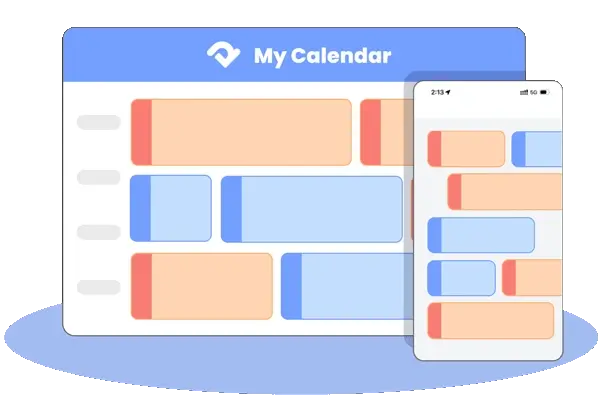
OTA calendar synchronization is the first and most critical function any software serving a small accommodation needs to provide. When a reservation comes in from Booking.com, the same dates need to close on Airbnb, on the property's direct booking page, and on any other platform the property uses — automatically, in real time, before the next guest can book.
This is not a premium feature. It is the operational foundation. Any system that does not do this reliably, or that requires a manual step to keep calendars in sync, creates the exact risk it should be eliminating.
The secondary implication: if the property is currently managing its OTA calendars manually — exporting iCal feeds and importing them elsewhere, or blocking dates by hand — the first return on any investment in software is the time and error risk this process currently carries.
The Owner-Operator Reality
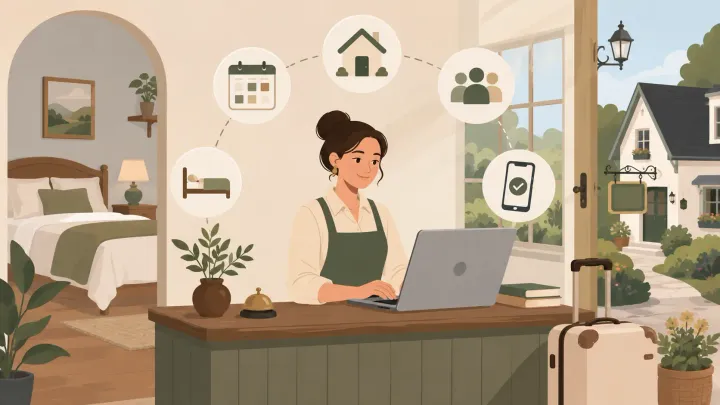
Most B&Bs and small guesthouses are run by one or two people. The owner manages reservations, responds to guest inquiries, takes payments at check-in, turns the rooms, and prepares breakfast. There is no front desk team. There is no housekeeping supervisor. The role divisions that hospitality software typically organizes around do not exist at this property.
This shapes what the software needs to do. A formal housekeeping status module — where staff mark rooms Ready or Cleaning from a phone app and the front desk dashboard updates in real time — is a workflow built for a property where housekeeping and front desk are different people. In a B&B where the owner turns every room themselves, the overhead of maintaining a digital status board adds friction rather than removing it.
The same applies to multi-staff permissions, shift scheduling features, and POS integration. These are not bad features — they are features designed for a different operational model.
What an owner-operator needs from software is low friction for one person: a clear view of what is booked, what is arriving, what needs to be paid, and what messages are outstanding. A system that is impressive to demo and laborious in daily use is not good software for a B&B.
Built for Small Accommodations, Not Watered-Down Hotel Software
Smart Order gives B&B and guesthouse owners OTA calendar sync, automated guest messaging, and direct booking capability in one system — without the enterprise features that drive up cost and complexity for properties that don't need them.
The Features That Genuinely Help a B&B
After OTA calendar sync, a short list of features adds real value at a small accommodation:
Automated guest messaging. A booking confirmation that sends immediately after reservation, a pre-arrival message with check-in details two days before arrival, and a post-checkout review request sent automatically — these three messages cover the guest communication lifecycle for most B&B stays without requiring the owner to write or send each one manually.
Payment handling and records. A reservation record that tracks what has been collected and what is outstanding prevents the awkward conversation at check-in about whether a deposit was received. A simple invoice the owner can send or print covers the guest who asks for a receipt.
Guest record keeping. A returning guest who mentioned a dietary restriction two stays ago, or who prefers an early check-in, is more likely to book again if the owner can reference that detail without searching through old emails. A reservation system that stores guest notes builds the relationship data that is the B&B's competitive advantage over larger, more impersonal hotels.
A direct booking option. A booking widget on the property's own website, or a direct booking link the owner can share by email or social media, captures reservations without an OTA commission. At $150 per night and a 15% commission rate, each direct booking saved is $22.50 kept. A direct booking tool that pays for itself in four reservations a year is straightforwardly worthwhile.
What B&Bs Do Not Need — and Why It Gets Sold to Them
Several features appear on hotel software comparison pages but serve a different operational model:
Formal housekeeping workflow. Useful when housekeeping and front desk are separate people who need to coordinate without calling each other. Not useful when one person does both.
Complex yield management. Dynamic pricing rules, minimum stay restrictions by day of week, and automated rate optimization are valuable for a busy independent hotel managing 30 rooms across six OTA channels. For a guesthouse with five rooms and two platforms, the overhead of configuring and maintaining rate rules often exceeds the revenue benefit.
POS integration. Point-of-sale tools connect to food and beverage service, retail, or spa operations. A B&B that offers breakfast but not paid à la carte service does not have a POS operation.
Multi-property reporting. Portfolio dashboards, cross-property occupancy views, and consolidated revenue reports are exactly what a single-property owner does not need.
These features appear in software demos because they are impressive and because the sales process for hotel software is often built around a larger buyer. The B&B owner who buys a system with all of these features and uses 20% of them has not bought professional-grade software — they have bought an expensive, complex system they mostly ignore.
The Right Tools for a Small Accommodation
Smart Order handles OTA sync, automated messaging, payment records, and direct bookings for B&Bs and guesthouses — at a price and complexity level that fits a one- or two-person operation.
FAQ
What software does a B&B actually need?
The minimum: OTA calendar synchronization to prevent double-bookings, basic reservation management with guest records, and payment handling. The next tier — worth adding once the basics are running well — includes automated guest messaging (confirmation, pre-arrival, review request) and a direct booking option. Formal housekeeping workflow, complex yield management, and POS integration are designed for larger operational models and add cost and complexity without benefit at a small accommodation.
How does OTA calendar sync work for a B&B?
When a reservation comes in from one platform — Booking.com, Airbnb, or another — the calendar sync function automatically closes those dates on every other connected platform. The owner does not need to log into each platform to block the dates manually. This prevents the double-booking that occurs when two platforms each show availability for the same dates and two guests book simultaneously.
Is a direct booking tool worth it for a guesthouse?
Yes for most properties with any web presence. A direct booking widget captures reservations from guests who find the property through search, social media, or a previous stay — without paying the OTA commission. At typical B&B rates and commission structures, a direct booking tool pays for itself in a handful of captured reservations per year and reduces the share of revenue going to third-party platforms over time.
What is the right monthly budget for B&B software?
Most B&Bs and small guesthouses operate comfortably in the $15–$60/month range for property management software that covers OTA sync, reservation management, and automated messaging. The upper end of that range typically adds more OTA channel connections, direct booking capability, and reporting depth. Pricing above that range usually reflects features — multi-property support, advanced yield management, POS integration — that a single-property small accommodation is unlikely to use.
Do B&Bs need a full PMS or just a channel manager?
A channel manager alone handles OTA availability sync but does not manage reservations, store guest records, process payments, or send automated messages. A basic PMS with built-in channel management does all of these from a single system. For a B&B, the integrated combination is what removes manual work from the guest lifecycle. Standalone channel managers make sense as an add-on for larger operations; for a small accommodation, an integrated PMS is simpler and usually cheaper.