1. A Hotel PMS quote should show the complete first-year cost, not only the base subscription.
2. Give every vendor the same property profile and ask the same 15 questions so the proposals are comparable.
3. Get included modules, usage limits, implementation work, payment fees, renewal terms, and data exit costs in writing.
A Hotel PMS quote can look precise while leaving out the costs that matter in daily operations. The base fee may cover the reservation calendar but exclude onboarding, online travel agency (OTA) connections, direct booking tools, payment fees, or priority support.
That makes a low quote difficult to evaluate. Before contacting vendors, define your requirements and send each one the same pricing questions. You will get proposals that are easier to compare and fewer surprises after go-live.
This checklist focuses on the quote itself. For typical pricing models and market cost ranges, read our Hotel PMS pricing guide.
First, Give Every Vendor the Same Hotel Profile
A quote is only useful when the vendor prices the same operating scenario. A 20-room inn with two OTA connections needs a different configuration from a 100-room hotel with a restaurant point-of-sale system and multiple properties.
Send a short profile before asking for a Hotel PMS quote. Include room and property counts, annual booking volume, OTA channels, direct booking needs, payment processor, integrations, users, launch date, migration needs, and expected growth.
15 Hotel PMS Pricing Questions to Ask
Ask vendors to answer these questions in writing. If an answer depends on usage, request the formula, minimum charge, and a worked example based on your hotel profile.
1. What is the pricing unit?
Confirm whether the subscription is charged per room, property, user, reservation, or feature tier. Ask about minimums and request prices for your current inventory and expected inventory in 12 months.
2. What exactly is included in the base subscription?
Request a line-by-line list of included functions. Clarify reservations, front desk, housekeeping, rates, reporting, users, mobile access, and updates. Do not accept “all core features” as an answer.
3. Which limits trigger an upgrade or extra charge?
A plan may cap users, properties, reports, API calls, messages, storage, or connected channels. Ask what happens when you exceed each limit, especially if fees rise with reservations or payment volume.
4. What are the setup and implementation fees?
Ask whether the one-time fee covers configuration, room and rate setup, taxes, permissions, integration testing, and launch support. Request a timeline showing hotel-side tasks and whether you receive a named implementation contact.
5. Is data migration included?
List the records you need moved, including future reservations, guest profiles, deposits, rate plans, and reports. Confirm data-cleaning requirements, validation support, extra import charges, and who resolves discrepancies before launch.
6. How much training is included?
Ask whether training is live or self-service, remote or on-site, and limited by hour or attendee. Include all departments, then check whether new employees and refresher sessions cost extra.
7. Is the channel manager included?
If you sell through OTAs, confirm whether the hotel channel manager is included and whether each channel or property adds a fee. Clarify whether reservations, rates, restrictions, and availability all sync.
8. Is the direct booking engine included?
Ask whether the hotel booking engine has a monthly fee, setup fee, or booking commission. Confirm what website installation includes and model any commission using expected direct revenue.
9. What payment costs sit outside the PMS subscription?
Separate software from payment costs. Ask about processing, refunds, chargebacks, international cards, currency conversion, payouts, and terminals. Confirm whether you must use the vendor's processor or pay to connect your own.
10. What does each required integration cost?
Provide your full integration list and request setup plus recurring fees on both sides. Confirm the required data flow; a nightly export is not equivalent to a real-time two-way connection.
11. What support level is included?
Document support channels, hours, languages, response targets, and escalation. Use a real scenario: if OTA reservations stop syncing on Friday evening, who responds, how quickly, and at what cost?
12. Are updates, security, API access, and reporting included?
Confirm whether updates, security patches, backups, reports, exports, multi-property views, and API access are included. Features shown in a demo may belong to a higher tier.
13. How will the price change when we grow?
Request worked examples for adding rooms, users, properties, channels, and modules. If growth requires an enterprise tier, ask for that price now rather than assuming your current discount continues.
14. What are the contract, renewal, and cancellation terms?
Confirm the term, billing frequency, deposit, automatic renewal, notice period, termination fee, refund policy, and renewal price cap. Check whether you can test your actual room setup and OTA flow before commitment.
15. What is the complete first-year and renewal-year cost?
Ask for one total covering the first-year subscription, implementation, migration, training, modules, integrations, support, hardware, and unavoidable usage charges. Then request the renewal-year cost without one-time launch fees.
Turn the Answers Into a Comparable Quote
Do not compare proposals until every required item has a price or is clearly marked as included. Use a simple table and record assumptions beside each number.
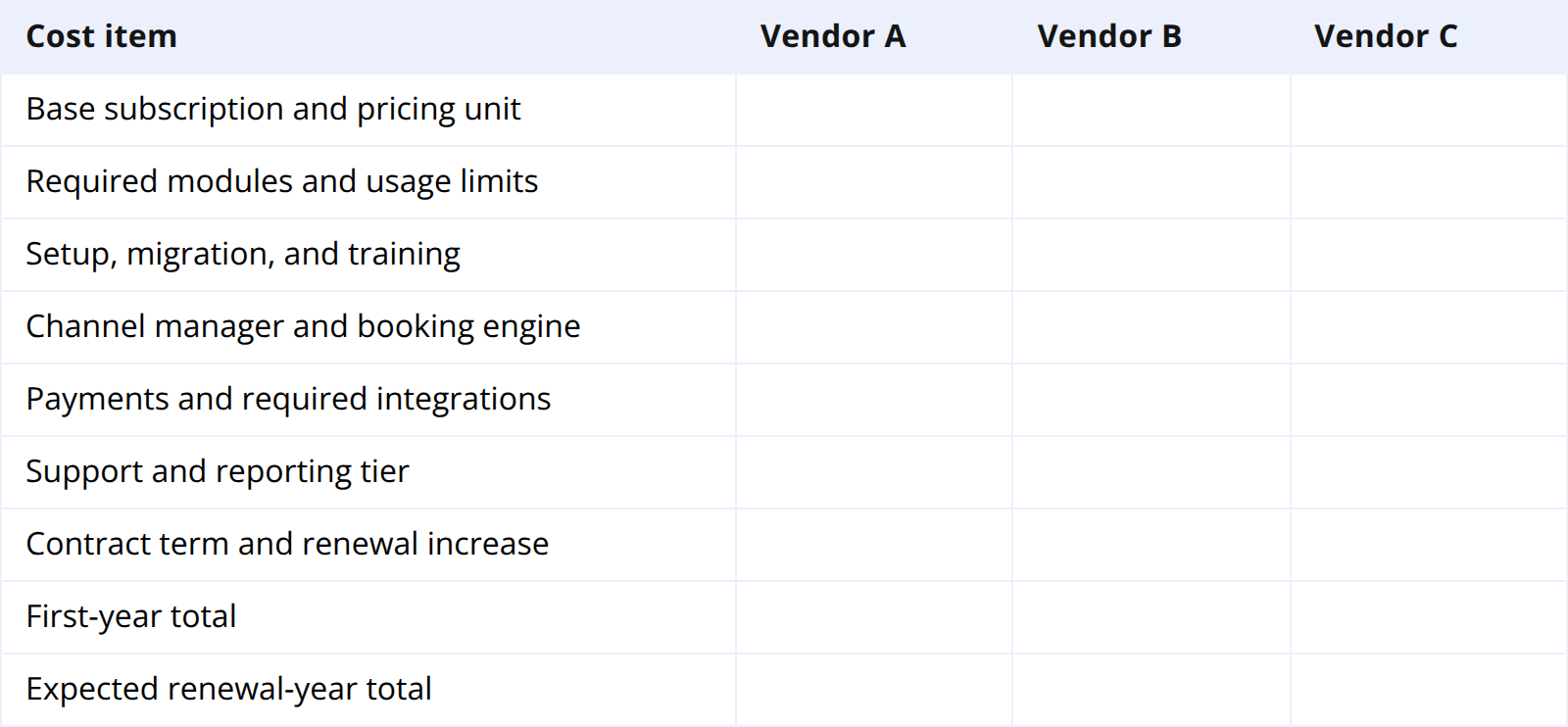
Add one operational note for each vendor. A higher quote may replace separate subscriptions, while a cheaper system may require manual work. Include both new costs and software you can retire.
Red Flags in a Hotel PMS Quote
A custom proposal is normal when a hotel has complex requirements. The concern is not custom pricing; it is an incomplete basis for that price.
Pause when a vendor avoids written inclusions, usage limits, required integration prices, or testing before a long contract. Treat verbal promises as unpriced. Also watch for overlapping modules that create both extra subscriptions and unclear ownership when a reservation fails to sync.
For pricing decisions, Smart Order's relevant workflow is the connected cost stack. An OTA or direct reservation enters the PMS, availability updates, and revenue appears in the same reporting environment. Hotels can compare required modules and channel performance without maintaining several overlapping systems.
Test the Workflow Before You Accept a Quote
See how Smart Order connects reservations, channel updates, direct bookings, and revenue reporting in one hotel PMS workflow.
FAQ About Hotel PMS Quotes
How much does a Hotel PMS usually cost?
Pricing varies by property size, modules, and service level. Compare complete first-year cost instead of relying on an advertised starting price.
Why do many Hotel PMS vendors require a quote?
Hotels differ in inventory, integrations, migration, and training. A tailored quote should still explain every pricing unit, inclusion, limit, and assumption.
What information do I need to request a PMS quote?
Provide property size, booking volume, channels, modules, users, payments, integrations, migration, support, launch date, and growth plans.
Should I choose monthly or annual Hotel PMS pricing?
Monthly billing offers flexibility; annual billing may provide a discount. Compare annual price, cancellation, renewal increases, and trial terms.
What is the most commonly missed PMS cost?
Commonly missed costs include implementation, migration, payments, channel or booking engine add-ons, integrations, premium support, and renewal increases.
Request the Number You Can Actually Budget
The best Hotel PMS quote is not necessarily the lowest. It is the proposal that clearly matches your property, includes the workflows you need, and shows how the price changes over time.
Send every vendor the same profile and the same 15 questions. Then compare first-year cost, renewal-year cost, contract risk, and the operational value of the systems each proposal replaces.