1. Booking engine pricing for small hotels can use a flat monthly fee, per-room subscription, booking commission, fixed transaction fee, or bundled software plan.
2. “Commission-free” describes the booking engine fee, not card processing, currency conversion, chargebacks, or website work.
3. Compare the total cost at your expected direct-booking value, then verify PMS sync, payment ownership, website integration, and contract terms.
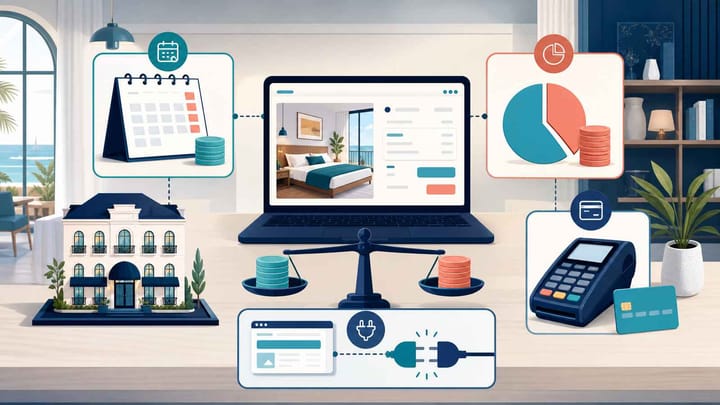
Booking engine pricing for small hotels is rarely one clean number. A vendor may advertise a low monthly fee while charging per booking, requiring its payment processor, or billing separately for website integration.
That makes the cheapest headline price a weak comparison. A useful quote shows what the hotel pays to run the engine, collect money, connect the website, and move each confirmed reservation into daily operations.
Booking Engine Cost Is Not PMS Cost
A hotel booking engine lets guests reserve directly on the property’s website. It displays live rooms, rates, restrictions, policies, taxes, and availability, then sends the confirmed reservation to the hotel’s operating system.
A Property Management System (PMS) handles the reservation after it arrives: calendar, room assignment, guest record, payment status, reporting, and front-desk workflow. Some vendors bundle both products, while others sell the booking engine as a standalone tool or add-on.
This distinction prevents double counting. If a PMS plan already includes a booking engine, the hotel should compare the incremental cost of activating direct bookings—not add the full PMS subscription again. If the engine is standalone, include any connector or API fee required to keep inventory synchronized.
Ask the vendor to label every component. “Booking engine included” may cover the checkout page but exclude payment processing, custom website work, Google Hotel Ads connectivity, premium support, or multilingual content.
The Main Booking Engine Pricing Models
Most quotes combine one or more of the following structures. Model the cost using your expected booking value and volume rather than comparing the advertised starting prices.
Flat Monthly Subscription
The hotel pays the same software fee each month, sometimes with a higher price for more rooms, properties, users, or features. This structure is predictable and becomes cheaper per booking as direct volume grows.
Check whether the quoted tier includes PMS sync, promo codes, rate plans, analytics, payment integration, and support. A low entry tier may not include the functions needed to launch.
Commission on Direct Booking Revenue
The vendor charges a percentage of each confirmed direct booking. A 1% booking-engine fee on $20,000 in monthly direct revenue costs $200, before card processing.
Revenue share reduces the fixed commitment during quiet months but grows with sales. Clarify whether commission is calculated on room revenue, taxes, fees, add-ons, deposits, or the entire reservation value. Also ask what happens after a cancellation or partial refund.
Fixed Fee Per Reservation
Instead of taking a percentage, the engine charges a fixed amount for every booking. This can work well for hotels with higher average booking values because the software fee does not rise with the room rate.
Confirm whether the fee is charged at confirmation, payment, check-in, or completed stay. A hotel should not assume a cancelled reservation reverses the charge.
Bundled or “Commission-Free” Plan
Some PMS packages include a booking engine with no separate commission. The hotel still pays the underlying software subscription and payment fees, but a larger share of each direct booking remains with the property.
Bundling can reduce connector costs and data gaps. It may also make the hotel more dependent on one vendor, so export access, contract length, and the cost of changing providers still matter.
For a small hotel, pricing becomes easier to understand when booking value and processing costs stay separate. Smart Order’s hotel booking engine is integrated with its PMS and sends direct reservations, live rates, and availability into the same operating flow without an OTA commission.
Add Direct Bookings Without a Separate OTA Commission
Connect your hotel website, booking engine, live availability, and PMS so direct reservations enter one operational calendar.
Payment Fees Are a Separate Cost Layer
The booking engine creates the reservation. A payment gateway or processor authorizes the card, wallet, bank payment, deposit, or full balance. These are different services and usually have different fees.
An online card fee often combines a percentage with a fixed amount per successful transaction. International cards, currency conversion, alternative payment methods, fraud tools, instant payouts, and chargebacks may carry additional charges. Pricing varies by processor and market.
Consider a 12-room hotel taking 40 direct bookings per month at an average value of $400. Monthly direct booking value is $16,000. At an illustrative processing rate of 2.9% plus $0.30 per transaction, payment processing is $476: $464 from the percentage plus $12 in fixed fees.
That $476 is not a booking-engine commission. It may apply whether the engine charges $49 per month, 1% of bookings, or no separate software fee. Keep the two lines separate when calculating direct-channel acquisition cost.
Ask who owns the merchant account and who receives the guest’s money. The cleanest setup gives the hotel visibility into each payment, refund, dispute, and payout. If funds pass through the software vendor first, confirm settlement timing, reserves, refund handling, and exit terms.
Website Integration Can Change the First-Year Cost
A booking engine needs a path from the hotel website into live search and checkout. The integration can be a booking button, embedded widget, hosted booking page, subdomain, or fully customized website.
A simple button is usually faster and cheaper. It can feel disconnected if the guest leaves the hotel’s domain or sees a checkout design that does not match the website. An embedded or customized flow can improve consistency but may require developer work and ongoing testing.
Budget for setup beyond the software:
- Website design or developer time, including mobile placement and analytics tracking.
- Room descriptions, photos, policies, taxes, rate plans, translations, and confirmation emails.
- Domain, hosting, security, accessibility, consent tools, and ongoing content changes.
- Testing across devices, currencies, payment methods, booking modifications, and cancellations.
Ask whether the vendor completes the website work or only supplies installation instructions. A “free integration” may mean a standard link, while design changes, custom tracking, or a new website remain billable.
Also test the return path. When a guest books, the reservation should enter the PMS with the correct room, rate, dates, guest count, payment record, source, and availability reduction. Manual re-entry turns a cheap website widget into an expensive daily process.
Compare Total Cost With a Small-Hotel Scenario
Use one set of assumptions for every quote. Suppose the hotel expects $16,000 in direct booking value from 40 monthly reservations.
Offer A charges $59 per month with no booking-engine commission. Offer B charges no monthly fee but takes 1% of booking value, or $160. Offer C charges $2 per booking, or $80. All three may still carry the same payment-processing cost.
The software comparison is therefore $59 versus $160 versus $80—not zero versus paid. Add setup, website, connector, support, and payment costs before choosing.
Volume changes the result. At $4,000 in monthly direct revenue, a 1% model costs $40 and may beat a $59 subscription. At $40,000, that same commission costs $400. Model a low month, expected month, and strong month.
Then calculate the effective booking-engine cost rate:
Monthly engine and integration cost ÷ direct booking value × 100
Keep payment processing as a second rate unless the vendor bundles it. This lets the hotel compare software economics without confusing the cost of accepting cards with the cost of generating a reservation.
Questions to Ask Before Signing
Request a written quote using your room count, website, currencies, expected volume, and payment methods. Avoid a generic “from” price.
Ask these questions:
- Is pricing monthly, per room, per reservation, revenue share, or a combination?
- What booking value does the commission apply to, and are cancellations reversed?
- Which payment processors can we use, and what card, international, FX, refund, and dispute fees apply?
- Are PMS sync, setup, training, support, updates, and booking-engine features included?
- Does website integration mean a link, widget, hosted page, or customized design?
- Who owns the domain, guest data, analytics, merchant account, and payment tokens?
- Is there a minimum term, implementation fee, annual increase, or cancellation charge?
- Can we export reservations, guest data, rates, content, and payment records if we leave?
Ask for a guest-facing test before committing. Search a room on mobile, apply a promotion, review the total price, pay a deposit, and confirm the booking appears correctly in the PMS.
FAQ
How much does a hotel booking engine cost?
Costs vary by pricing model, room count, booking volume, included software, and website work. Small hotels may see a fixed subscription, per-booking fee, percentage commission, or a booking engine bundled with PMS software.
Is a commission-free booking engine really free?
Usually not. Commission-free means the vendor does not take a percentage of booking revenue. The hotel may still pay a monthly subscription, card processing, website, setup, support, currency conversion, and dispute fees.
Are payment fees included in booking engine pricing?
Sometimes, but they are commonly separate. Ask for the booking-engine fee and payment-processing fee as distinct line items, including international cards, currency conversion, refunds, and chargebacks.
Does a small hotel need a new website?
Not always. Many engines can connect through a button, hosted page, or embedded widget. A new or customized website is useful when the existing site is slow, difficult to use on mobile, or cannot support a trustworthy booking flow.
Should the booking engine integrate with the PMS?
Yes. Live rates and availability should reach the website, while confirmed reservations should enter the PMS and reduce inventory automatically. Without that connection, staff must re-enter bookings and risk stale availability.
Compare the Cost of a Working Direct Channel
The right booking engine is not simply the one with the lowest monthly fee. It is the one that gives a small hotel a clear total cost, reliable PMS sync, payment control, and a booking path guests can complete.
Compare software, commissions, payments, and website work separately. Then combine them into a first-year cost and an expected monthly cost. That reveals whether a cheap headline price will remain affordable once direct bookings start growing.