1. Boutique hotel management depends on disciplined handoffs: every arrival, room, payment, guest request, and maintenance issue needs a current status and owner.
2. Review demand and rates daily, but avoid changing prices without checking pickup, remaining inventory, restrictions, cancellations, and channel display.
3. Personal service works only when guest context is recorded in a shared system rather than held in one employee’s memory or inbox.
4. End each day with reconciled payments, reliable reports, documented exceptions, and a clear plan for tomorrow.
Boutique hotel management is the daily work of turning an individual property concept into a consistent, profitable guest experience. Owners must protect the details that make the hotel distinctive while controlling the same operational risks as a larger property: reservations, rooms, rates, payments, staffing, maintenance, and distribution.
The challenge is concentration. A small team handles more functions per person. One missed room-status update can delay an arrival, while one OTA rate error can affect much of the remaining inventory.
Strong management does not mean the owner personally completes every task. It means the hotel has a repeatable operating rhythm, clear decision rights, and one reliable view of what needs attention.
Why Boutique Hotel Management Is Operationally Different
Boutique hotels compete through individuality and personal attention, but their teams are usually smaller than those of full-service chain properties. Front-desk employees may handle reservations, payments, guest messaging, recommendations, and service recovery in the same shift. Managers may also review rates, inspect rooms, approve purchasing, and respond to reviews.
This flexibility is a strength when context moves with the work. It becomes a weakness when information is scattered across paper logs, messaging apps, OTA extranets, payment dashboards, and employee memory.
Every material guest, room, revenue, or payment event should have a status, responsible person, and next action in a shared system. Personalization then becomes repeatable instead of depending on one employee’s memory.
A Daily Boutique Hotel Operating Rhythm
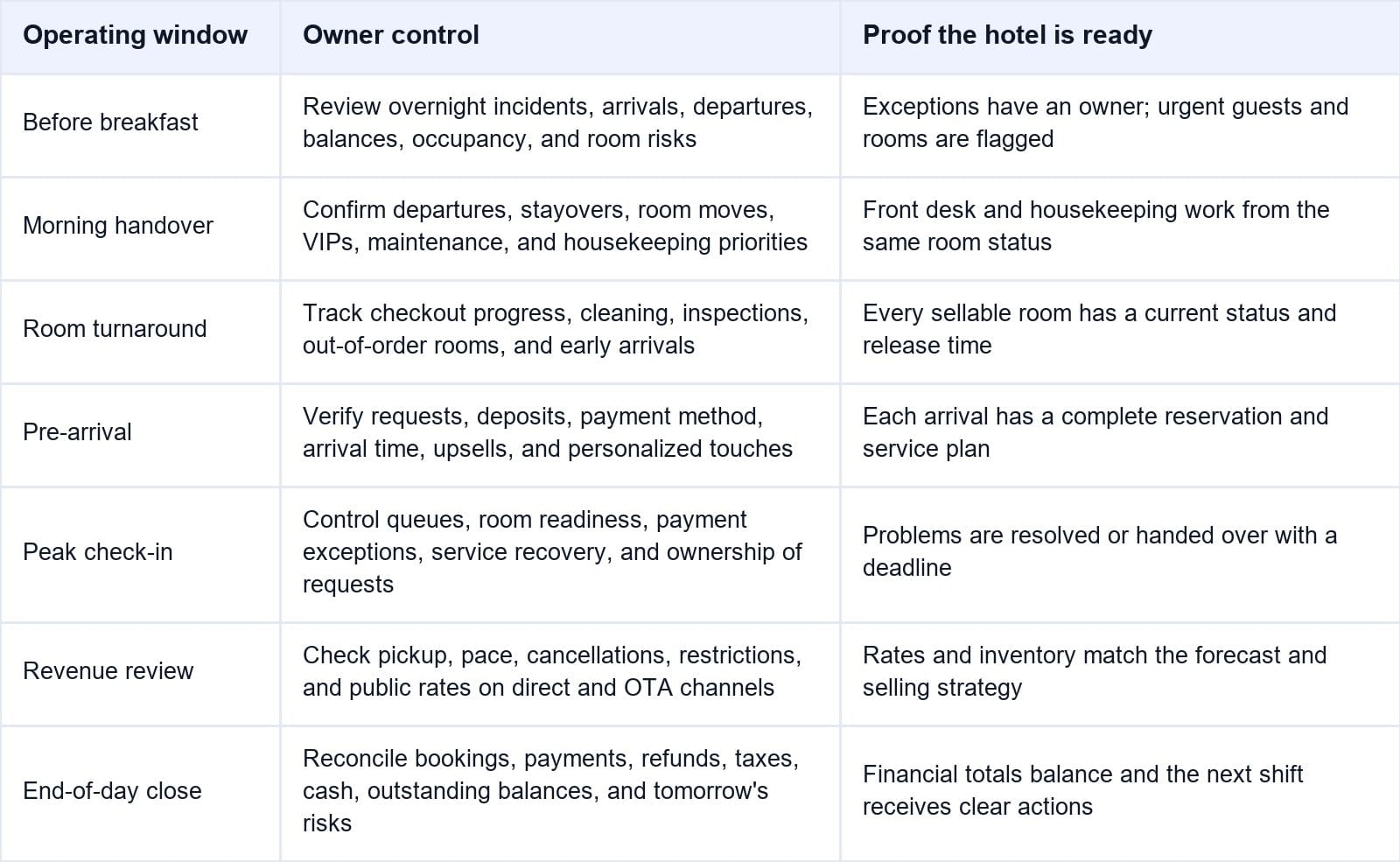
Times vary by property, but the controls remain similar: start with exceptions, align rooms and arrivals, monitor the operation, then reconcile the day.
Owners should assign each control to a role, not a name. The process must continue when the usual manager is off, sick, or helping a guest.
Smart Order’s hotel PMS keeps reservations, room activity, guest details, payments, and reporting in one operating flow so the team can hand work over without rebuilding the story.
Put Daily Boutique Hotel Operations in One System
Give your team one view of reservations, rooms, guest details, channels, payments, and reports without adding enterprise complexity.
Start the Morning With Exceptions, Not a Full Inbox
The morning review should identify what can disrupt today’s service or cash position. Begin with overnight incidents, rooms still occupied, unexpected no-shows, payment failures, maintenance blocks, early arrivals, late departures, special requests, and bookings with missing information.
Compare arrivals and departures with physical room availability. Room moves, out-of-order rooms, extensions, and early check-ins can create conflicts even when total availability looks sufficient.
Review balances before arrival: deposits, pay-at-property terms, virtual cards, failed payment links, refunds, and totals that differ from the confirmed policy.
The output of the morning review should be short: named exceptions, an owner for each, and a deadline. Routine bookings should remain routine.
Make Housekeeping and Front Desk Share One Room Truth
Room status is a live operational control, not a housekeeping-only checklist. Front desk needs to know whether a room is occupied, dirty, being cleaned, inspected, ready, out of order, or held for a specific reason.
At the morning handover, confirm stayovers, departures, early arrivals, priority rooms, linen or amenity changes, maintenance access, and rooms that should not be assigned. Housekeeping should understand why a room is urgent, not simply see a long cleaning list.
Track three separate facts: the guest departed, cleaning finished, and inspection passed. Treating them as one status creates premature room releases.
Maintenance issues require a commercial decision. A broken lamp may allow the room to remain sellable with immediate repair; failed air conditioning may require an out-of-order block. Record the impact, responsible person, expected return time, and whether inventory has been removed from every selling channel.
Prepare the Arrival Before the Guest Reaches the Desk
Before check-in, review arrival time, guest count, room and rate, payment status, requests, previous stay notes, dietary needs, transportation, and promised inclusions.
Not every reservation needs an expensive amenity. A relevant room assignment, clear message, remembered preference, or accurate recommendation often creates more value.
Ensure the channel promise matches operations. Breakfast, parking, pets, extra beds, taxes, deposits, and check-in instructions should surprise nobody.
Upsells should also be operationally valid. Do not sell an early arrival before housekeeping confirms capacity or a package before the included service is available. Record the charge and fulfillment responsibility with the reservation.
Control Rates and Inventory Every Day
Boutique hotel revenue management requires understanding demand and whether current selling controls still make sense—not changing rates hourly.
Review occupancy, pickup, pace, cancellations, remaining rooms, lead time, and local events against the forecast and recent pattern.
Then review public availability. Confirm that direct booking and priority OTA channels show the correct rooms, rates, occupancy pricing, taxes, policies, minimum stays, and closed dates. A rate sent by the hotel is not enough; the guest-facing result is what sells.
Protect peak dates from unnecessary discounting. On soft dates, improve the offer before cutting blindly; a package, flexible policy, or better presentation may preserve value.
Use the hotel channel manager to update connected inventory and rates from one source, but still audit failed deliveries, overrides, promotions, and the final public display.
Manage Peak Check-In as a Controlled Handover
During arrivals, watch room readiness, queue time, payment exceptions, unresolved requests, and employees pulled away from reception.
Set employee authority for room moves, small recovery gestures, late checkout, amenity replacement, and rate corrections. Escalate financial risk, safety, serious complaints, and exceptions outside those limits.
Every open request needs an owner and expected completion time. “Housekeeping knows” or “maintenance was told” is not a usable status. The guest-facing employee must know when to update the guest, even if another team completes the work.
Boutique service should feel natural to the guest, but the internal handoff must be explicit.
Keep Staff Aligned Without Holding Constant Meetings
Small teams need short, structured communication. A morning alignment and arrival-window check can replace repeated messages when both use the same data.
Document only what the next person needs to act. Record the booking or room, issue, guest promise, responsible person, deadline, and current outcome. Avoid long narrative notes that hide the next step.
Keep standing procedures separate from daily exceptions. Refund authority and emergency contacts belong in procedures; today’s broken shower belongs in the live handover.
If only one employee understands payments, OTA changes, or reports, the hotel has continuity risk. Cross-train the control, not only the task.
Close the Day With Financial and Operational Reconciliation
End-of-day control should explain what the hotel sold, collected, refunded, and still needs to resolve. Reconcile reservations, charges, taxes, deposits, payments, refunds, and balances.
Investigate differences rather than carrying them forward. A folio that does not match the confirmed rate may indicate a manual change, mapping error, missing extra, promotion, or tax problem. Correcting it after checkout is harder.
Review tomorrow’s arrivals, room constraints, unpaid bookings, special requests, group activity, staffing gaps, and maintenance. The night or next morning team should receive actions, not raw data.
A concise control view should include occupancy, ADR, revenue, pickup, cancellations, unpaid balances, payment exceptions, channel mix, rooms out of order, and unresolved issues. Smart Order’s reports and analysis connect those numbers with current reservation data.
Know What Belongs in the Daily, Weekly, and Monthly Cycle
Daily management protects today’s guests, rooms, cash, and selling position. It should remain fast enough to repeat without becoming a reporting exercise.
Use weekly reviews for schedules, purchasing, maintenance backlog, review themes, channel performance, and forward demand.
Use monthly reviews for profit and loss, payroll, acquisition cost, net ADR, RevPAR, budget variance, cash flow, and capital needs.
Keep strategic debate out of the daily briefing, but analyze repeated exceptions before they become permanent workarounds.
Common Boutique Hotel Management Failures
Personal Service Exists Only in One Employee’s Memory
Record useful preferences and promises where the authorized team can act on them, not in one employee’s memory.
Room Status Is Updated After the Decision
Make the shared room status the trigger for assignment, cleaning, inspection, and release.
Rates Are Managed by Feeling
Use pickup, pace, inventory, channel cost, and event demand before changing the selling strategy.
Daily Revenue Is Not Reconciled
Reconcile payments, refunds, taxes, virtual cards, and balances while the people and context are still available.
FAQ
What does boutique hotel management include?
It includes reservations, front desk, room and housekeeping control, guest service, rates, distribution, payments, reporting, staffing, maintenance, purchasing, sales, and financial oversight.
How is managing a boutique hotel different from managing a chain hotel?
Boutique teams are usually smaller and more cross-functional, while service is more personalized and property-specific. This creates flexibility but requires clear handoffs and shared guest context.
What should a boutique hotel owner check every day?
Check arrivals, departures, room readiness, payment exceptions, special requests, occupancy, pickup, rates, inventory, maintenance blocks, unresolved guest issues, and the day’s financial reconciliation.
Does a boutique hotel need revenue management?
Yes. Limited inventory makes each pricing and availability decision important. The process can be simple, but owners should still monitor pace, pickup, demand, cancellations, channel cost, and public rates.
What software is essential for boutique hotel management?
A practical core includes a PMS, channel manager, direct booking engine, payment workflow, guest records, housekeeping visibility, and reliable reporting. For a small team, connected tools are usually more valuable than a large number of separate systems.
The Owner’s Standard
Excellent boutique hotel management makes a distinctive experience repeatable without making it feel standardized.
The owner’s job is to establish the controls behind that experience: accurate reservations, ready rooms, prepared arrivals, sensible rates, clear staff ownership, reconciled payments, and useful reporting. When those controls work every day, the team has more freedom to deliver the personal service guests remember.