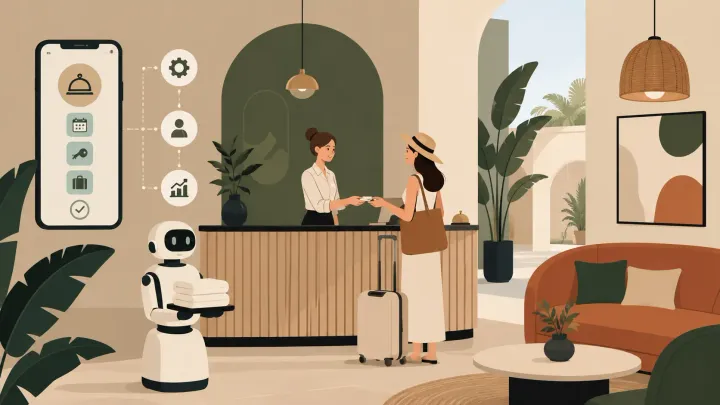
1. Boutique hotels resist automation because they associate it with impersonal service — but the operational tasks that automation handles are not the same tasks that produce the personal touch guests return for
2. What guests mean by personal service is staff who know their name, give genuinely useful local recommendations, and respond quickly when something goes wrong — none of those require manual booking confirmation emails or whiteboard room status updates
3. Boutique hotels need automation more than larger properties, not less: with smaller teams and higher service expectations, every staff minute spent on a manual operational task is a staff minute not spent on a guest interaction
4. The decision is not whether to automate, but which tasks to automate — and the answer is the operational layer, not the guest relationship layer
The Assumption That Holds Boutique Hotels Back
Boutique hotels are often the last to adopt operational automation, and the reason is usually stated as a values position: "We are known for our personal service. Automation would make us feel like a chain."
The assumption embedded in that statement is that automation is visible to guests — that what guests experience as personal or impersonal is determined by whether the hotel uses software behind the front desk. It is not.
Guests at a boutique hotel who feel the personal touch are responding to something specific: a staff member who addressed them by name at check-in, a recommendation that turned out to be exactly right for what they wanted, a note waiting in the room that acknowledged something they mentioned at booking. None of those moments require a manual process. All of them require staff attention — which is exactly what automation frees up.
What Guests Actually Mean by Personal Touch
When boutique hotel guests describe what they valued about a stay, the details they cite are consistent:
Staff recognized them. Not from a room number, but by name — or by remembering that they asked for an extra pillow last time, or that they were celebrating an anniversary.
The recommendation felt specific to them. Not "there are great restaurants nearby" but "given that you mentioned wanting somewhere quiet for a long dinner, there's a place two blocks away that most tourists miss."
Something small was unexpected. A welcome amenity that reflected a note in their reservation. A handwritten card. A minor problem resolved before they had to ask twice.
None of these require any manual back-office process. All of them require a staff member who has time to notice the guest, who has access to the notes in the reservation record, and who is not occupied with operational tasks that a PMS could handle automatically.
The Operational Tasks That Should Not Be Personal
There is a category of interactions in hotel operations where personal attention adds no value — where consistency and reliability are more important than warmth, and where a missed or delayed task creates a problem regardless of how warmly the staff member apologized afterward.
Booking confirmation. A guest who books online expects a confirmation immediately. A confirmation that arrives four hours later because someone was handling a manual check-in is an operational failure. The confirmation should be automatic.
Pre-arrival logistics. Check-in time, parking instructions, access codes, key collection procedures — these details are the same for every guest. Sending them manually is a task that automation handles without reducing any of their value to the recipient.
Payment processing. A charge that is applied incorrectly because it was entered manually, or a deposit that was not collected because the process was not followed during a busy check-in, is not a hospitality failure — it is an operational one. Payment processes benefit from automation exactly because human consistency under pressure is unreliable.
Room status updates. A housekeeper who marks a room Ready in a PMS app updates the front desk dashboard instantly. A housekeeper who finishes a room and then has to find a supervisor to call the front desk creates a chain of communication where the personal touch is irrelevant — the guest is waiting for a room, not for warmth.
Post-checkout review request. Sent at the same time, to every departing guest, with the same message. Consistency here is the entire value. Manual review requests are sent to some guests and forgotten for others.
Free Your Staff From Operational Tasks — So They Can Focus on Guests
Smart Order handles OTA channel sync, automated guest messaging, room status, and payment processing in one system — so boutique hotel staff spend their shift on guest interactions, not manual operational work.
Guest Communication: What to Automate and What to Keep Human
The distinction that matters in guest communication is not automated versus manual — it is templated versus judgment-dependent.
Automate the templated interactions. Booking confirmation, pre-arrival instructions, check-in time reminder, post-checkout review request — these messages convey accurate logistical information. Their value is in their reliability and timing. A boutique hotel that sends the pre-arrival message to every guest on time, every time, is delivering a better guest experience than one that sends it manually "when we remember."
Keep judgment-dependent communication human. A guest who messages to ask for a restaurant recommendation is not looking for a template — they are asking a staff member to know the neighborhood and make a judgment call based on what the guest has told them. A guest who reports a problem during their stay does not want an automated acknowledgment — they want a human response that addresses the specific situation.
The clearest test: if the same message, word for word, would serve every guest equally well, automate it. If the message needs to reflect something specific about this guest, this stay, or this situation, it should come from a person.
Boutique hotels that get this distinction right use automated messaging for logistics and staff attention for relationship. The two work together: automation handles the baseline so staff have capacity for the exceptions.
Room Status and Housekeeping: Automation That Makes Staff Available
In boutique hotels with small teams, housekeeping coordination is often the biggest source of operational friction during the check-in window. A property with six rooms and three guests arriving between 2pm and 4pm needs to know which rooms are ready before it can check in the arriving guests — and in a manual system, that question requires a call or a radio.
A PMS with a housekeeping status module eliminates that communication chain. The housekeeper updates the room status on a phone screen as they work. The front desk sees which rooms are Ready in real time. No call, no radio, no interruption of the housekeeping workflow.
The outcome is not just faster check-ins. It is front desk staff who are not on the phone when the arriving guest walks in. The personal touch moment — the greeting by name, the invitation to sit while the room is prepared, the immediate handoff to local knowledge — happens because the staff member is available for it, not managing a phone call about room status.
What the PMS Should Handle So Staff Do Not Have To
Beyond messaging and housekeeping status, a PMS built for boutique hotel operations handles several functions that consume staff time in manual workflows:
OTA channel synchronization. When a Booking.com reservation closes the room for those dates across every connected platform automatically, the staff member who would have manually updated three OTA calendars is not doing that — they are available for something else.
Reservation records with guest notes. A reservation record that captures a guest's preferences — early check-in request, anniversary noted at booking, dietary restriction mentioned in a message — is accessible to every staff member who handles the reservation. The personalization that feels surprising to the guest is possible because the information was captured systematically.
Reporting without manual assembly. An end-of-day report that shows occupancy, revenue by channel, and payments processed does not require a staff member to compile it. The time spent on manual reporting reconciliation is real; removing it returns time to the work that defines a boutique stay.
Run a Boutique Hotel Operation Without the Manual Overhead
Smart Order connects reservations, OTA channels, room status, and automated messaging in one system — so a small boutique hotel team handles a full guest roster without the operational workload that typically requires twice the staff.
FAQ
Does automation make a boutique hotel feel less personal?
Only if automation is applied to the interactions that should be personal — judgment-dependent guest communication, problem resolution, the in-person relationship between staff and guest. Automation applied to the operational layer (booking confirmation, pre-arrival logistics, payment processing, room status updates) is invisible to guests and frees the staff time that produces the personal moments guests actually remember and review.
What operations should a boutique hotel automate first?
The highest-value first automations are: OTA calendar sync (to eliminate double-bookings), automated guest messaging (confirmation and pre-arrival logistics), and room status tracking. These three cover the operational failures that create the most guest friction and consume the most staff time in manual workflows. None of them replace any human interaction that contributes to the boutique experience.
How does a PMS help boutique hotels with small teams?
A PMS reduces the per-guest operational overhead on each staff member — handling the calendar management, messaging schedule, payment recording, and room status tracking that would otherwise require manual action for every reservation. A boutique hotel with two or three front desk staff can manage a full guest load with the same attentiveness per guest as a larger team, because the PMS handles the tasks that would otherwise crowd out personal interactions.
What guest communications should boutique hotels keep human?
Any communication that requires knowledge of the specific guest's situation, preferences, or request should come from a staff member. Restaurant recommendations, responses to complaints, in-stay messages that address something the guest mentioned, and follow-up after a problem is resolved are all relationship interactions. What distinguishes boutique service is the quality of judgment behind these messages — which automation cannot replicate and should not try to.
Can boutique hotels use a PMS without losing their distinct identity?
Yes — a PMS operates behind the scenes on the operational layer. Guests do not interact with the PMS; they interact with staff and with the property itself. The tools that define the boutique identity — the curated design, the local knowledge, the staff relationship — are not affected by whether the hotel uses software to synchronize its OTA calendars or automate its check-in messages. What changes is the staff time that operational automation returns to the work that actually creates that identity.