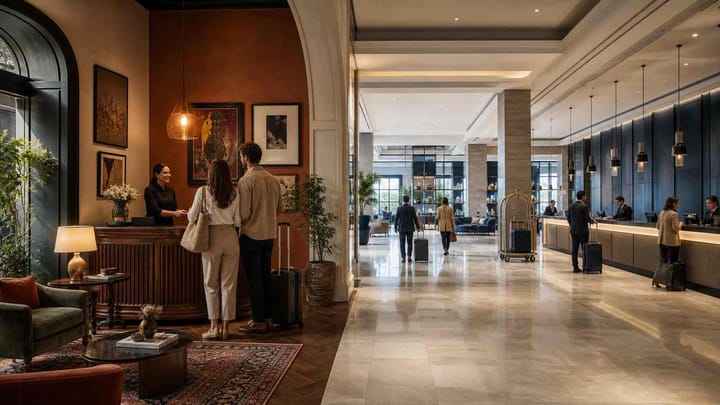
1. A boutique hotel is a hotel business positioned around individuality, intimate scale, distinctive design, personalized service, and a strong sense of place.
2. “Boutique” is not a universal legal classification. A small room count or stylish lobby alone does not create a defensible boutique concept.
3. Compared with a conventional or chain hotel, the operating model usually requires more flexible service, stronger direct storytelling, tighter guest-profile use, and more active rate management.
4. Owners should choose the model their property, market, team, capital, and systems can deliver consistently—not the label that sounds most attractive.
For an owner, a boutique hotel vs hotel comparison is not about which type travelers should book. It is about which operating model the property can execute profitably.
A boutique hotel is still a hotel. The word “boutique” describes its market position and guest promise: individual character, a more intimate atmosphere, locally relevant design, and service that feels personal rather than standardized.
A conventional hotel can be independent, franchised, chain-managed, budget, full-service, or luxury. It may compete through consistency, facilities, location, or price.
The distinction affects far more than interior design. It changes staffing, procedures, technology, pricing, marketing, distribution, capital allocation, and how the owner measures performance.
What Makes a Hotel Boutique From an Owner’s Perspective?
Boutique hotels are often described as having roughly 10 to 100 rooms, but there is no universal global cutoff or certification. Room count is a useful operating clue, not the business definition.
The stronger test is whether the property delivers a coherent concept that guests can recognize and staff can repeat. The building, neighborhood, rooms, public spaces, service language, food, photography, offers, and communications should support the same position.
Small does not automatically mean boutique. A 25-room property with generic rooms and undifferentiated service is simply a small hotel. Boutique also does not automatically mean independent; groups and soft brands can operate distinctive properties.
The label creates expectations. If operations cannot consistently deliver individuality and attention to detail, boutique positioning can increase disappointment rather than rate potential.
Boutique Hotel vs Hotel: Owner Operating Comparison
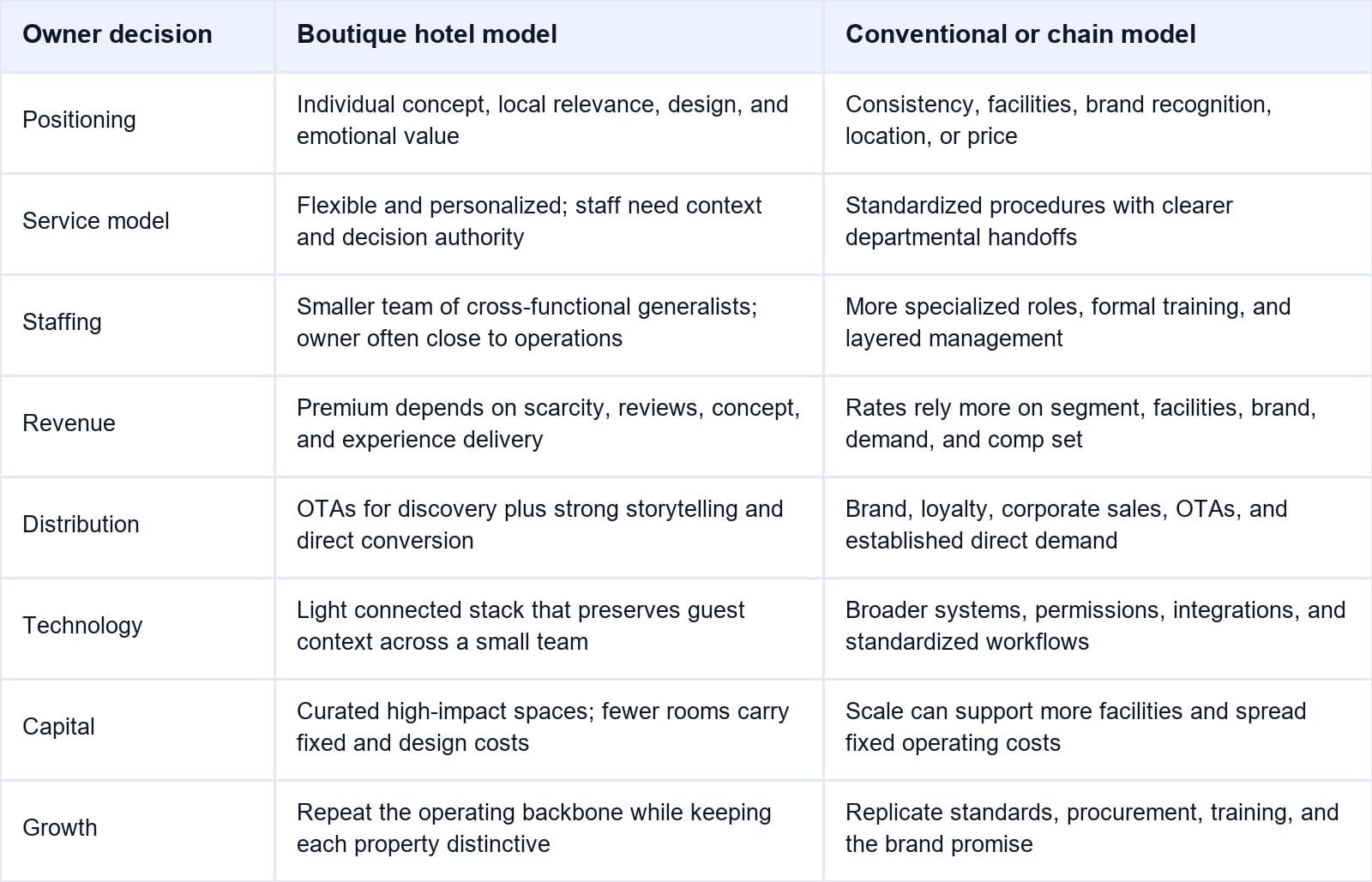
The matrix shows typical tendencies, not fixed rules. A well-run conventional independent hotel may personalize service, while a branded boutique property may use formal procedures behind the scenes.
The owner’s objective is alignment. The concept sold online must match the building, employee behavior, rate, facilities, and experience delivered after arrival.
Positioning: A Product Story Versus a Standard Promise
A conventional hotel can sell a straightforward promise: a reliable room in a convenient location with specified facilities. Brand affiliation may reduce the amount of explanation required because guests already understand the standards, loyalty benefits, and service level.
A boutique hotel must create its own reason to exist. The answer may come from heritage, architecture, food, wellness, art, neighborhood access, or a specific guest community.
That positioning must be commercially useful. “Unique” is too vague. A strong concept identifies the target guest, the experience they value, the details that prove it, and the rate premium or demand advantage it should support.
Test the concept against the competitive set. If every local hotel offers the same artwork, welcome drink, and “authentic experience,” those features no longer differentiate.
Operations: Flexible Service Requires Stronger Systems
Conventional and chain hotels often reduce variation. Standard operating procedures define room setup, check-in language, escalation, amenities, brand audits, and service recovery. This structure supports training and consistency across shifts and locations.
Boutique operations allow more discretion. Staff may adapt recommendations, remember preferences, arrange local experiences, change room touches, or communicate in a less scripted way. That flexibility can produce memorable service, but it also creates operational risk when important information remains in personal messages, paper notes, or employee memory.
The smaller team does not need less structure. It needs lighter structure that preserves context. Guest preferences, reservation changes, payments, room status, requests, and communication ownership should remain visible without forcing employees through enterprise workflows.
Smart Order’s hotel PMS centralizes reservations, guest information, room activity, and reporting so an independent team can personalize service without losing operational control.
Keep Boutique Service Personal and Operations Controlled
Connect reservations, guest details, rooms, channels, payments, and reporting in one PMS designed for independent hotel teams.
Staffing: Generalists Versus Specialized Departments
Large conventional hotels can divide work among reservations, front office, concierge, housekeeping, revenue, sales, finance, engineering, and food and beverage. Role boundaries make accountability clear, although handoffs can slow decisions.
Boutique teams are usually flatter. One employee may handle check-in, messaging, recommendations, payments, and reservation changes during the same shift.
This model can create warm, responsive service, but recruitment and training become critical. Boutique employees need judgment, local knowledge, commercial awareness, and confidence using the property’s systems—not only a task checklist.
Labor planning must reflect the promise. Define which service touches influence reviews, repeat stays, and rate acceptance, then staff those moments deliberately.
Revenue: Boutique Does Not Automatically Mean Higher Rates
Boutique positioning may support a premium when the concept is scarce, the location is strong, reviews confirm the experience, and photography communicates the value. Limited inventory can also create pricing power on high-demand dates.
The label alone does not justify a premium. A small hotel may have higher cost per available room because it spreads management, software, maintenance, and staffing across fewer units. Historic buildings can add energy, repair, accessibility, and room-consistency challenges.
Owners should compare net ADR, RevPAR, contribution margin, and acquisition cost—not only the public rate. A boutique property charging more may still earn less if it depends heavily on OTA commission, includes expensive amenities, or requires high labor per occupied room.
Views, layouts, terraces, and signature suites may deserve distinct pricing. Too many products, however, can confuse guests and complicate channel mapping.
Distribution and Marketing: Individuality Must Be Discoverable
Chains can rely on brand websites, loyalty databases, corporate agreements, global sales teams, and established search demand. Independent boutique hotels must build recognition property by property.
OTAs provide valuable discovery, especially during launch and low-demand periods. The risk is allowing the OTA listing to become the entire brand. If guests see identical rates, descriptions, and offers everywhere, they have little reason to visit the hotel’s own website.
The direct channel should explain the concept better than a marketplace listing can. Photography, room differences, neighborhood knowledge, policies, packages, and the booking experience must reinforce the property’s position. A connected hotel booking engine should display live inventory and return confirmed reservations to the same operating system.
Track booking source, net revenue, cancellation behavior, length of stay, lead time, and repeat demand. Boutique marketing works when distinctive positioning produces a healthier channel mix and stronger guest value—not merely more social engagement.
Facilities and Capital: Curated Does Not Mean Incomplete
Conventional hotels may compete through a wide facility set: meeting space, parking, gym, pool, multiple outlets, club lounge, business services, and standardized accessible rooms. Scale helps spread the cost and labor required to operate them.
Boutique owners typically need sharper capital discipline. One excellent bar, breakfast concept, courtyard, library, or wellness partnership may support the brand more effectively than several underused facilities.
Every design choice should survive operations. Custom furniture must be repairable. Decorative finishes must tolerate housekeeping. Historic layouts need honest room descriptions. Technology, soundproofing, lighting, storage, accessibility, and climate control affect reviews even when they are less photogenic than the lobby.
Distinguish an experience asset from a vanity asset. If it does not strengthen demand, rate, revenue, satisfaction, or efficiency, question its return.
Brand and Growth: Replication Changes the Model
A conventional hotel model is generally easier to replicate because standards, procurement, training, layouts, and brand systems already exist. This can support franchising, management contracts, and multi-property growth.
Boutique growth requires deciding what remains consistent and what must stay local. The operating platform, financial controls, data structure, service principles, and quality standards can repeat. The story, design, partnerships, and guest-facing details may need to change by destination.
Over-standardization can remove the individuality that created demand. Under-standardization can make costs, reporting, training, and quality impossible to control. Owners building a boutique group need a repeatable operating backbone with property-specific expression.
Which Model Should an Owner Choose?
Choose boutique positioning when the property has a credible concept, distinctive physical or local assets, a team capable of discretionary service, and a market willing to value the difference.
Choose a more conventional model when predictability, efficient staffing, broad facilities, corporate demand, brand distribution, or repeatable standards are more important than individual identity.
The choice is not absolute. An independent hotel can add personalization without using the label, while a boutique property can automate without becoming generic.
Start with the guest segment and investment case. Define the promise, expected ADR, occupancy, channel mix, labor model, capital needs, and operating systems. Then decide which label accurately describes the business you can sustain.
FAQ
What is the main business difference between a boutique hotel and a regular hotel?
A boutique hotel competes primarily through individual identity, intimate scale, design, local relevance, and personalized service. A conventional hotel may compete through consistency, facilities, brand recognition, loyalty, distribution, location, or price.
How many rooms should a boutique hotel have?
Many definitions use approximately 10 to 100 rooms, but there is no universal cutoff. Owners should focus on whether the scale supports personal service and a coherent experience while remaining financially viable.
Does a boutique hotel need to be independently owned?
No. It can be independent, part of a collection, or associated with a larger hotel group. Ownership matters less than whether the property retains a distinctive identity and delivers its positioning.
Can boutique hotels charge higher rates?
They can when location, scarcity, design, service, reviews, and demand justify the premium. The word “boutique” alone does not raise willingness to pay, and higher operating costs can offset a stronger ADR.
What technology does a boutique hotel need?
At minimum, owners need reliable reservation and room management, channel synchronization, direct booking, payments, guest records, housekeeping visibility, and reporting. The system should support personalization without adding enterprise complexity.
Bottom Line for Owners
The boutique hotel vs hotel distinction is an operating and positioning decision, not a decorating style.
A sustainable boutique property connects its concept to service, staffing, pricing, distribution, technology, and capital choices. If those elements reinforce one another, individuality can become a commercial advantage. If they do not, “boutique” remains a marketing word the operation cannot consistently deliver.