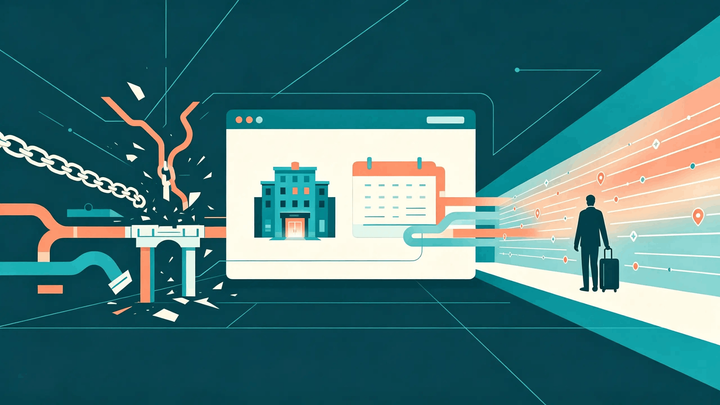
1. A direct booking engine lets guests book rooms through your hotel's own website at zero commission — you keep the full room rate
2. OTA commissions run 15–25% per booking; a single shift of 20% of reservations to direct can recover tens of thousands of dollars per year for a mid-size property
3. A booking engine only works if it's connected in real time to your PMS — stale availability or pricing on your own site sends guests back to Booking.com
4. The three-system stack — PMS, channel manager, booking engine — is what makes direct bookings operationally viable without manual update work
5. Guest data ownership is the long-term value: every direct booking gives you a verified email address and stay history that OTA bookings never provide
What Is a Direct Booking Engine?
A direct booking engine is a booking tool embedded in your hotel's own website that lets guests check availability, select a room, and complete a reservation — without going through an OTA. The guest pays you directly. No Booking.com, no Agoda, no commission deducted from the room rate.
The mechanics are straightforward. A guest lands on your website, clicks a "Book Now" button, selects their dates, chooses from available room types and rate plans, enters payment details, and receives a confirmation. From the hotel's side, that reservation appears in the property management system exactly like a booking from any other channel — except the full room rate stays with you.
The critical distinction from an OTA booking is economic. On a $150 room booked through Booking.com at 17% commission, you net $124.50. The same booking through your direct engine nets $150 — a $25.50 difference on a single transaction. At 300 rooms per month, that difference is $7,650. At 1,000 rooms per month, it's $25,500 in recovered margin, monthly.
For context on the broader strategy of reducing OTA dependency — including channel diversification, closed user group rates, and converting repeat guests — see How to Reduce OTA Commission Fees.
Why Direct Bookings Are Structurally More Profitable
OTA commission is not just a percentage of revenue — it is a fixed cost on every transaction with no ceiling. As your ADR increases or as you move into higher-demand periods, the absolute dollar amount you pay per booking rises with it. A hotel that raises its rates to capture peak-season demand simultaneously raises its per-booking commission cost.
Direct bookings do not work this way. The cost of running a booking engine is fixed — typically a flat monthly fee or a per-room subscription — regardless of how many reservations it processes or at what price. A booking engine that costs $100/month and processes 100 reservations at $200 each has a cost-per-booking of $1. The equivalent OTA cost at 17% commission is $34 per booking.
The other structural advantage is guest data. An OTA booking gives you a name, a reservation number, and a stay date. The OTA owns the email address, the payment relationship, and the guest history. A direct booking gives you all of that — a verified email address, payment details for future use, and a contact you can market to directly for the guest's next trip. Over time, a hotel with a functioning direct booking engine accumulates a guest database that becomes increasingly valuable as a zero-cost repeat booking channel.
What a Direct Booking Engine Needs to Actually Work
A booking engine that doesn't convert is overhead. The features that determine whether guests complete a booking directly — or navigate back to an OTA — fall into five areas.
- Real-time availability sync. If a room sells out on Booking.com at 11pm and your direct engine still shows it available at 11:01pm, you either take a double booking or disappoint a guest who clicked through. The booking engine must connect directly to your PMS so availability updates the moment any reservation is confirmed on any channel. Stale inventory on your own website is one of the primary reasons direct booking conversions fail.
- Mobile-first checkout. A significant share of hotel bookings originate on a phone. A booking engine that requires horizontal scrolling, small tap targets, or multiple screens to complete a reservation loses mobile guests at a measurably higher rate than a desktop-optimized experience. The mobile checkout flow should complete in three steps or fewer.
- Rate and promotion management. The booking engine should display rate plans — flexible, non-refundable, advance purchase — the same way OTAs do, and allow you to apply exclusive direct-booking discounts or promotional codes that are not visible on OTA listings. A guest comparing your website rate to Booking.com should see a reason to book direct. If rates are identical, there is no incentive.
- Secure payment processing. Guests will not enter card details on a booking engine that looks or behaves differently from what they expect. PCI-compliant payment processing, visible security indicators, and support for the payment methods common in your market are baseline requirements.
- Booking confirmation and pre-arrival messaging. Immediately after a direct booking is confirmed, the guest should receive a confirmation email from your property — not from a third-party processor. That email is the first direct communication in the guest relationship. Properties that route confirmation through the PMS's messaging system can follow up with pre-arrival instructions, upsell offers, and check-in details through the same channel.
A booking engine that works before guests reach Booking.com
Smart Order's direct booking engine connects to your PMS in real time — guests see live availability, complete their booking on your site, and you keep the full room rate.
How a Booking Engine Fits Into the Three-System Stack
A direct booking engine does not operate in isolation. Its effectiveness depends on how it integrates with the other two systems that manage your distribution.
- The PMS is the source of truth. Room types, rate plans, availability, and occupancy all originate in the property management system. When a booking engine connects directly to the PMS, every change you make in one place — a rate adjustment, a room block, an inventory restriction — appears on your website immediately. The booking engine is not a separate inventory system. It reads from and writes to the same data your front desk and channel manager use.
- The channel manager keeps parity accurate. When a room books through your direct engine, the channel manager closes that room across every connected OTA simultaneously. When a room books on Agoda, availability closes on your website at the same moment. This real-time two-way sync is what prevents overbooking across a mixed distribution stack. Without it, running a direct booking engine alongside multiple OTAs creates a permanent overbooking risk.
- The booking engine turns the stack into a revenue tool. The PMS manages operations. The channel manager manages distribution. The booking engine manages the guest acquisition channel you control entirely. Together, the three systems let a hotel run multiple distribution channels simultaneously while keeping all inventory, pricing, and reservation data in a single place.
Smart Order includes all three in one subscription — PMS, channel manager, and direct booking engine — so the integration between them is native rather than reliant on third-party APIs. A rate change in Smart Order pushes to your website and to every connected OTA at the same time. A reservation from any source closes inventory everywhere at the same moment.
The Financial Case: How Many Direct Bookings to Break Even
The cost of running a booking engine is easy to calculate. The savings are proportional to how much volume shifts to direct.
A 20-room property on Smart Order's Professional plan pays $5 per room per month — $100/month total for PMS, channel manager, and booking engine combined. At an average room rate of $120 and OTA commission of 17%, each direct booking instead of an OTA booking saves $20.40 in commission. To break even on the booking engine at $100/month, you need approximately five direct bookings per month. A 20-room property running at 60% occupancy processes roughly 360 room-nights per month. Five direct bookings is 1.4% of monthly volume.
For a larger property — 50 rooms, $150 ADR, 17% commission — each shifted booking saves $25.50. At 20% direct booking share (72 rooms/month), the monthly commission saving is $1,836. The booking engine cost at $5/room/month is $250. Net monthly recovery: $1,586. Annual: $19,032.
These figures assume no additional marketing cost to drive direct traffic. Properties that invest in Google Hotel Ads, brand search campaigns, or post-stay email programs will see faster volume shift but should account for those costs in the calculation.
How to Drive Traffic to Your Direct Booking Engine
A booking engine that no one visits converts no bookings. The three highest-return traffic sources for direct hotel booking pages are:
- Brand search protection. Guests who search your hotel name on Google often see OTA listings above your own website. A Google Ads brand campaign — bidding on your own hotel name — ensures your direct booking link appears at the top. The cost-per-click is typically low because brand terms have minimal competition. The conversion is high because the searcher already knows they want your property.
- Google Hotel Ads (meta search). Google Hotel Ads displays your direct rate alongside OTA rates in Google Search and Google Maps. When a guest is comparing options, seeing your direct rate — ideally at parity or with a visible discount — gives them a reason to click through to your site instead of an OTA. The cost per acquisition through meta search is almost always lower than OTA commission on the resulting booking.
- Post-stay email to direct. Every guest who arrived through an OTA and left with a positive experience is a potential direct booker on their next trip. A post-stay email sent 24–48 hours after checkout, thanking them for their stay and noting that their next booking is available directly at the same or better rate, converts a meaningful percentage of return guests. The email cost is near zero. The commission saving on each converted return visit is permanent.
PMS, channel manager, and booking engine in one plan
Smart Order includes all three from $5 per room per month — so your direct booking engine is integrated from day one, not bolted on after the fact.
FAQ
What is a direct booking engine for hotels?
A direct booking engine is a reservation tool embedded in a hotel's own website that allows guests to check availability, select a room, and complete a booking without going through an OTA. The full room rate goes to the hotel with no commission deducted. The booking engine connects to the property management system so availability and pricing are always current.
How much commission does a hotel save with direct bookings?
At a typical OTA commission rate of 15–17%, a hotel saves between $15 and $17 on every $100 of room revenue that shifts from OTA to direct. For a 30-room property averaging $130 per night at 65% occupancy, shifting 25% of bookings to direct saves approximately $14,600 per year in commission — before any additional marketing spend is factored in.
Does a direct booking engine prevent overbooking?
Yes, if it is connected in real time to the PMS and channel manager. When a room books on the hotel's direct engine, the channel manager closes that inventory across all connected OTAs immediately. When a room books on an OTA, the hotel website updates at the same moment. Real-time two-way sync between the three systems is what prevents double bookings across a mixed distribution stack.
Can a small hotel afford a direct booking engine?
A booking engine is most cost-effective when it comes bundled with a PMS and channel manager in a single subscription. Paying for three separate tools with separate monthly fees raises the break-even threshold significantly. Smart Order's Professional plan includes all three from $5 per room per month — a 20-room hotel pays $100/month for the full stack, and needs approximately five direct bookings per month at a $120 ADR to recover the entire subscription cost in commission savings.
What is the difference between a booking engine and an OTA?
An OTA (Online Travel Agency) is a third-party marketplace — Booking.com, Agoda, Airbnb — where travelers discover and compare hotels from multiple properties. A hotel booking engine is a reservation tool on the hotel's own website that serves guests who have already chosen the property. OTAs provide discovery and demand generation; the booking engine captures the conversion without paying commission. The two channels are complementary, not competing.
How long does it take to see results from a direct booking engine?
Traffic volume and brand awareness determine the timeline. Properties with an established web presence, active review profiles, and consistent OTA volume typically see measurable direct bookings within the first two to three months. Faster results come from brand search campaigns and Google Hotel Ads participation, which route existing demand directly to the hotel's booking page. Properties starting from a minimal web presence should expect three to six months before direct volume becomes significant.