
1. Treat the hotel website as another live sales channel connected to the same PMS inventory used by Airbnb and Booking.com.
2. Use a channel manager or supported direct connection for two-way reservation, rate, and availability updates; a separate website calendar creates manual work and overbooking risk.
3. Map room types and rate plans, define one source of truth, test bookings and cancellations on every channel, and monitor failed updates after launch.
Direct booking website OTA sync means a room sold on your hotel website must immediately affect what can still be sold on Airbnb and Booking.com. The reverse must also work: an OTA booking should reduce availability on the direct booking page before another guest reserves the same room.
Do not maintain three independent calendars. The booking engine, property management system (PMS), and channel manager should form one loop with clear rules for rates, restrictions, reservations, and exceptions.
This guide explains that loop from an owner’s operational perspective.
Direct Booking Website OTA Sync Architecture
The PMS should hold the hotel’s room structure and reservation record. The booking engine shows live rooms and rates on the hotel website. The channel manager exchanges supported data with Airbnb, Booking.com, and other online travel agencies (OTAs).
The normal flow is:
Guest books direct → reservation enters PMS → room-type inventory falls → channel manager sends new availability to Airbnb and Booking.com
An OTA booking follows the reverse path:
Guest books on an OTA → reservation enters PMS → inventory falls → the hotel website and other connected channels receive the new quantity
In most setups, each channel exchanges data through the PMS and channel manager or an integrated platform.
What Should Sync Across the Website and OTAs
Separate shared-source data from channel-specific content.
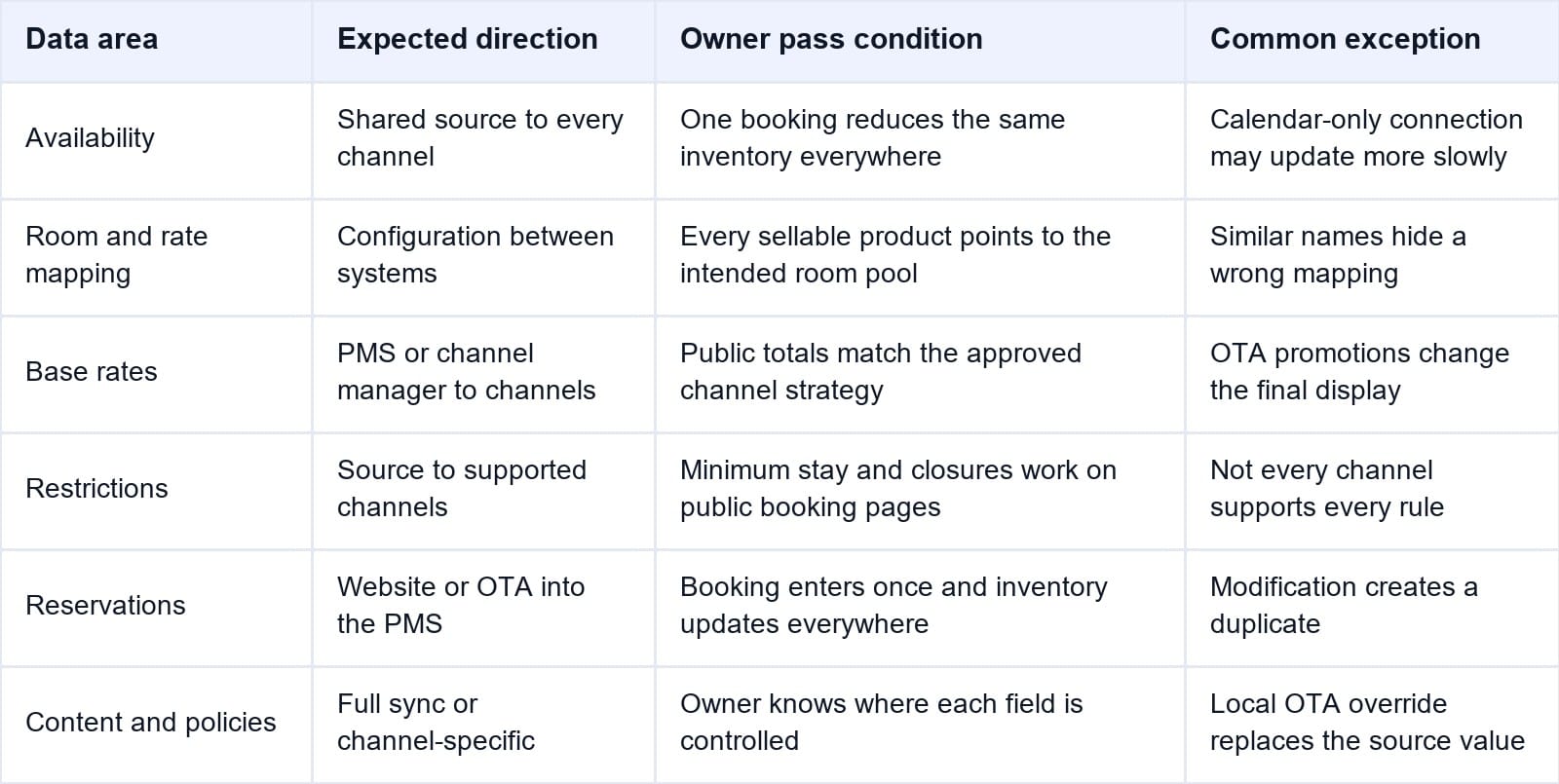
Availability and reservations require the strongest control because an error can sell the same last room twice. Rates and restrictions also matter, but the guest-facing result can differ when an OTA applies its own promotion, fee, tax display, discount, or unsupported rule.
Smart Order connects its hotel booking engine with PMS inventory and the hotel channel manager. A direct reservation enters the operating calendar, reduces the intended room pool, and sends revised availability to connected OTA channels.
Keep Direct and OTA Inventory in One Booking Loop
Connect your hotel website, PMS, and OTA channels so every reservation updates the same live room inventory.
Choose One Source of Truth
Before connecting anything, decide where employees will manage each value. A common structure is:
- PMS or channel manager controls room types, base rates, availability, and supported restrictions.
- Booking engine reads the approved direct offers and writes direct reservations into the PMS.
- Airbnb and Booking.com receive supported updates while retaining channel-specific content, promotions, fees, policies, or overrides where required.
Do not let several employees change the same base availability in three extranets. Manual edits can be appropriate during an incident, but they must be documented and reconciled with the source afterward.
The source-of-truth decision also needs an owner. One person should approve room mapping, rate logic, intentional channel allocations, and changes to connected products.
Availability Must Use the Same Physical Inventory
Start with rooms the hotel can physically assign. Group rooms into one sellable type only when they are interchangeable for the guest.
Suppose the property has four Deluxe Kings. The flexible and non-refundable offers on the website and OTAs are different rate plans, but they still draw from the same four rooms. Selling one rate should reduce availability for every other offer attached to that room pool.
Problems appear when a direct booking page has its own allocation or when two OTA products point to separate copies of the same physical room. The software may show successful updates while the combined channels sell more rooms than exist.
Test a quiet date, a nearly sold-out date, an out-of-order room, and the final available unit. Direct booking website OTA sync is reliable only when each event changes the correct shared quantity.
Rate Sync Does Not Always Mean Identical Public Prices
Choose a base rate source and document channel adjustments. The hotel may intentionally publish a direct-only offer, add an OTA markup, retain an OTA promotion, or use different cancellation terms.
The synchronization target is the approved rate strategy, not necessarily one identical number on every screen. For each room and rate plan, confirm:
- Which system holds the base rate
- Whether the channel rate is fixed, derived, or adjusted
- Which taxes, fees, meals, occupancy charges, and discounts affect the displayed total
- Which restrictions the connection supports
Check one-night and multi-night searches on the public website, Airbnb, and Booking.com. Compare the total and conditions a guest sees, not only the rate sent by the PMS.
If a parent rate changes, verify every derived direct and OTA rate. A successful base-price update does not prove the child calculation or public total is correct.
Airbnb and Booking.com Connections Behave Differently
Airbnb officially supports two software-sync choices: syncing everything or syncing only pricing and availability. Under pricing-and-availability sync, hosts can maintain listing content and booking settings in Airbnb, and local overrides may remain possible. The owner must know which fields are controlled in the PMS and which stay on Airbnb’s side.
Booking.com states that individual properties normally connect through a channel manager rather than building a direct API connection. Its connectivity tools support rates and availability, while other functions depend on the provider’s connection and the property’s setup.
This is why “connected to both channels” is not a complete operating rule. Keep a short control sheet showing the source for availability, rates, restrictions, content, promotions, taxes, payments, reservation changes, and cancellations on each platform.
Do not assume Airbnb’s calendar-only iCal connection is equivalent to a full two-way API connection. Calendar feeds may focus on blocked dates and may not exchange rates, restrictions, reservation details, or updates with the same scope.
Map Room Types and Rate Plans Before Opening Inventory
Mapping tells the system which products are equivalent. “Deluxe King” on the hotel website might be called “Superior Double Room” on Booking.com and have a different title on Airbnb. Names can differ; the physical room promise must match.
For every active product, check room pool, maximum occupancy, bed setup, view or category promise, rate conditions, cancellation policy, meals, and payment method. Then map each rate plan to the intended offer.
Do not map a refundable website rate to a non-refundable OTA rate merely because both use the same room. The availability pool may be shared, while price and policy remain separate.
Close or resolve unmapped OTA products. A forgotten listing can continue selling outside the direct booking website OTA sync workflow.
Understand Delays, Failures, and Manual Overrides
“Real time” is an operating goal, not permission to ignore delivery status. Updates move through several systems, and an OTA may reject or delay a message because of mapping, credentials, rate limits, unsupported restrictions, or channel-side maintenance.
The hotel PMS or channel manager should show failed updates, affected dates and products, retry status, and enough detail for staff to respond.
Create a simple incident rule:
- Identify the affected room, rate, dates, and channels.
- Protect inventory manually if there is immediate overselling risk.
- Record the temporary OTA override.
- Fix the source or mapping error.
- Resend or wait for the approved retry.
- Reconcile every public channel and remove the temporary override.
Never assume an update succeeded because the internal calendar changed. The public booking page is the final selling surface.
Run Test Bookings Through Every Path
Use low-risk future dates and record starting availability, rate, restrictions, and public totals. Then run at least one direct booking, one Airbnb booking, and one Booking.com booking.
For every reservation, verify the correct PMS room type, rate plan, dates, guest, source, external ID, price, payment status, and policy. Confirm availability falls on the hotel website and both OTAs.
Modify dates and guest count where supported. Cancel the reservation and verify that the existing PMS record changes without a duplicate and that availability returns exactly once.
Test the last room separately. Set one remaining unit, complete a booking, and confirm the product closes everywhere. Repeat for each distinct physical inventory pool and any rate with unusual restrictions or payment conditions.
Save reservation IDs, timestamps, screenshots, expected results, actual results, and resolution notes. Retest the full loop after any correction.
Monitor the Sync After Go-Live
During the first 48 hours, review every new, changed, and cancelled reservation plus the next 30 days of availability. Check failure logs several times during busy sales periods.
After stabilization, monitor alerts daily and audit public rates and room availability on a regular schedule. Re-test whenever the hotel adds or renames a room, launches a rate, changes occupancy pricing, modifies restrictions, connects a new OTA, or replaces its channel manager.
Track incidents by cause. Repeated mapping errors, manual overrides, missing cancellations, stale inventory, or rejected rates indicate a configuration or ownership problem, not random bad luck.
Frequently Asked Questions
Can I sync my hotel website directly with Airbnb and Booking.com?
Usually, the hotel website’s booking engine connects to a PMS and channel manager, which then manages supported OTA connections. Booking.com directs properties to connect through a channel manager, while Airbnb supports approved PMS or channel-manager software connections.
What should update after a direct booking?
The reservation should enter the PMS, reduce the correct room-type inventory, update the operating calendar, and send revised availability to Airbnb, Booking.com, and other connected channels.
Do rates have to be identical everywhere?
No. Hotels may use direct offers, channel adjustments, or OTA promotions. The owner should define the intended relationship and verify the final guest-facing total, policy, and restrictions.
Is iCal enough to prevent double bookings?
iCal can exchange calendar blocks, but its scope and update behavior differ from a full API connection. Confirm timing, fields, and limitations with the provider, and do not assume it synchronizes rates or detailed restrictions.
How often should I test OTA sync?
Test before launch and after any room, rate, restriction, occupancy, mapping, or integration change. Monitor alerts daily and run periodic last-room checks.
One Inventory Source, Three Selling Channels
Reliable direct booking website OTA sync depends on one physical inventory structure, approved mappings, defined rate ownership, supported connections, and visible failure handling.
Treat the direct website as a real channel, not a separate calendar. When every booking enters the same PMS record and triggers updated availability across Airbnb and Booking.com, the hotel can grow direct sales without adding manual inventory work or creating an avoidable overselling window.