1. Free hotel PMS is rational while it supports your real workflow without recurring manual work or material operating risk.
2. Room count alone does not determine when to upgrade. Channel updates, guest messages, payment follow-up, reporting, and support exposure often reach the limit first.
3. Upgrade when the monthly value of time recovered, losses avoided, and profit enabled is greater than the paid plan's full monthly cost.
Free hotel management software is not automatically temporary. A small inn with one booking source, simple payments, and an owner at the front desk may use a free core efficiently for years. The decision changes when more channels, messages, payments, staff, or pricing decisions create work beyond reservations and room status.
The correct upgrade date is therefore not “when the hotel grows.” It is the first month in which a paid capability produces more measurable value than it costs.
What a Free Hotel PMS Should Cover
A useful free hotel property management system (PMS) should provide a reservation calendar, rooms or room types, guest records, check-in and checkout status, basic rate controls, and simple reporting. Some plans include more; others reserve distribution, payments, automation, or advanced reports for paid tiers.
“Free” may mean a permanent plan, a trial, a room-capped tier, or software with paid modules. Verify what happens after the trial and whether you can export reservations, guest records, and financial data.
If the free core completes weekly work accurately and without parallel spreadsheets, it is doing its job.
Use an Upgrade Formula, Not a Feature Checklist
Calculate the monthly value of the paid capabilities you would actually use:
Upgrade value = labor recovered + losses avoided + incremental profit enabled
Then compare it with the full monthly upgrade cost:
Upgrade when upgrade value > subscription + usage fees + required add-ons
For labor, multiply hours a paid feature would remove by the employee's loaded hourly cost. Estimate avoided losses from your own payment leakage, rate errors, overbookings, or slow responses, not a vendor's best case.
Count incremental profit, not revenue. Deduct payment, servicing, and marketing costs before comparing a new booking with the upgrade price.
Use the hotel PMS pricing formula to include channel, transaction, support, and setup charges. Usage fees can reverse the result.
Six Signals That a Paid Plan Can Earn Its Cost
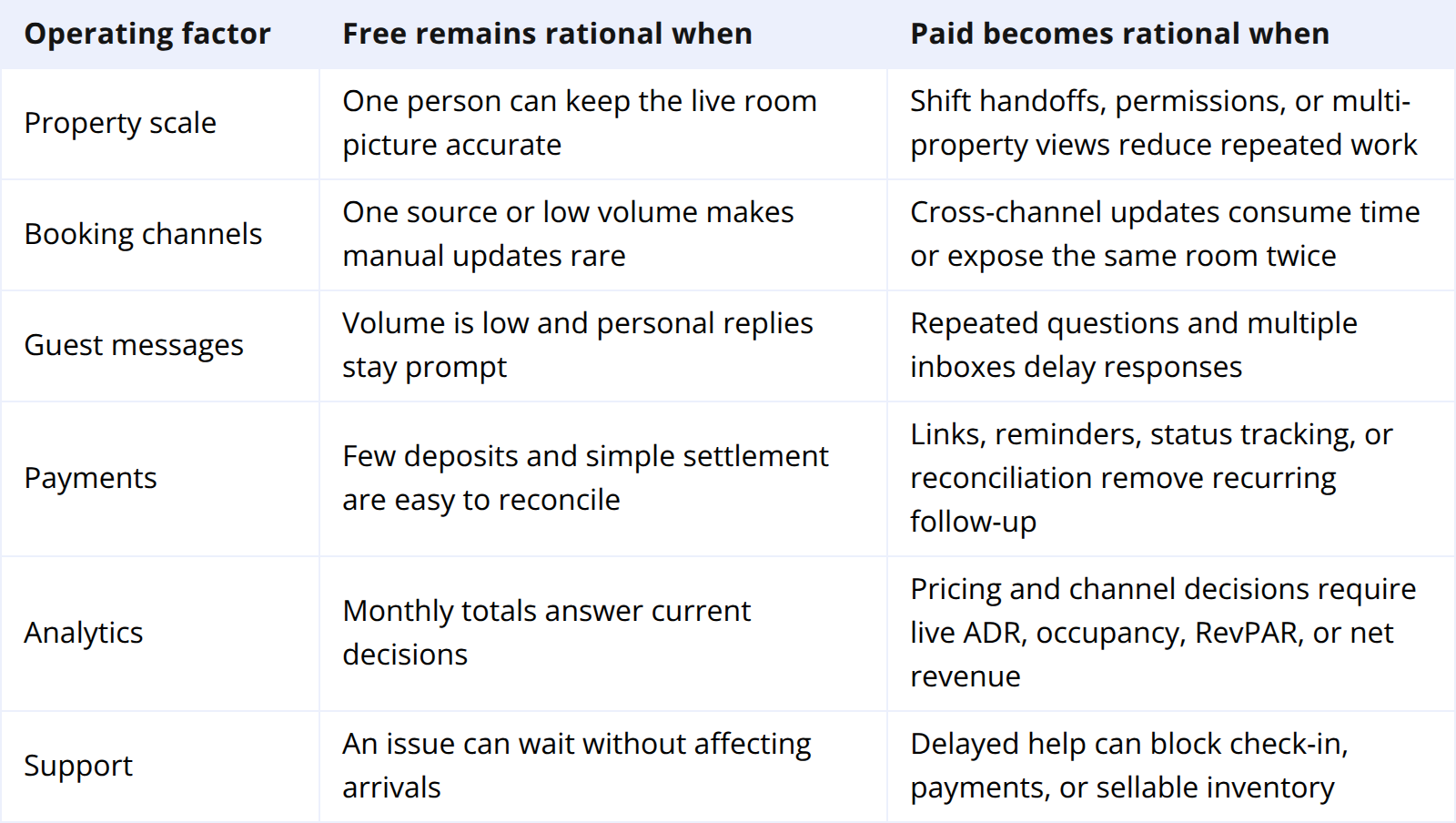
These are workload tests. Ten high-turnover rooms on five channels may justify an upgrade before 30 rooms with long stays from one source.
Property Size Measures Concurrency
Room count increases bookings, cleans, payments, and staff actions, but concurrency is the trigger. If two employees edit the same list, housekeeping needs a separate status view, or an owner adds a property, paid permissions and shared workflows may recover time. Measure duplicate entries, clarification calls, and shift handovers for two weeks.
Channel Count Measures Synchronization Work
A property on one OTA may manage availability there. Add another OTA and a direct website, and each change can require several updates. Multiply monthly rate, restriction, and availability update time by labor cost, then add documented error exposure. If the result exceeds channel management cost, automation has reached break-even. Review what happens when hotels manage OTAs without a channel manager.
Message Volume Measures Response Load
The signal is the share of predictable questions and the number of inboxes monitored. Tag one week of messages by confirmation, arrival, directions, access, payment, cancellation, and custom request. Automation has value when triggers handle a recurring group while staff retain exceptions. Low-volume, unique conversations may not justify it.
Payment Complexity Measures Follow-Up
A free plan can work when guests pay at arrival. Paid tools gain value when staff send deposits, chase balances, verify transfers, or match gateway records to bookings. Price that monthly time and documented missed collections against both the premium and transaction rate. Model percentage fees at normal and peak occupancy.
Analytics Must Change a Decision
Reporting is valuable only when someone acts on it. Occupancy can drive a rate change; channel net revenue can change distribution; ADR and RevPAR can expose weak weekdays. List weekly decisions and their required data. Price manual report-building time. If nobody acts, the dashboard has no economic value yet.
Support Is Operational Insurance
Email support may be enough for simple operations with a fallback. It becomes risky when an error can close inventory or block arrivals. Estimate exposure as incident probability × financial impact, then add self-troubleshooting labor. Pay when the support premium is lower and its response hours match hotel operations.
Two Worked Upgrade Decisions
A Six-Room Guesthouse Stays Free
The owner receives bookings from one channel, collects payment at arrival, and spends one monthly hour on work a paid feature could remove. At $20 per hour, recoverable value is $20. If a paid plan costs $30 and creates no new margin, staying free is rational. Recalculate after adding a channel, deposits, or staff.
An 18-Room Hotel Upgrades
At $5 per room, a paid plan costs $90 monthly. Staff spend four hours updating channels and three on payment and message follow-up. At $18 per hour, recoverable labor is $126. The upgrade yields $36 monthly before avoided errors, but the hotel must still confirm transaction fees and add-ons.
Smart Order keeps Free Basic at $0 and lists Pro at $5 per room per month, with regional terms and volume pricing confirmed separately. In the paid workflow, OTA and direct bookings update connected availability, payment information stays linked to reservations, and staff see current operating data without rebuilding files.
Test the Workflow Before Paying for It
Start with Smart Order Free Basic, measure the manual work around channels, payments, messages, and reporting, then move to Pro only when those capabilities clear your own break-even calculation.
Review the Decision Every Quarter
Each quarter, record rooms, channels, bookings, repetitive messages, payment and reporting hours, and incidents. Recalculate using the next plan's complete price.
Upgrade the smallest capability set that solves the constraint. If a module clears break-even while a full suite does not, choose the module.
After 60 days, compare actual results with the forecast. If value falls short, improve adoption, downgrade, or reconsider the vendor.
FAQ
Is free hotel PMS really free?
Sometimes. Confirm whether it is permanent or a trial; check room, user, channel, storage, and support limits; and review transaction fees. A $0 subscription can still have usage costs.
How many rooms can a hotel manage on free software?
There is no universal threshold. A small multi-channel hotel may need automation sooner than a larger property with one booking source and simple stays.
When should a hotel pay for a channel manager?
Pay when labor and expected error exposure from repeated updates exceed the channel manager's full cost. Use actual changes, staff time, and incident history.
Is paid hotel management software always better?
No. Paid software is better only when added capabilities solve a current requirement. Unused features create cost without return.
Should a new hotel start with a free or paid PMS?
A new hotel can start free if launch channels, payments, staff access, and support are covered. Measure workload and upgrade before a known constraint affects guests or inventory.