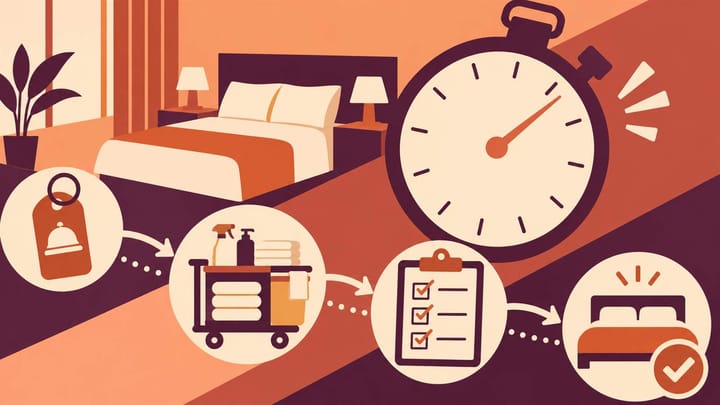
1. Start with a consistently recorded departure event and finish when the verified room-ready status is visible to reception.
2. Separate the cleaning interval from time waiting for assignment, inspection, maintenance, or a status update.
3. Compare similar rooms and retain unresolved or reworked turns so the figures do not reward premature release.
“The room took 50 minutes” tells a manager very little. It might mean 30 minutes of cleaning and 20 minutes waiting for inspection, or a cleaner delayed because reception recorded checkout late.
Add a few event times to your hotel housekeeping checklist. They turn a vague complaint about slow rooms into a practical explanation of where the checkout-to-ready period was spent.
Define the Start and the Room-Ready Finish
For this workflow, checkout-to-room-ready turnaround is the elapsed time from the recorded departure that releases the room for servicing to the verified ready status being visible to reception. Use actual event times where reliably known and distinguish them from later data entry.
Do not start the clock at the standard checkout hour if the guest still occupies the room. If the guest leaves at 11:02 but checkout is not entered until 11:20, retain both times when supported. Otherwise, identify the record as late-entry data rather than pretending the cleaning team received the room at 11:02.
Define “ready” with the team. It should mean the room has completed the hotel's required cleaning and inspection, has no unresolved occupancy or maintenance restriction, and can be assigned to the intended arrival. A cleaner's completion message alone may not meet that definition.
Status names and inspection requirements vary by property and PMS, or Property Management System. Agree the events first, then map them to the available records. Do not invent an extra mandatory screen or claim every system stores every milestone.
A 52-Minute Turn With Only 30 Minutes Between Cleaning Start and End
Consider a hypothetical departure room with these recorded events:
- 11:02: guest departure releases the room for servicing.
- 11:12: cleaning begins.
- 11:42: cleaning is marked complete.
- 11:50: the required inspection passes.
- 11:54: reception sees the verified room-ready update.
The full turnaround is 52 minutes. The intervals are 10 minutes before cleaning, 30 minutes from cleaning start to completion, 8 minutes to inspection approval, and 4 minutes to the visible release. Those intervals add to 52 minutes; they are not all cleaning labor.
If a repair or supply interruption occurred inside the 30-minute interval, record it separately where possible. Elapsed time from cleaning start to end is not automatically 30 minutes of uninterrupted work.
When a room is approved but reception is still waiting for a call, the handoff adds delay without improving cleanliness. In Smart Order's mobile hotel workspace, authorized floor staff can update room information while reception reviews the shared record. Use that workflow to reduce late status entry; verify what timestamps are available before treating it as an automatic turnaround report.
Make the Room-Ready Update Reach Reception
Coordinate room-status updates from the floor with the front desk view so a completed room does not remain hidden behind a delayed handoff.
Add Event Capture to the Hotel Housekeeping Checklist
Keep the existing cleaning and inspection standards. Add a short timing record linked to the physical room and the specific departure turn, not just the calendar date.
Capture the property, room number and type, departure event, cleaning start, cleaning completion, inspection outcome where required, and final release. Include the responsible employee or team and any reason for delay. Avoid unnecessary guest personal details in the timing log.
Use system history for milestones it reliably records. For missing events, use a simple approved tracker or task note with a clear owner. A current green room icon cannot reconstruct yesterday's cleaning start, and an employee's later estimate should not be presented as a system timestamp.
Apply this capture routine to a manageable group of departure rooms:
- Confirm the guest has departed and the room is released for servicing. Flag late entry or disputed vacancy instead of sending staff into an occupied room.
- Record when work actually starts, not when the task was assigned or printed.
- Complete the cleaning checklist and record completion, including any interruption or defect that needs follow-up.
- Record inspection and rework according to the hotel's normal standard. If the room fails, keep the unfinished work visible.
- Approve release only after readiness is confirmed, then check that reception sees the correct room status. Retain the final usable release time.
A room marked ready at 12:10 and withdrawn again at 12:15 because inspection failed is not a clean success. Preserve the first incorrect release and the eventual valid release. Measuring only the first green status would reward the very mistake the checklist is meant to prevent.
Read the Delays Before Changing Staffing Targets
Rooms Wait Before Cleaning Starts
Check late checkout, delayed departure entry, unclear assignment, supplies, and travel between floors. A longer gap here is not proof that a cleaner works slowly. Distinguish an occupied room from a released room waiting in the queue.
Cleaning Takes Longer for Particular Rooms
Compare equivalent room types and work scopes. A suite with a kitchenette, an extra bed, or an unusually demanding departure should not be judged against an ordinary short-stay double room without context.
Separate stayover service from departure turns. Record interruptions, equipment issues, and additional work rather than hiding them inside one average. Use the information to plan work and supplies, not to encourage staff to omit checklist items.
Clean Rooms Wait for Inspection or Release
Look at supervisor coverage, reinspection, and the last status handoff. If the main delay occurs after cleaning, a shorter cleaning target will not fix it. Review the front desk room board with the floor team to identify rooms physically approved but not yet visible as ready.
Maintenance Prevents the Room From Returning
Keep the room protected until the fault is resolved. Classify the turn as maintenance-blocked and retain its elapsed time or open status. Do not remove every long turn from the review merely to produce a better figure.
Report routine-turn performance separately from maintenance exceptions, while keeping the excluded count and reason visible. If the block spans several days, use full dates and times rather than subtracting clock times alone.
Review a Useful Sample, Not a Single Fastest Room
Start with a consistent period and clearly defined set of departure turns. Count the rooms completed, still open, missing timestamps, and requiring rework. A completed-room average can look fast while the slowest rooms remain unfinished.
Compare the typical completed turn and the slower cases by room type, shift, and arrival pressure. A median can help show the middle result without one long repair dominating it; it does not excuse ignoring that repair. Check data quality before drawing conclusions from small samples.
Use hotel reports and operational exports for the reservation and room context available, supplemented by the approved timing record where needed. Calculate a cleaning-stage measure only when its start and finish events have both been captured reliably.
Set improvement targets from the hotel's own evidence and service standard. In the example, reducing the inspection wait may be more useful than demanding five fewer cleaning minutes. Keep quality and safe release as acceptance conditions, not optional costs of a faster score.