1. A hotel PMS application requirements document should describe workflows and measurable results, not just name features.
2. Assign each requirement a priority, internal owner, acceptance test, and evidence the vendor must provide.
3. Independent hotels should cover reservations, rooms, rates, channels, payments, reports, security, data, reliability, and implementation.
4. Test critical workflows with hotel-specific examples before signing and repeat them before go-live.
A hotel PMS application requirements checklist turns “we need a better system” into a decision the owner, front desk, housekeeping, finance team, and vendor can verify.
Feature lists alone are weak procurement tools. Two systems may both claim to support housekeeping or OTA integrations while handling the hotel’s actual workflow very differently. A useful requirement states who needs the capability, what must happen, and how the hotel will prove it works.
Use the matrix below as a starting point, then replace the examples with your room types, channels, payment methods, reports, tax rules, devices, and staff roles.
Hotel PMS Application Requirements Matrix
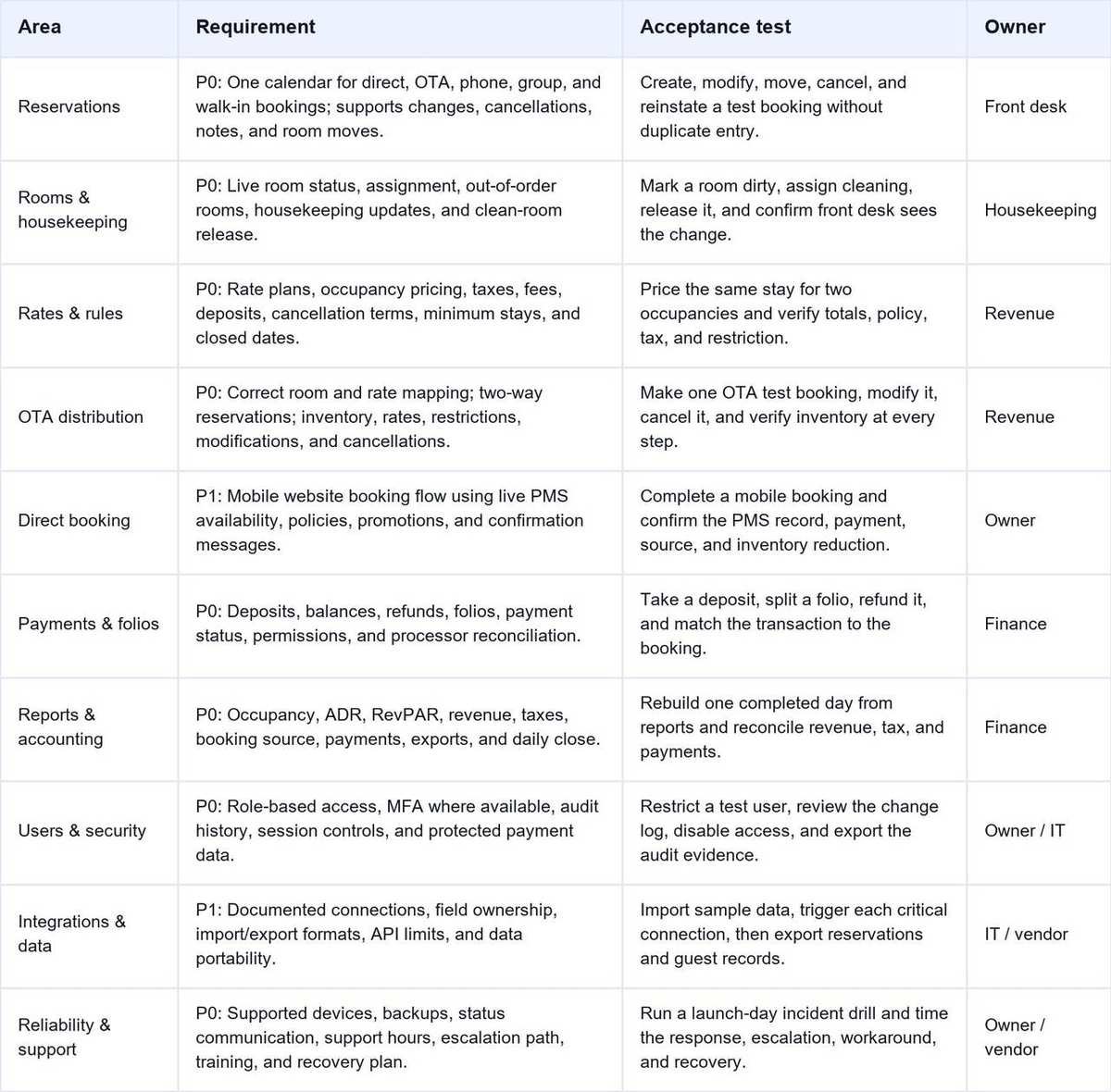
Copy each row into an internal spreadsheet or procurement document. Add columns for vendor response, included plan, one-time cost, recurring cost, evidence, score, and open questions.
The priority labels keep the project realistic. P0 means the hotel cannot operate or go live safely without it. P1 means it should be included in the selected solution or committed implementation phase. P2 means useful later, but not worth delaying the core launch.
Do not let every department mark every request P0. A requirement is critical only when its absence blocks a legal obligation, guest promise, revenue control, payment process, security control, or essential daily workflow.
Start With Hotel Workflows, Not Software Modules
Document how work enters and leaves the hotel. A reservation may begin on an OTA, change dates through the front desk, collect a deposit through a payment provider, create a housekeeping task, and finish in the daily revenue report.
The requirement should cover that full path. “Reservation management included” is not measurable. A stronger version is: “An authorized front-desk user can create, modify, move, cancel, and reinstate a booking while retaining the guest record, payment history, source, rate, notes, and audit trail.”
Interview the people who perform the work. The owner defines commercial and risk priorities. Front desk documents arrivals, departures, room moves, folios, and exceptions. Housekeeping defines room-status handoffs. Finance owns payment, tax, reconciliation, and export requirements. The vendor explains product limits but should not decide what the hotel needs.
Smart Order places reservations, room status, channel data, and reporting in one hotel operating flow. The hotel PMS gives independent properties a practical reference point when testing how daily workflows connect.
Test Your Hotel Workflows in One PMS
Review reservations, rooms, channels, payments, and reports against a connected operating system before finalizing your requirements.
Define Reservation and Front-Desk Requirements
The reservation calendar should show enough information to run the day without opening multiple systems. Define the views needed for arrivals, departures, in-house guests, unassigned bookings, room conflicts, balances, special requests, and housekeeping status.
Specify every reservation action staff must perform: create a booking, quote a rate, assign or move a room, extend a stay, shorten dates, add guests, change a rate, split or merge folios, record notes, cancel, reinstate, check in, and check out.
Add exception scenarios. Can staff handle a same-day check-out and new arrival in the same room? What happens when a guest changes room type after paying a deposit? Can a manager see who changed a rate or removed a charge?
For group business, define room blocks, release dates, rooming lists, master folios, individual payments, and pickup reporting only if the property uses them. Do not buy enterprise complexity for hypothetical business.
Specify Rooms, Rates, Channels, and Direct Booking
Room requirements should distinguish physical rooms from sellable room types. Include room assignment, out-of-order status, maintenance notes, housekeeping status, occupancy limits, bed setup, and any interchangeable inventory.
Rate requirements should name the rules the property actually sells: base and derived rates, occupancy pricing, meal plans, taxes, mandatory fees, deposits, cancellation policies, booking windows, minimum stays, closed dates, and arrival or departure restrictions.
For every OTA connection, specify the data direction. Confirm which system owns inventory, rates, restrictions, promotions, content, and reservations. Require room-and-rate mapping, delivery status, failed-update alerts, reservation modifications, cancellations, and last-room availability.
A booking engine is a separate guest-facing layer even when bundled with the PMS. Test the complete mobile path from date search to confirmation. The booking must return with the correct room, rate, policy, taxes, guest count, payment, source, and inventory change. Smart Order’s booking engine connects that direct flow to live PMS availability.
Make Payment and Reporting Requirements Reconcile
List how the property accepts deposits, full payment, pay-at-property reservations, refunds, cash, bank transfers, cards, virtual cards, and incidental charges. Define who may view, charge, refund, void, or adjust a transaction.
Payment requirements should state where funds settle, how transactions link to bookings, what appears on the guest folio, and how finance reconciles processor payouts. “Payment integration available” does not prove that refunds, split payments, failed transactions, or virtual cards fit the workflow.
Define the reports by decision and accounting task. At minimum, an independent hotel often needs arrivals, departures, occupancy, ADR, RevPAR, room revenue, taxes, payments, balances, booking source, cancellations, and daily-close information.
For every essential report, record the filters, date basis, currency, tax treatment, export format, and person responsible. During the demo, ask the vendor to rebuild a completed operating day and explain why the revenue, payments, and taxes reconcile.
Add Security, Data, and Reliability Requirements
A PMS contains guest identities, stay history, staff activity, and payment-related information. Security requirements therefore belong in the main matrix, not in a final technical appendix.
Require role-based access so staff see only what their work needs. Ask about multi-factor authentication, password and session controls, audit logs, encryption, payment-data handling, backups, vulnerability response, employee offboarding, and access by vendor support.
Data ownership must be explicit. Define what the hotel can export, the available format, whether attachments and audit history are included, how quickly a full export can be delivered, and what happens to data after the contract ends.
Reliability requirements should cover supported browsers and devices, internet interruption, backups, recovery objectives, maintenance notices, system-status communication, support hours, languages, escalation contacts, and launch coverage. “24/7 support” is incomplete without a response target and escalation path for a property that cannot check in guests.
Turn Each Requirement Into an Acceptance Test
Write requirements in this pattern:
User + action + operating condition + expected result + evidence
For example: “A housekeeper using a phone can mark Room 204 clean; the front desk sees the updated status within one minute; the system records the user and timestamp.”
Ask vendors to demonstrate requirements using a prepared test property rather than a polished standard presentation. Use your room names, taxes, rate plans, restrictions, user roles, and sample reservations where practical.
Score each item from 0 to 3: 0 means unavailable, 1 requires a manual workaround or uncommitted development, 2 works through a supported integration, and 3 works in the proposed product and plan. Multiply the score by the requirement weight.
Do not award full points for roadmap promises. Record the delivery date, contractual commitment, price, dependency, and fallback. If the requirement is P0, an uncommitted future feature is a failed requirement.
Use the Checklist Through Go-Live
The matrix should remain active after vendor selection. Add the contracted answer, configuration owner, target date, test result, evidence link, defect, and final sign-off.
Before launch, repeat the P0 tests with real mappings and production-like data. Complete one direct reservation and one reservation on every materially different OTA connection. Modify and cancel them. Reconcile the payment, inventory, guest record, confirmation, room status, and reports.
Assign one person to approve each requirement. A vendor saying “configured” is not acceptance; the hotel owner must see the expected outcome. Unresolved P0 failures should block go-live or receive a documented temporary control with an owner and deadline.
FAQ
What are the basic requirements of a hotel PMS?
Core requirements normally include reservation and room management, front-desk workflows, rates and restrictions, housekeeping status, payments and folios, operational reporting, staff permissions, data protection, and reliable support. Channel management and direct booking may be bundled or integrated.
Who should write hotel PMS requirements?
The owner should lead the decision, but front desk, housekeeping, finance, revenue, and IT or an external adviser should define and approve the workflows they own. Vendors can clarify capability but should not write the hotel’s priorities.
How many PMS requirements should an independent hotel have?
There is no ideal number. Start with the workflows that protect daily operations, guest commitments, revenue, payments, security, and compliance. A concise set of measurable requirements is more useful than hundreds of generic feature names.
What is the difference between a requirement and a feature?
A feature is a named capability such as housekeeping. A requirement describes the result the hotel needs, such as a housekeeper updating room status on a phone and the front desk seeing the change within one minute.
Should price be part of the requirements matrix?
Yes. Record whether each capability is included, an add-on, an integration, or custom work. Add setup, recurring, transaction, support, hardware, and exit costs so a high-scoring solution can also be evaluated against its complete cost.
Final Requirement
The best PMS checklist is not the longest one. It is the one staff can test, owners can approve, and vendors can answer without ambiguity.
Define the operating result, assign an owner, set the priority, request evidence, and repeat the test before go-live. That turns a feature comparison into a controlled hotel-system decision.