1. The biggest PMS selection mistake is shopping by feature count instead of feature fit — a longer feature list at the same price is not a better deal if half the features serve a different property type
2. Feature requirements differ dramatically: what a hostel needs (bed-level inventory, dorm management) is irrelevant for a vacation rental; what a multi-property operator needs (portfolio reporting) is unnecessary for a B&B
3. Five property types have distinct PMS requirements, and the cost range for each reflects those differences — selecting the wrong tier in either direction wastes either money or capability
4. A short set of features is universal across all property types; everything beyond that should be evaluated against the specific operation, not a generic feature checklist
Why Property Type Determines Feature Priority
A PMS that is excellent for a 20-room independent hotel will be wasteful for a single-unit vacation rental and insufficient for a hostel managing 80 beds across gender-separated dorms. The features that determine fit vary not by price tier but by operational model.
Most buyers approach PMS selection with a checklist downloaded from a vendor's comparison page — a list that the vendor wrote to highlight their own strengths. A more useful starting point is a matrix of what each property type actually needs, organized by priority.
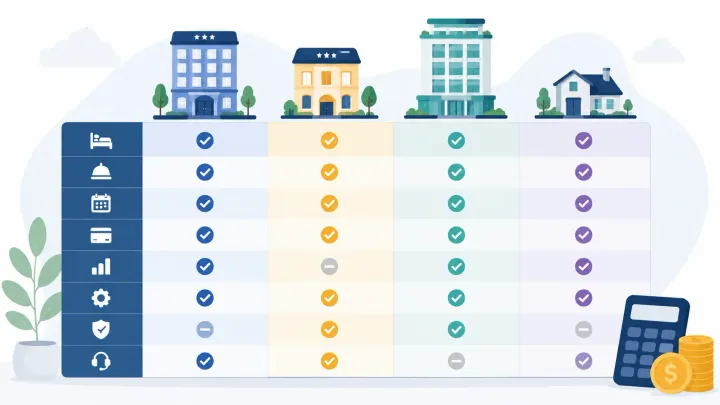
The matrix below covers five property types. For each, the features are grouped by necessity: what the operation cannot function without, what adds genuine value as the property grows, and what belongs to a different operational model entirely.
Feature Matrix by Property Type
Independent Hotel (6–30 Rooms)
Must have: Room-type inventory management, OTA channel sync, front desk check-in and check-out workflow, payment handling and invoice generation, revenue reporting by channel.
Useful but secondary: Yield management and rate rules, automated guest messaging, housekeeping room status module, multi-staff permissions by role.
Typically unnecessary: Bed-level inventory, dorm management, per-bed pricing, shared space booking, hostel-specific payment splits.
Typical monthly cost range: $40–$150/month.
The independent hotel's primary operational need is managing room-type inventory across OTA channels while running a reliable front desk. The yield management and housekeeping modules become valuable once the property has consistent occupancy and more than two staff roles.
B&B and Small Guesthouse (2–10 Rooms)
Must have: OTA calendar sync (preventing double-bookings across platforms), guest payment handling, basic reservation management with guest records.
Useful but secondary: Automated pre-arrival and confirmation messaging, rate management, direct booking link or widget for the property website.
Typically unnecessary: Multi-property reporting, complex yield management, POS integration, formal housekeeping workflow software (small enough to manage informally).
Typical monthly cost range: $15–$60/month.
A B&B's primary risk is double-bookings from unsynced OTA calendars. Everything else is secondary to that problem. Properties at this scale rarely need a formal housekeeping module — the owner or one staff member handles the full turn, and the overhead of a digital status workflow adds more friction than it removes.
Hostel
Must have: Bed-level inventory management (not room-level), dorm type management (gender-separated, mixed, private), group booking handling, per-bed pricing and payment.
Useful but secondary: OTA channel connections (Hostelworld, Booking.com), automated check-in notifications, shared space booking (lockers, common areas).
Typically unnecessary: Upscale guest messaging flows, complex yield management, room-service POS integration, per-room revenue reporting (reporting is per bed and per dorm type).
Typical monthly cost range: $50–$200/month.
Hostels have the most distinct PMS requirements of the five types. Most general-purpose hotel PMS products manage inventory at the room level — a hostel needs bed-level control within each dorm, with logic for gender separation, mixed availability, and group reservations that may span multiple dorm types. A room-level PMS cannot serve this need regardless of its other features.
One System for Independent Hotels, B&Bs, and Vacation Rental Portfolios
Smart Order's PMS covers the features that independent hotels, B&Bs, and vacation rental operators actually use — without charging for the enterprise features that serve a different operational model.
Vacation Rental (1–10 Units)
Must have: Multi-platform OTA sync (Airbnb, Vrbo, Booking.com), automated guest messaging (check-in instructions, access codes), direct booking capability, payment processing.
Useful but secondary: Dynamic pricing integration, cleaning team assignment and scheduling, maintenance tracking, damage deposit handling.
Typically unnecessary: Traditional front desk check-in workflow, POS integration, formal housekeeping room status updates, hotel-style revenue reporting.
Typical monthly cost range: $15–$80/month.
Vacation rental operations are distribution-first — the primary operational challenge is keeping availability synchronized across platforms and automating the guest communication that replaces the front desk interaction. The features vacation rental operators need most are messaging automation and multi-platform sync; the features they need least are the hotel-facing workflows that assume a physical front desk.
Multi-Property Operator (3+ Properties)
Must have: Cross-property reporting (portfolio-level occupancy, ADR, RevPAR), centralized channel management across all properties, property-level and portfolio-level dashboard views, user permissions scoped by property, consolidated payment and revenue reporting.
Useful but secondary: Cross-property booking transfers (moving a guest from one property to another when one is full), dynamic pricing applied at portfolio level, repeat guest tracking across properties.
Typically unnecessary: Features specific to a single property type not in the portfolio (hostel dorm management if the portfolio is all standard hotel rooms).
Typical monthly cost range: $100–$400/month.
The multi-property operator's defining need is visibility without aggregation work — seeing portfolio performance in one view without requesting reports from each property. The PMS that serves this need must natively support multiple properties under one account, not require a separate subscription per property with manual consolidation.
Features That Matter Regardless of Property Type
Four capabilities are necessary across all five property types, regardless of size or format:
Real-time availability sync. Any system that does not update availability across channels the moment a booking is confirmed will produce double-bookings as volume grows.
Payment handling and invoice generation. Every property type needs to collect payment, record it against a reservation, and produce a receipt or invoice. This is not a premium feature.
Guest record keeping. A searchable record of who has stayed, when, and what they paid is the operational foundation for communication, dispute resolution, and repeat guest recognition.
Occupancy and revenue reporting. The minimum reporting a property owner needs: how full is the property and what is it earning. Every property type uses this regardless of scale.
See Occupancy, Revenue, and Channel Performance Without a Separate Report
Smart Order's reporting module shows occupancy, ADR, and booking source in one view — the features that matter regardless of whether you run a guesthouse, vacation rental, or multi-property portfolio.
FAQ
How do I choose the right PMS for my property type?
Start with the "must have" features for your property type, not the full feature list. A vacation rental operator does not need a formal front desk check-in workflow; a hostel operator needs bed-level inventory that most standard PMS products do not offer. Match the system to your operational model first, then evaluate cost, support, and usability within the shortlist that fits.
Can one PMS work for multiple property types?
Most general-purpose PMS products serve independent hotels, B&Bs, and vacation rentals reasonably well. Hostels are the exception — bed-level dorm management is a specialized requirement that most hotel-focused systems do not support. Multi-property operators need a system that explicitly supports multiple properties under one account; a single-property system used multiple times does not produce the portfolio-level reporting the use case requires.
What is the typical monthly cost of a hotel PMS?
Cost varies by property type and feature scope: B&Bs and small vacation rentals typically pay $15–$60/month; independent hotels with channel management pay $40–$150/month; hostels pay $50–$200/month depending on bed count and OTA connections; multi-property operators pay $100–$400/month depending on portfolio size. Within each range, the price difference usually reflects the number of OTA channels connected, the number of user accounts, and the reporting depth.
What PMS features do vacation rental operators actually need?
Vacation rental operators primarily need multi-platform OTA sync, automated guest messaging (check-in instructions, access codes, pre-arrival reminders), payment processing, and a direct booking option. The hotel-specific features — traditional check-in workflow, housekeeping room status, POS integration — rarely apply to vacation rental operations where the guest handles their own arrival and the property is self-check-in.
What should a multi-property hotel operator look for in a PMS?
The essential requirement is native multi-property support: a single account that shows each property's reservations, occupancy, and revenue separately while also producing a portfolio-level view without manual aggregation. Multi-property operators should also look for centralized channel management (one place to manage OTA rates and availability across all properties) and user permissions that can be scoped to specific properties rather than granting staff full-portfolio access.