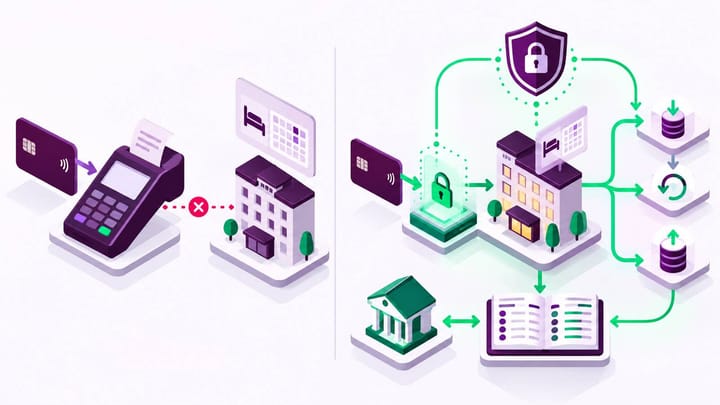
1. A payment gateway securely carries a payment request between the guest, processor, and financial network.
2. Integrated hotel payments connect that transaction to the reservation, balance, refund, and reporting workflow.
3. A direct Stripe connection affects account ownership, payout visibility, fees, disputes, and support responsibility.
4. PCI DSS remains a shared responsibility; using a compliant provider does not remove the hotel's obligations.
A payment gateway for hotels and an integrated hotel payment solution are not the same purchase. The gateway helps authorize and route a transaction. Integration determines whether hotel staff can see that payment against the correct reservation, collect the right deposit, process a refund, reconcile a payout, and hand over an accurate balance.
For owners, the buying question is not simply “Can guests pay online?” It is “Who controls the merchant account, where does the money go, how does the PMS know what happened, and what work remains for front desk and finance?”
What a Payment Gateway Does
A payment gateway is the secure connection used to submit payment information for authorization. It helps pass the transaction between the guest's payment method, the processor or acquiring side, and the financial network. The gateway returns a result such as authorized, declined, or requiring another step.
That result does not automatically update a hotel reservation. A standalone gateway can successfully collect money while the PMS still shows an unpaid balance. Staff may then need to search a separate dashboard, identify the guest, and post the payment manually.
Ask whether the quoted service includes only the gateway or also processing, merchant-account support, local payment methods, fraud tools, refunds, disputes, payouts, and PMS integration. Vendors sometimes group these under one “payments” label even though the responsibilities and fees differ.
What Integrated Hotel Payments Add
Integrated payments connect the transaction with the booking and hotel workflow. A deposit request can use the reservation amount, a successful payment can update the balance, and a refund can remain attached to the original charge.
The operational benefit appears at the desk. Staff can see whether the OTA collected payment, the hotel collected a deposit, a direct-booking balance remains, or a charge failed. Finance can reconcile reservation revenue with transactions and payouts without matching guest names across unrelated exports.
Smart Order's hotel payment solution connects payments with reservations, PMS operations, and a centralized transaction view. It supports integrated online collection and links payment status to the booking workflow.
Connect Every Payment to the Right Reservation
Give front desk and finance one view of charges, balances, refunds, and transaction status instead of reconciling a separate gateway dashboard.
What a Direct Stripe Connection Means
A direct Stripe connection normally means the hotel connects its own Stripe account to the hotel system rather than receiving funds through an unrelated merchant account. The hotel should confirm whose legal entity owns the account, which bank account receives payouts, who controls users and authentication, and who manages disputes and compliance tasks.
Smart Order supports integration with payment providers including Stripe, allowing payments to flow into the hotel's connected account while the PMS keeps the transaction visible with the reservation workflow. Availability, pricing, currencies, and payment methods can still vary by country and account, so confirm the actual setup before purchase.
Ask who provides support when a payment is declined, a payout is delayed, or the PMS status differs from Stripe. “Direct” should not mean the hotel is left to coordinate two vendors without an escalation owner.
PCI DSS: What the Hotel Still Owns
PCI DSS applies to organizations that store, process, or transmit cardholder data. A compliant payment provider and a low-risk hosted or tokenized payment flow can reduce the card data handled by hotel systems and therefore reduce the hotel's compliance burden.
It does not make PCI responsibility disappear. The hotel still needs to use the approved payment flow, complete the required validation for its setup, control staff access, protect accounts and devices, and avoid copying full card details into email, chat, notes, or spreadsheets.
When comparing systems, ask where card data is entered, whether it passes through the hotel's website or PMS, what payment details staff can view, how tokens are used, and which annual compliance steps belong to the property. Do not accept “PCI compliant” as the entire security explanation.
Follow One Payment Through the Full Hotel Workflow
Use a real booking example during the demonstration. A guest reserves on the hotel's booking engine, pays a deposit, modifies the stay, pays the balance, buys an extra service, and later receives a partial refund.
Ask the vendor to show where each event appears in the reservation, folio, transaction view, payout record, and report. Confirm whether the payment status changes automatically and how staff distinguish authorization, capture, settlement, refund, failure, and dispute.
Then test an OTA-collected reservation. The system should not describe an expected OTA payout as if the guest still owes the hotel. Integrated payments are valuable only when the status matches the party responsible for collection.
Compare Fees Without Double Counting
Separate the charges before comparing offers: gateway or processing fee, payment-method fee, currency conversion, cross-border charge, refund treatment, dispute fee, payout fee, PMS transaction fee, and monthly software cost.
Ask which fee is deducted before payout and which appears on a separate invoice. Confirm whether refunded processing fees return, whether local wallets have different pricing, and whether failed or disputed transactions create extra cost.
A low processing percentage can be outweighed by manual reconciliation and slower collection. An integrated solution may cost more per transaction but reduce missed deposits, duplicate charges, and staff time. Compare total cost against the workflow your hotel will actually run.
Check Reconciliation and Reporting
The reservation total, paid amount, outstanding balance, refunds, fees, and payout are related but not identical. The system should let finance move from one reservation to its payment events and from one payout back to the included transactions.
Use hotel reports and analysis to compare reservation revenue, collections, outstanding balances, channel performance, and transaction records. Accounting reports should preserve the difference between when revenue is earned and when cash reaches the bank.
Ask how corrections are handled. If staff attach a payment to the wrong reservation, the audit trail should show the original action and correction rather than silently replacing history.
Evaluate Front-Desk Controls
Front desk users need enough access to collect an approved amount, send a secure payment request, confirm status, and follow the hotel's refund procedure. They usually do not need full merchant-account administration, unrestricted exports, or access to sensitive card data.
Confirm role permissions, manager approval thresholds, refund limits, device access, and shift handover. Test a declined payment and a payment that appears successful to the guest but has not updated the PMS.
The safest workflow tells staff what action is allowed. It should prevent repeated charging, keep uncertain payments visible, and give managers an escalation path.
Use This Buying Decision
Choose a standalone gateway when the property already has reliable reservation posting and reconciliation around it, needs a specialist provider, and accepts the operational work of separate systems.
Choose integrated hotel payments when the team wants online collection, payment status, balances, refunds, and reporting connected to each reservation. Confirm the integration depth rather than assuming a logo on the partner page proves the full workflow.
For either option, document merchant ownership, supported countries and currencies, payment methods, payout timing, fees, refunds, disputes, PCI responsibilities, data access, support ownership, and exit terms before signing.
Frequently Asked Questions
Is a payment gateway the same as a payment processor?
No. The gateway securely submits the payment request, while processing and acquiring functions move the transaction through financial networks and settle funds. Vendors may package these services together.
What makes hotel payments integrated?
The transaction is connected to the reservation and operating record, so deposits, balances, refunds, status, and reconciliation do not depend on manual re-entry.
Does using Stripe make a hotel PCI compliant automatically?
No. A secure Stripe integration can reduce the card data the hotel handles and simplify obligations, but the hotel remains responsible for using the approved flow and completing the compliance requirements for its setup.
What should a hotel confirm about a direct Stripe connection?
Confirm account ownership, bank payouts, supported markets and payment methods, fees, refunds, disputes, user access, PCI tasks, PMS status updates, and support responsibility.
Which option is better for a small hotel?
Integrated payments are often easier when a small team needs booking balances and transaction status in one system. A standalone gateway can fit when the hotel already has strong payment operations and specialist requirements.