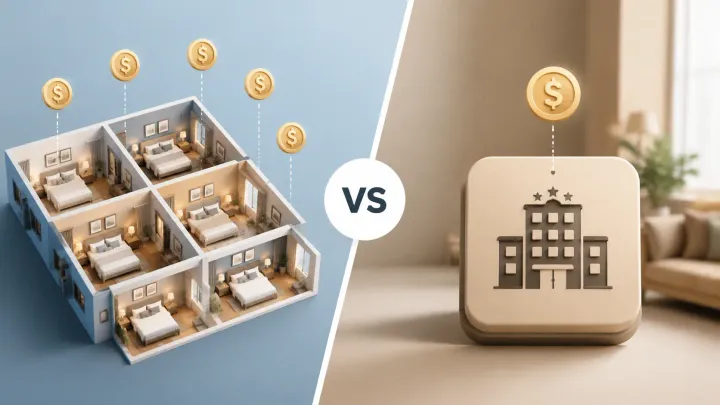
1. Per-room hotel PMS pricing is usually cheaper for small properties because the bill scales with actual room count.
2. Flat-rate PMS pricing can be cheaper for larger properties, but only if the plan includes the features you need without expensive add-ons.
3. The cheapest model is the one with the lowest 12-month total cost after setup, channel manager, booking engine, support, and payment fees are included.
Hotel PMS pricing looks simple until you compare two quotes side by side. One vendor charges $5 per room per month. Another charges $199 per property. A third advertises a low base plan, then charges extra for channel management or support.
The real question is not whether per-room or flat-rate hotel PMS pricing is cheaper in theory. The answer depends on your room count, occupancy, feature needs, and growth plans.
This guide breaks down how both models work, where each one wins, and how to calculate the actual cost before you sign.
How Per-Room Hotel PMS Pricing Works
Per-room hotel PMS pricing charges a fixed amount for each room, unit, or rentable space. If the rate is $5 per room per month, a 20-room property pays $100 per month.
This model is common in cloud PMS products because it scales with property size. Small properties do not pay the same as large hotels.
The advantage is fairness and predictability. If you have 12 rooms, you pay for 12 rooms. Your software bill does not rise because you had a strong month, sold more room nights, or improved occupancy.
The drawback appears as room count grows. A rate that feels low at 15 rooms can become expensive at 80 or 120 rooms, especially if key modules are charged separately.
How Flat-Rate PMS Pricing Works
Flat-rate PMS pricing charges one monthly fee for the property or account, regardless of whether the hotel has 15 rooms or 75 rooms.
The main benefit is simplicity. The bill is easy to understand, and larger properties may pay less than they would under a per-room model.
The risk is plan limitation. The base fee may cover front desk tools but exclude channel manager connections, booking engine access, payment tools, or advanced reports.
Flat-rate pricing can be awkward for very small properties. A 10-room inn paying $199 per month is effectively paying $19.90 per room.
The Break-Even Math
The cleanest way to compare hotel PMS pricing is to calculate break-even room count.
Use this formula:
Flat monthly fee ÷ per-room monthly price = break-even room count
If a flat-rate PMS costs $199 per month and a per-room PMS costs $5 per room, break-even is about 40 rooms. Below that, per-room costs less. Above that, flat-rate costs less before add-ons.
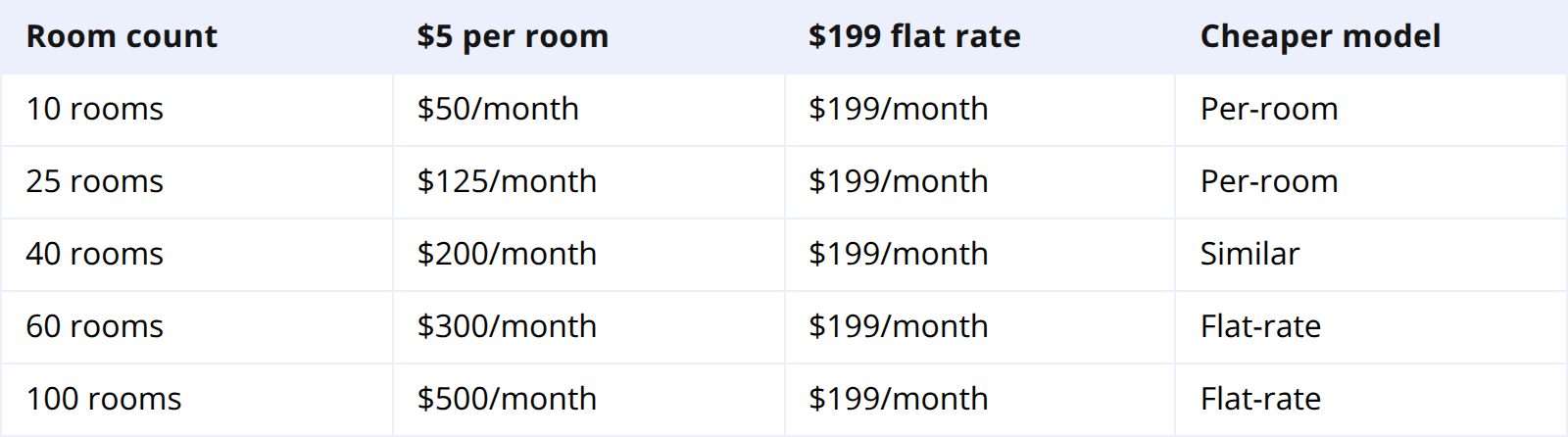
This table only compares the headline PMS fee. The real cost comparison starts after required modules and fees.
Why Headline Pricing Can Mislead You
A hotel PMS rarely operates alone. Most properties need a channel manager, booking engine, reporting, payment tools, user permissions, and support.
For example, a flat-rate PMS at $199 may charge $80 for channel manager access and $50 for booking engine use. A per-room PMS at $5 may include those tools. In that case, per-room can remain cheaper even above the apparent break-even point.
Payment processing is another blind spot. Transaction fees may be unavoidable, but gateway fees, payment-link fees, or required processor markups should be counted separately.
Support terms matter too. A low monthly fee is less valuable if urgent support sits behind a premium tier.
Which Model Costs Less by Property Size?
- For hotels under 30 rooms, per-room hotel PMS pricing usually costs less. The hotel pays in proportion to its scale.
- For mid-size properties with 30 to 80 rooms, the answer depends on included features. A flat-rate plan may win if it includes the full operational stack. A per-room plan may win if it bundles PMS, channel manager, and booking engine.
- For larger hotels above 80 rooms, flat-rate pricing can become attractive if the system is robust enough. If reporting, permissions, or integrations require enterprise upgrades, the advantage can disappear.
- For multi-property operators, compare total portfolio cost. A flat rate per property may be cheap for one site but expensive across ten small properties.
When Per-Room Pricing Is the Better Choice
Per-room pricing is usually better when your property is small, growing, or cost-sensitive. You pay for actual room count rather than unused capacity.
It also works well when the plan includes important modules. A $5 per-room PMS with channel management is very different from a $5 plan that only covers front desk basics.
Per-room pricing is also easier to evaluate against revenue. If one room generates $100 to $200 per occupied night, a monthly software cost of $5 to $15 per room is easier to justify.
Smart Order uses a per-room pricing structure because most independent hotels and vacation rentals need predictable cost at their actual size. The value improves when PMS, channel manager, direct booking, and reporting are handled in one connected system.
Compare PMS Cost Against Your Actual Room Count
Smart Order gives independent hotels a connected PMS, channel manager, booking engine, and reporting system with predictable per-room pricing.
When Flat-Rate Pricing Is the Better Choice
Flat-rate PMS pricing can be better when the property has enough rooms to pass break-even and the plan includes the tools the hotel needs.
It can also suit operators who want a fixed property-level budget. A 70-room property on a complete $199 plan may get a strong deal if key modules are included.
The problem is that many flat-rate plans are built around a simple base package. They may be fine for reservations but weaker for OTA distribution, payments, or reporting.
Before choosing flat-rate pricing, ask what happens when you add more channels, users, payment tools, or properties.
A Practical Cost Checklist
Before comparing vendors, build a 12-month cost view.
Include these costs:
- PMS subscription fee
- Channel manager fee
- Booking engine fee
- Setup or onboarding fee
- Payment gateway or payment-link fees
- Support tier fee
- Extra user, property, or integration fees
Then calculate cost per room and cost per booking. Cost per room shows fit by property size. Cost per booking shows whether cost stays reasonable in slow and peak months.
Avoid percentage-based pricing for core PMS functions when possible. A system that takes a share of booking revenue becomes more expensive when your hotel performs better.
FAQ About Hotel PMS Pricing
Is per-room PMS pricing cheaper than flat-rate pricing?
Per-room PMS pricing is usually cheaper for small hotels because the bill scales with room count. Flat-rate pricing can become cheaper for larger properties after the break-even point, but only if key features are included.
What is a fair per-room price for hotel PMS?
Cloud hotel PMS pricing often ranges from about $4 to $15 per room per month, depending on features, support, and integrations. Budget tools may cost less, while more advanced systems with channel management and reporting may cost more.
What is the biggest hidden cost in hotel PMS pricing?
The biggest hidden costs are usually channel manager access, booking engine fees, onboarding, support tiers, payment gateway fees, and integration fees. Always compare the full 12-month cost, not the advertised monthly price.
Should small hotels choose per-room or flat-rate PMS pricing?
Most small hotels under 30 rooms should start by comparing per-room pricing because it usually fits their scale better. A flat-rate plan can still work if the price is low and includes every required feature.
Does PMS pricing increase when occupancy improves?
Fixed per-room and flat-rate PMS pricing should not increase when occupancy improves. Commission or percentage-based pricing does increase with booking revenue, which can make peak months more expensive.
Final Takeaway
Per-room hotel PMS pricing usually costs less for small properties. Flat-rate pricing can cost less for larger properties. The deciding factor is not the pricing label. It is the complete 12-month cost of the system you actually need.
Before choosing, run the break-even math, add every required module, and compare cost per room. A pricing model that looks cheap on the vendor page may not be the cheapest once your real workflow is included.