1. PMS, channel manager, and booking engine solve different problems — managing internal operations, synchronizing OTA availability, and capturing direct bookings — and are not interchangeable
2. The buying order matters because each tool creates dependencies: a channel manager without a PMS has nowhere to send bookings; a booking engine without a PMS has no system to manage what it receives
3. New hotels should buy the PMS first (or an all-in-one that includes channel management); OTA-heavy hosts should add a booking engine after the PMS is stable; direct-booking strategies require the booking engine and PMS as paired investments
4. The most common buying mistake is purchasing a channel manager or booking engine before the operational foundation is in place
What Each Tool Actually Does
These three tools are regularly grouped together in hotel software conversations, which gives the impression they are interchangeable or that one can substitute for another. They cannot. Each operates at a different layer of the same business.
A Property Management System (PMS) manages everything that happens inside the property — reservations, check-in and check-out, room status, payments, guest records, and reporting. It is the operational record: the source of truth for who is staying, when they arrived, what they owe, and what room they are in. Without a PMS, those records exist in a spreadsheet or someone's memory.
A channel manager manages what appears on OTA platforms. When you list rooms on Booking.com, Airbnb, and Expedia simultaneously, you need a mechanism that pushes live availability and rates to all three at once and pulls bookings back when a room closes. Without a channel manager, you update each platform manually — which means a booking on Airbnb can sit unregistered on Booking.com for hours, creating a double-booking risk.
A booking engine creates a direct reservation path on your own website. Guests who find you through Google or a referral can book without going through an OTA — and without paying OTA commission. It handles the transaction: availability lookup, room selection, payment. It is the mechanism for building a direct booking channel.
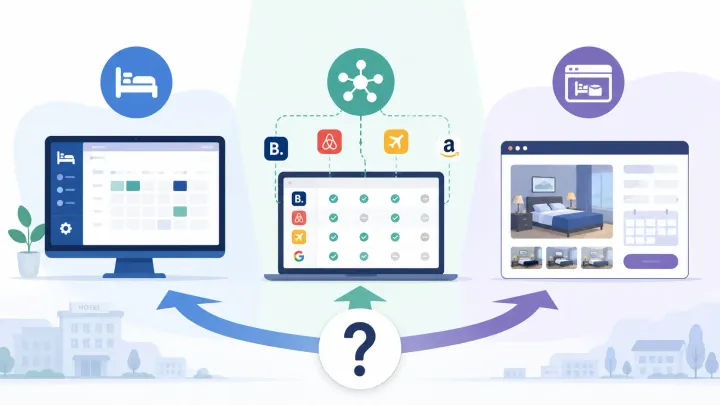
The distinction worth holding: a PMS manages what happens at the property. A channel manager manages what appears on OTA platforms. A booking engine creates a direct booking alternative. They serve different layers of the same operation — not the same function repeated three times.
Buying Sequence for New Hotels Starting With OTAs
A hotel that has just opened and listed on one or two OTAs is in the most common starting position. There is no internal system yet. Bookings come in through Booking.com or Airbnb and get logged in a notebook or spreadsheet.
Buy the PMS first — or an all-in-one system that includes channel management alongside PMS functionality.
The PMS is the operational foundation. Without it, there is no reliable record of who is staying, when, and what they paid. A channel manager purchased at this stage creates a specific problem: bookings arrive through the channel manager, but there is no system to receive them. The channel manager syncs OTA platforms; the PMS is what those synced bookings flow into. Buy the channel manager without the PMS and you have moved the booking record from one spreadsheet to another — just with more software involved.
Some all-in-one systems, including Smart Order, include channel management built into the PMS subscription. For a hotel just opening, this simplifies the first purchase considerably. Instead of evaluating two separate tools, integrating them, and managing two vendor relationships, the paired functionality comes in one system.
When to add a booking engine: after the property has a functioning website, some returning guest base, and a reason to offer a direct price advantage. For a hotel still building awareness and OTA reviews, the booking engine is not yet urgent. The PMS and channel manager are.
Buying Sequence for OTA-Heavy Hosts Wanting to Reduce Commission
A host managing two to four OTA listings with no direct booking capability — possibly running on spreadsheets — is already experiencing the pain this sequence is designed to fix. The typical symptoms are inconsistent rates across platforms, occasional double-bookings, and a growing awareness that 15–20% of every booking is going to OTA commission.
Buy the PMS and channel manager as a paired foundation. At this stage, both are needed simultaneously. The pain points — double-bookings, rate inconsistency across platforms — are channel manager problems. But the channel manager has nowhere to send bookings without a PMS underneath it. Running both from day one means the distribution layer and the operational record are connected from the start.
Once PMS and channel management are stable — bookings flowing in cleanly, rates consistent across all platforms, no overbooking incidents — the next step is the booking engine.
The booking engine at this stage enables a price-parity strategy: offer the same room at or slightly below the OTA rate on your direct channel, without the commission cost. Guests who find the direct price competitive book through the website. The same revenue generates more margin because no commission is paid out. The channel manager continues distributing to OTAs while the booking engine grows the direct share in parallel.
PMS + Channel Management in One Subscription
Smart Order includes PMS and channel management together — the operational foundation and OTA sync in a single tool, without managing two separate vendors.
Buying Sequence for Properties Building a Direct Booking Strategy
A property that already has OTA presence and has made a deliberate decision to grow its direct channel is in a different position. The goal is not to solve a double-booking problem — it is to shift revenue mix away from commission-paying channels.
Buy the booking engine and PMS as a paired investment. The booking engine needs the PMS to receive and manage the bookings it generates. A booking engine without a PMS submits reservations to a spreadsheet — which is not a direct booking strategy, it is a data entry problem in different software.
With both in place, maintain the channel manager to keep OTA distribution running while the direct share grows. The goal is not to abandon OTAs immediately — it is to increase the proportion of bookings that arrive without commission. OTAs continue acquiring new guests. Over time, as direct bookings compound, the commission load decreases as a percentage of total revenue.
When You Need All Three
At a certain distribution volume, all three tools become necessary and the question shifts from which to buy to whether each is separate or integrated.
A hotel listing on three or more OTAs with a direct booking site and multi-staff operations needs the PMS for internal operations, the channel manager for OTA sync, and the booking engine for the direct channel. The case for each tool exists independently.
The more relevant decision at this point is whether to manage three separate vendor relationships — each with its own subscription, API connection, and support line — or find a single platform that provides all three. Integration friction between separate tools accumulates: availability pushed from the channel manager needs to reflect in the booking engine in real time, and both need to feed into the same PMS record. When all three live in one platform, the data moves without a seam.
The Most Common Buying Mistake
Buying the channel manager or booking engine before the PMS.
It is a predictable mistake. The pain that prompts the purchase is usually a distribution problem — a double-booking from two OTAs, or a rate appearing incorrectly on Booking.com. The channel manager looks like the answer. And it is — but only once there is a PMS in place for bookings to land in.
A channel manager that receives bookings from five OTAs and pushes them into a spreadsheet has not solved the double-booking problem. It has moved it. When someone books through the channel manager and staff manually update availability, the gap between systems still exists — with more software layered on top.
The PMS is the foundation. The channel manager and booking engine are built on top of it. Properties that delay the PMS purchase while managing distribution tools accumulate more complexity to unwind later — not less.
Smart Order's Booking Engine and Channel Manager Work in One System
No integration needed between the direct booking layer and the OTA distribution layer — both run inside the same platform, feeding the same PMS record.
FAQ
Do I need all three tools — PMS, channel manager, and booking engine?
Not immediately. The answer depends on your operation. A new hotel on one or two OTAs needs a PMS first, possibly with channel management included. A property focused on reducing OTA dependency adds a booking engine after the PMS and channel management are stable. All three become necessary when you are running multi-OTA distribution alongside an active direct booking channel.
Can a channel manager replace a PMS?
No. A channel manager distributes availability and rates to OTA platforms and receives bookings. It does not manage check-in, room status, guest records, payments, or operational reporting. Without a PMS, bookings received through the channel manager have no system to flow into. The PMS is the operational foundation; the channel manager connects that foundation to external distribution.
What happens if I buy a booking engine without a PMS?
The booking engine can collect reservation requests, but there is no system to manage them. The PMS is what receives, processes, and records bookings — regardless of which channel they come from. A booking engine without a PMS requires manual handling of every direct booking, which defeats the purpose of building a direct channel.
Is it possible to get PMS, channel manager, and booking engine from one vendor?
Yes, and for most independent properties it is the more practical option. A single platform removes integration dependencies — availability syncs between the booking engine and OTAs without a third-party connector, and all bookings from every channel enter the same PMS record. Smart Order provides PMS, channel management, and booking engine functionality under one subscription.
When should a hotel prioritize a booking engine over other tools?
After the PMS and channel manager are stable and the property has a functioning website with returning or referral traffic to convert. A booking engine earns its investment when there is a guest base with direct booking intent. For a new property still building OTA reviews and awareness, the booking engine is not the first priority — the operational foundation is.