1. Hotel self check-in lets guests bypass the front desk using a mobile app, web link, or kiosk terminal — reducing wait times and front desk workload
2. Software-based self check-in requires no hardware investment; kiosk systems require a physical terminal and significant upfront hardware cost
3. The best hotel self check-in software syncs with your PMS in real time to update room status, trigger housekeeping, and issue digital keys automatically
4. Independent hotels and boutique properties typically get better ROI from software-only solutions; large hotels with high walk-in traffic may benefit from kiosk hardware
5. Smart Order includes Self Check-in as part of its full PMS stack from $5/room/month — no separate hardware required
What Is Hotel Self Check-in Software?
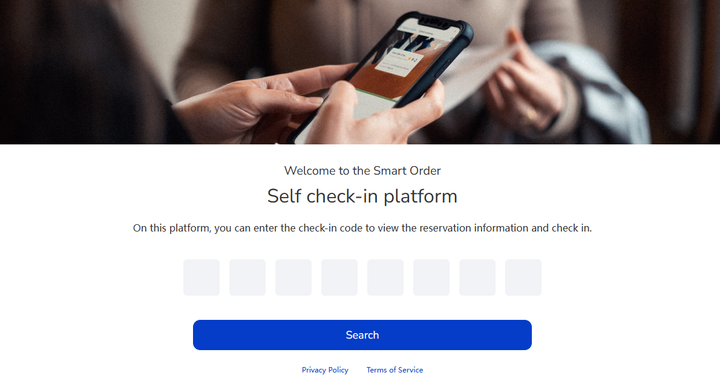
Hotel self check-in software allows guests to complete the check-in process independently — without waiting at the front desk. Guests receive a link or use a mobile app to verify their identity, confirm their reservation, and receive a digital room key before or upon arrival.
Software vs Kiosk: Two Different Approaches
Software-based self check-in runs entirely on the guest's phone or a web browser. No dedicated hardware is required at the property. Guests complete check-in remotely — from the airport, the car park, or anywhere with a connection. The system syncs with the hotel PMS, updates room status, and delivers a smart lock code or digital key automatically.
Kiosk-based self check-in uses a physical terminal installed in the hotel lobby. Guests interact with a touchscreen, scan their ID, and collect a physical key card. Kiosks require procurement, installation, maintenance, and ongoing support — representing a significant upfront hardware investment compared to software-only solutions.
Which Is Right for Your Property?
For most independent hotels, boutique properties, and small hotel groups, software-based self check-in delivers faster ROI with lower total cost. Kiosk hardware makes more sense for high-volume properties where guests regularly arrive without advance reservations and need an on-site terminal.
How Hotel Self Check-in Works
Guest Flow
- Pre-arrival notification — the system sends the guest a check-in link by SMS or email before their arrival date
- Identity verification — the guest uploads an ID photo or completes a verification step through the app
- Reservation confirmation — the guest reviews their booking details, room type, and any outstanding balance
- Room assignment — the PMS assigns the room and triggers housekeeping if the room is not yet ready
- Key delivery — the guest receives a smart lock code or digital key directly to their phone
- Arrival — the guest goes straight to their room without stopping at the front desk
Backend: PMS Sync
Every check-in action updates the PMS in real time. Room status changes to "occupied," housekeeping assignments update, and reservation records close automatically. No manual entry required.
Key Features to Look for in Hotel Self Check-in Software
- No hardware dependency — works on the guest's own device; no terminal procurement or maintenance
- Real-time PMS sync — room status, housekeeping, and reservation records update the moment the guest checks in
- Smart lock integration — digital key delivery requires a compatible smart lock; confirm your current lock hardware before selecting software
- ID verification — automated identity checks reduce fraud risk and replace manual passport or ID copying
- Multi-language support — critical for properties serving international guests
- Included in PMS pricing — standalone self check-in modules add cost; look for platforms where the feature is bundled
Let Guests Check In Without the Front Desk
Smart Order's Self Check-in syncs with your PMS in real time — no kiosk hardware needed. Included in Smart Order from $5/room/month.
Hotel Self Check-in Software vs Kiosk: Key Differences
Software-based:
- No hardware purchase or installation
- Guests check in on their own device from anywhere
- Digital key delivery via smart lock integration
- Updates PMS in real time
- Suitable for independent hotels, boutique properties, and hotel groups
- Typically included in PMS subscription pricing
Kiosk hardware:
- Physical terminal required in the lobby
- Guests check in on-site at the terminal
- Prints physical key cards (in addition to or instead of digital keys)
- Requires hardware maintenance, repairs, and periodic replacement
- High upfront hardware investment
- Best suited for high-volume properties with significant walk-in traffic
Best Hotel Self Check-in Software in 2026
Smart Order
Best for: Independent hotels, boutique properties, and small hotel groups.
Smart Order includes Self Check-in as a standard module within its full PMS stack. Guests receive a check-in link before arrival, verify their identity, and receive a smart lock code — without any front desk interaction. The system connects to 11 OTAs including Booking.com, Airbnb, Agoda, and Expedia via real-time two-way sync, so room status updates across all channels the moment a guest checks in.
Smart Order also includes a unified inbox for guest messages, a direct booking engine, and PriceLabs integration for dynamic pricing.
Pricing: From $5/room/month. Self Check-in is included — no additional module cost.
Mews
Best for: Mid-market and upscale properties seeking a full cloud PMS with self check-in capability.
Mews offers a guest portal for online check-in and digital key delivery. It integrates with a range of smart lock providers and supports pre-arrival upselling. Pricing is custom based on property size.
Little Hotelier
Best for: Small properties and B&Bs looking for a simple all-in-one solution.
Little Hotelier includes an online check-in feature within its property management platform. The workflow is designed for smaller teams and properties with limited technical resources. Pricing available on request.
Innroad
Best for: Independent hotels and resorts in the US market.
Innroad provides a PMS with integrated online check-in capabilities. The platform is focused on the US independent hotel segment and includes channel management alongside guest-facing features. Pricing available on request.
How to Implement Self Check-in at Your Hotel
- Confirm smart lock compatibility — self check-in digital key delivery requires a compatible smart lock. If your property uses physical key cards only, assess whether a smart lock upgrade is feasible before selecting software.
- Select a PMS with Self Check-in included — avoid purchasing a standalone self check-in module on top of an existing PMS. Bundled solutions are lower cost and reduce integration complexity.
- Connect your OTA channels — ensure your PMS channel manager is active so room availability updates automatically when guests check in via any channel.
- Configure the guest check-in flow — set the pre-arrival notification timing (typically 24–48 hours before arrival), ID verification method, and room assignment rules.
- Test before going live — run a full check-in cycle internally before activating for real guests. Verify smart lock codes are delivered correctly and PMS records update as expected.
See How Smart Order Self Check-in Works
Book a 20-minute demo to see guest self check-in, PMS sync, and OTA channel management in one platform.
FAQ
What is the best check-in software for hotels?
For independent hotels and boutique properties, Smart Order provides the most complete stack — Self Check-in, PMS, channel manager, unified inbox, and direct booking engine from $5/room/month with no additional module fees. For mid-market properties, Mews and Little Hotelier are established options with comparable self check-in features.
How does self check-in kiosk work?
A self check-in kiosk is a physical terminal installed in the hotel lobby. Guests approach the screen, enter their reservation details or scan a booking confirmation code, verify their identity with an ID scan, and collect a physical key card from a built-in card dispenser. The kiosk connects to the hotel PMS to update reservation status in real time.
What software do most hotels use?
Independent hotels and boutique properties most commonly use cloud-based property management systems such as Smart Order, Mews, Little Hotelier, or Cloudbeds — which bundle front desk operations, channel management, and guest-facing features including self check-in in a single platform.
How much does PMS software cost?
Cloud PMS pricing typically ranges from $3–$15 per room per month depending on the platform and features included. Smart Order starts at $5/room/month and includes Self Check-in, channel manager, unified inbox, and direct booking engine. Enterprise platforms with custom pricing are typically used by larger hotel groups and chains.
Do hotels need a kiosk for self check-in?
No. Software-based self check-in uses the guest's own smartphone or a web browser — no dedicated kiosk hardware is required. Guests receive a check-in link by SMS or email before arrival and complete the process remotely. Kiosk hardware is an additional option for properties that want an on-site terminal, but it is not required for self check-in to function.
What is the difference between self check-in software and a kiosk?
Self check-in software runs on the guest's phone or a web browser — no hardware at the property is needed. A kiosk is a physical terminal in the hotel lobby where guests check in on-site. Software-based solutions have lower total cost and work for remote pre-arrival check-in; kiosks work well for on-site walk-in guests but require hardware investment and maintenance.
Can self check-in software work with an existing PMS?
It depends on the platform. Standalone self check-in tools can integrate with some PMS systems via API, but compatibility varies. The most reliable approach is to use a PMS that includes self check-in as a built-in module — which eliminates integration risk and reduces cost. Smart Order includes Self Check-in natively within the same platform as the PMS and channel manager.