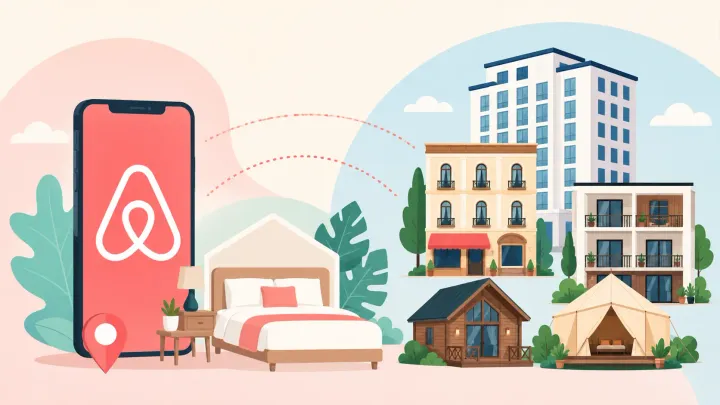
1. Airbnb is a global travel marketplace with 8+ million listings across 220+ countries — not just a vacation rental platform
2. Hotels can list on Airbnb; boutique and independent properties are actively featured as of 2026
3. Airbnb reaches a traveler profile that Booking.com and Agoda often do not — experience-seeking, discovery-driven guests
4. Boutique hotels, micro hotels, design-led properties, and destination stays benefit most from the platform
5. Economy and midscale hotels competing on price see the least incremental value from an Airbnb listing
6. A channel manager keeps Airbnb availability in sync with your other OTAs so one booking doesn't create an overbooking on another channel
What Is Airbnb?
Airbnb is an online travel marketplace where travelers book accommodation directly from hosts and property owners around the world. It launched in 2007 in San Francisco, founded by Brian Chesky, Joe Gebbia, and Nathan Blecharczyk, originally as a way for homeowners to rent out spare rooms. It has since grown into one of the largest travel platforms on earth.
As of 2025, Airbnb has over 8 million active listings across more than 220 countries, more than 5 million hosts, and 275 million registered users. The platform booked 533 million nights and experiences in 2025 — up 8% from the prior year — generating $91.3 billion in gross booking value.
The common perception of Airbnb as a vacation rental platform for apartments and private homes is accurate but incomplete. Hotels — specifically boutique, independent, and unique properties — are listed and bookable on Airbnb alongside private rentals. For the right property type, Airbnb is a distribution channel that reaches a guest segment your standard OTA stack may not fully cover.
How Airbnb Works as a Hotel Distribution Channel
When a hotel lists on Airbnb, the mechanics are similar to any OTA. You set up a property listing with photos, descriptions, room rates, availability, and house rules. Guests search, compare options, and book directly through the platform. Airbnb handles the guest-facing booking flow, payment processing, and customer support. You receive the reservation, manage the stay, and pay commission after checkout.
The commission structure on Airbnb differs from Booking.com and Agoda. Airbnb typically splits the fee: the host pays a service fee of around 3%, and the guest pays a booking fee of around 14%. The result is that your net commission cost per booking is lower than on most other OTAs — at the expense of slightly higher visible pricing for guests.
For multi-room properties listing multiple units, Airbnb supports multi-calendar management. When a room is booked on Airbnb, that availability needs to close across your other OTA channels immediately — otherwise the same room can be booked twice. This is where a channel manager becomes non-negotiable for any hotel listing on more than one platform.
Which Types of Hotels Benefit Most from Listing on Airbnb
Not every hotel gets the same return from an Airbnb listing. The platform's guest base skews toward experience-driven, discovery-oriented travelers who are actively looking for something different — not just the cheapest room at the nearest property. Properties that fit that profile perform well. Properties that don't are largely invisible in search regardless of how the listing is set up.
Boutique and Independent Hotels
Airbnb's 2026 platform direction has made this explicit. The company is actively featuring boutique and independent hotels in top destinations globally — selected for neighborhood location, design, and hospitality quality. Large chain properties are excluded from this initiative.
For a boutique property with 10 to 40 rooms and a distinct design identity, that is a meaningful platform advantage. Airbnb's search algorithm surfaces properties that generate strong engagement and review volume. Boutique hotels that invest in listing quality — professional photos, detailed descriptions, a response rate above 90% — can rank ahead of much larger properties that do not match the platform's traveler intent.
Micro Hotels and Urban Properties
Micro hotels in city centers are a strong fit for the Airbnb traveler profile. Solo travelers, city-break tourists, and business travelers who book short stays value location and character over room size. A well-positioned 20-room micro hotel in a dense urban neighborhood competes on Airbnb with apartment rentals and private rooms — and often wins on the combination of private en-suite facilities, professional hospitality, and a competitive nightly rate.
The platform's guest demographics support this: users aged 25 to 34 make up the largest single segment, and business travel on Airbnb grew from 28% in 2019 to 44% in 2024. Both groups index heavily toward urban, short-stay, design-forward properties.
Unique and Design-Led Properties
Airbnb's search prominently surfaces properties that offer something unusual — distinctive architecture, themed interiors, historic buildings, notable communal spaces, or unusual locations. A converted warehouse hotel, a boutique property in a heritage building, or a design hotel with a rooftop bar all have competitive advantages on Airbnb that they do not have on Booking.com, where the default sort is by price and review score.
If your property has a story that photographs well, that differentiation has tangible search value on Airbnb.
Destination, Coastal, and Rural Properties
Properties in leisure destinations — beach towns, mountain locations, rural retreats — perform consistently well on Airbnb. Travelers booking destination stays often search Airbnb specifically before checking traditional OTAs, because the platform's inventory in those markets skews toward distinctive accommodation that a Booking.com search would not surface.
A boutique coastal property or a design guesthouse in a rural location reaches a guest segment through Airbnb that would not find it through traditional hotel OTAs. Adding Airbnb to the channel stack for this property type typically adds incremental bookings rather than just splitting existing demand across more platforms.
Properties With Distinctive Amenities
Hot tubs, pools, outdoor spaces, pet-friendly policies, and dedicated work setups generate measurably higher visibility and revenue on Airbnb compared to otherwise similar properties without them. The platform's filter and search behavior amplifies amenity differentiation in a way that standard hotel OTAs do not.
If your property has amenities that guests actively filter for, Airbnb's search mechanics favor you. The same room in the same location with a hot tub earns a significantly higher nightly rate and occupancy rate than one without it — a dynamic that is more pronounced on Airbnb than on Booking.com or Agoda.
Which Hotels See Less Benefit from Listing on Airbnb
Economy and midscale chain properties — properties without distinctive design, location advantages, or amenity differentiation — compete directly on price with the vast supply of affordable private rentals on Airbnb. In that price bracket, a 40-room budget hotel does not have a clear advantage over an apartment listing with strong reviews and a lower nightly rate.
For properties in this segment, Booking.com and Agoda are more efficient distribution channels. The commission structure is more straightforward, the search intent better matches standard hotel inventory, and the platform actively promotes hotels as a core product category rather than as a secondary listing type.
The test is simple: does your property offer something that a guest searching for a local apartment or vacation rental would choose instead? If yes, Airbnb adds incremental value. If your primary pitch is price and availability, it probably does not.
Add Airbnb to your OTA stack without managing it manually
Smart Order's channel manager syncs your availability across Airbnb, Booking.com, Agoda, and more in real time — one dashboard, no manual extranet updates.
Managing Airbnb Alongside Your Other OTA Channels
The operational challenge of listing on Airbnb is not the listing setup — it is keeping availability synchronized across platforms. A hotel running Booking.com, Agoda, and Airbnb simultaneously has three systems that need to reflect the same room inventory at all times. If a guest books on Booking.com at 9pm and that room is not immediately closed on Airbnb, a second guest can book the same room minutes later. The result is an overbooking that costs more to resolve than any incremental Airbnb revenue is worth.
A channel manager eliminates this risk. When a booking is confirmed on any connected OTA, the channel manager closes that room across every other platform in real time — including Airbnb. Rate updates work the same way: change your nightly rate in one place and it pushes everywhere simultaneously.
Smart Order's PMS includes an integrated channel manager that connects Airbnb alongside your standard OTA channels. Adding Airbnb to your channel stack does not require a separate tool, a second login, or a manual sync process — availability and rate updates move through the same system that handles your Booking.com and Agoda connections.
Connect Airbnb to your PMS and manage everything in one place
Smart Order syncs your Airbnb listing with the rest of your OTA channels automatically — so your availability is always accurate, on every platform, without extra work.
FAQ
Can hotels list on Airbnb?
Yes. Hotels — particularly boutique, independent, and unique properties — can list on Airbnb and receive bookings through the platform. Airbnb has actively expanded its hotel listings since 2020 and in 2026 launched a dedicated initiative featuring boutique and independent hotels in major global destinations. Large chain hotels are largely excluded from this push, giving independent operators a platform advantage.
What types of properties perform best on Airbnb?
Boutique and independent hotels with strong design identity, micro hotels in urban locations, unique or design-led properties, destination and coastal stays, and properties with distinctive amenities such as hot tubs or outdoor spaces consistently outperform on Airbnb. The platform's traveler base skews toward experience-driven guests who are actively filtering for something different — properties with that differentiation rank better and convert more bookings.
How much commission does Airbnb charge hotels?
Airbnb typically charges hosts a service fee of around 3% per booking. The guest also pays a separate booking fee of approximately 14%. The combined cost sits below the 15–20% commission that most other OTAs charge hotels on the full booking value, making Airbnb's net cost per booking lower for hotel operators — though the guest-facing price is correspondingly higher.
Do hotels need a channel manager to list on Airbnb?
Any hotel that lists on Airbnb alongside other OTA channels needs a channel manager to prevent overbooking. Without real-time availability sync, a booking confirmed on one platform can create a conflict on another. A channel manager that integrates Airbnb alongside Booking.com and Agoda keeps availability accurate across all channels simultaneously without manual intervention.
Is Airbnb worth it for small hotels?
For boutique, independent, and design-forward small hotels, yes. Airbnb reaches a guest segment — younger, experience-seeking, discovery-driven travelers — that traditional OTAs serve less effectively. For economy or midscale properties without distinctive design or location advantages, the incremental value is lower. The question is whether your property's character and offering match what Airbnb's traveler base is actively searching for.