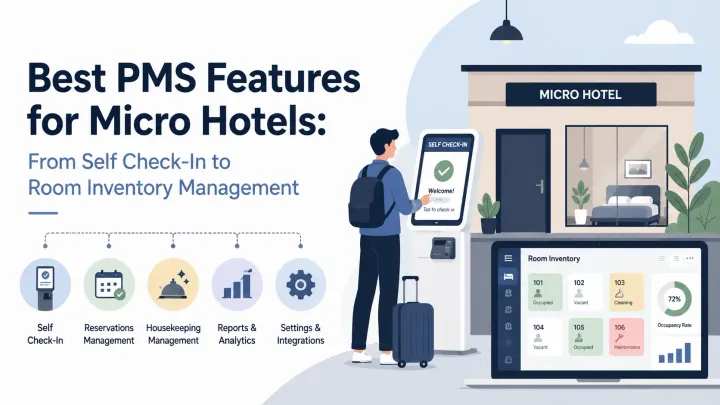
1. Self check-in removes the front desk bottleneck micro hotels cannot staff around the clock
2. Real-time room inventory sync prevents overbooking when even one displaced guest matters
3. With fewer than 30 rooms, every cancellation and overbooking has outsized financial impact
4. Micro-stay and hourly booking support unlocks revenue from rooms sitting empty between standard check-ins
5. Cloud PMS with mobile access lets a lean team run the full operation from anywhere
What Makes a Micro Hotel's PMS Needs Different
Micro hotels operate lean by design — fewer rooms, smaller teams, faster room turnover. The standard PMS checklist built for a 200-room full-service property addresses problems that don't exist at a 20-room micro hotel, and misses several that do. Sophisticated concierge modules, multi-outlet F&B reporting, and group billing tools add cost and interface complexity without adding value for an operator running a focused, high-efficiency property.
The features that justify a PMS investment for a micro hotel fall into a specific, narrower set. Self-service arrival, real-time inventory control, automated OTA sync, and support for non-standard booking lengths are where the return on investment actually lives. Understanding exactly which features belong in that set — and why — prevents paying for enterprise software when lean-purpose tools are the right fit.
If you are new to the micro hotel format, the What Is a Micro Hotel? Guide for Hotel Owners covers the business model and basic technology requirements before diving into the specific features below.
Self Check-In: Running Arrivals Without a Permanent Front Desk
A traditional hotel can staff a front desk across three shifts. Most micro hotels cannot — and operationally, they should not need to. Self check-in removes the staffing bottleneck at arrival entirely, letting guests complete the process on their own timeline and letting your team focus on maintenance, housekeeping, and guest issues rather than key handoffs.
Mobile Check-In vs. Kiosk
Mobile web-based check-in is the practical entry point for micro hotels. The guest receives a link before arrival, completes identity verification, confirms payment, and gets room access details — without downloading an app or waiting in a queue. For properties under 30 rooms, this handles the vast majority of arrivals with minimal hardware investment.
Kiosk systems make more sense at higher volumes or in locations where guests arrive without having engaged with pre-arrival messages. A hardware kiosk sits in the lobby 24/7, guides walk-in guests through the same flow, and encodes a key card on the spot. The setup time and cost are higher, but the coverage is complete. For most micro hotels launching today, mobile-first is the right starting point — kiosks can be added later if traffic justifies it.
Smart Lock Integration
Mobile check-in reaches its full potential when the PMS is connected to a smart lock system. When a booking is confirmed, the PMS generates a time-limited door code or digital key and delivers it to the guest automatically — before they arrive. No key handoff, no front desk interaction, no gap if your team is off-site at check-in time.
The integration works in both directions. When a guest checks out or a booking is cancelled, the code expires. Your team does not need to track physical keys, chase returns, or recut cards. For a micro hotel operating with two or three staff members, that elimination of routine key logistics frees up meaningful time.
Self check-in, room sync, and OTA management in one system
Smart Order's cloud PMS connects your bookings to smart locks and OTA channels automatically — so your front desk runs itself, even when your team isn't there.
Real-Time Room Inventory Management
Room inventory management sounds straightforward until you understand what "real-time" actually means in practice. A booking confirmed on Booking.com at 11:47pm should close that room across every other channel at 11:47pm — not in the next hourly sync, not on the next manual update. Any gap between confirmation and inventory closure is a window for a second booking to come in on a different channel.
Why Small Room Count Amplifies the Risk
At a 200-room hotel, one overbooking is a manageable inconvenience. At a 20-room micro hotel, that same overbooking represents 5% of your total inventory — and if it happens on a fully occupied weekend, there may be no comparable room to offer as a remedy. The guest gets relocated to a competitor, your review score takes the hit, and the relationship is unlikely to recover.
The exposure scales inversely with room count. Micro hotels cannot afford the operational slack that larger properties use to absorb the occasional inventory error. Real-time sync is not a premium feature for micro hotels — it is baseline infrastructure.
Inventory Updates Across the Full Booking Stack
Real-time inventory management means the PMS acts as the single source of truth, pushing updates outward to every connected channel the moment a booking is confirmed. The channel manager receives the change and relays it to Booking.com, Agoda, Airbnb, and any other connected OTA in seconds. Your direct booking engine, which pulls live availability from the PMS, reflects the same state simultaneously.
When a cancellation comes in, the same logic runs in reverse — availability opens back up across all channels automatically, without any staff action. The result is a property that is always bookable to its full available capacity, on every channel, without manual intervention.
OTA Channel Management Built Into the PMS
A channel manager is not optional equipment for a micro hotel with OTA listings. It is the mechanism that makes multi-channel distribution work without creating a full-time manual job. The question is whether to run it as a separate tool connected to your PMS via API, or as a module built natively into the same platform.
Rate Parity and What Breaks Without Sync
OTAs monitor rate parity. If Booking.com shows one price for your room and Agoda shows a different one, the platform with the higher rate will flag the discrepancy and can reduce your property's visibility in search results. Managing this manually — logging into each extranet and updating rates individually after every pricing decision — is not sustainable when rates should be adjusting with demand.
Without an integrated channel manager, the practical outcome is that micro hotel operators end up running rates that rarely change because updating them is too labor-intensive. Static rates leave money on the table during high-demand periods and cause the property to underperform during soft demand windows where a modest price reduction would have driven occupancy.
Which Channels Micro Hotels Actually Need
Booking.com and Agoda drive the highest volume for urban micro hotels targeting independent travelers and short-stay guests. Airbnb is essential for properties in markets where it holds strong share, and for operators who want to reach a guest segment that values unique, design-forward properties. A direct booking engine on your own website captures the commission-free layer on top of OTA distribution.
Beyond these four, the return on adding more channels diminishes quickly for a micro hotel. Managing ten OTA connections for a 15-room property creates integration overhead without meaningfully increasing booking volume. Start with the three or four channels where your target guest actually books, get those connections working cleanly, and add others only when the data shows a volume opportunity.
Housekeeping Coordination for High-Turnover Properties
Micro hotels turn rooms over faster than conventional hotels. A property supporting micro-stay bookings may see the same room go through checkout, cleaning, and a new check-in twice in a single day. Without a system tracking room status in real time, your housekeeping team cannot reliably know which rooms need attention and your front desk cannot accurately tell an early arrival when their room will be ready.
A PMS with housekeeping management tracks the complete status cycle for each room: occupied, due for checkout, cleaning in progress, inspected, and available. When a guest checks out, the system flags the room for cleaning automatically. When housekeeping marks it complete, availability opens in the PMS and across all connected channels — without any front desk action in between.
For a micro hotel running two housekeeping staff, automated assignment based on checkout schedule replaces the morning whiteboard briefing. Rooms that need urgent turnaround for a same-day arrival get prioritized automatically. Staff can update room status from a mobile device, so the front desk always has a live view of what is clean and what is not.
Micro-Stay and Hourly Booking Support
A standard hotel sells one booking per room per night. A micro hotel has the option — and the right market positioning — to sell the same room twice in a day. Micro-stays, typically bookings of two to six hours for airport layovers, early arrivals between flights, business travelers needing a quiet space mid-day, or guests extending before a late departure, are a revenue layer that most traditional hotels cannot operationally support.
For a micro hotel in an urban location near a transit hub or business district, rooms that would sit empty from 10am to 3pm under a standard model can instead generate 40–60% of a full night's rate through a single micro-stay booking. Over a month, that revenue gap is meaningful.
The PMS requirement is specific: the system must support partial-day inventory without creating a conflict with the same room's same-night reservation. A booking from 11am to 3pm needs to exist alongside a check-in at 4pm without triggering an overbooking flag. Not every PMS handles this natively — it is a feature worth confirming before selection if micro-stay revenue is part of your model.
Direct Booking Engine as a Revenue Channel
OTA commissions typically run 15–20% of the booking value. For a micro hotel with a moderate average daily rate, that commission compounds across hundreds of bookings per year into a significant cost. A direct booking engine on your own website is the mechanism for converting some of that OTA-driven discovery into commission-free revenue.
The booking engine must be connected directly to your PMS — not manually updated — for it to function reliably. Guests who find your property through an OTA and then check your website before booking should see the same room availability and the same rate parity-compliant pricing that your OTA listings show. A booking engine with a stale calendar or pricing that does not match current OTA rates undermines both direct bookings and your OTA listing quality.
The practical return on a direct booking engine scales with how much direct traffic you can drive — through your own social presence, Google profile, repeat guest relationships, and any content or word-of-mouth that sends guests directly to your website before they search an OTA.
Choosing a PMS That Fits a Micro Hotel
The cleanest setup for a micro hotel is a single platform that covers PMS, channel manager, and booking engine under one subscription. Separate tools for each function mean three monthly fees, three support relationships, and a data flow that depends on APIs working reliably between systems you do not control end to end.
Before committing to any platform, confirm the following:
- The system is cloud-native with mobile access — you should be able to manage check-ins, room status, and channel updates from a phone, not a server room in your property
- Channel manager and booking engine are included in the base plan, not sold as add-ons that double the monthly cost
- Pricing is based on your actual room count — per-room models at $5–$15/month are standard for small properties; avoid enterprise tiers built for chains
- A real free trial is available with live OTA connections, so you can test actual sync behavior before signing a contract
Smart Order's cloud PMS covers all four of these requirements from the Essential plan at $5 per room per month — including real-time OTA sync with Booking.com, Agoda, and Airbnb, a direct booking engine, and mobile access to manage the full operation from anywhere.
One platform for your micro hotel from $5/room/month
Smart Order's PMS includes channel manager, booking engine, and real-time OTA sync in one subscription. No separate tools, no add-on fees for core functionality.
FAQ
What PMS features are most important for a micro hotel?
The highest-priority features for a micro hotel are real-time room inventory sync across all OTA channels, self check-in with smart lock integration, and an integrated channel manager and direct booking engine. Secondary priorities include housekeeping status tracking and micro-stay or hourly booking support for properties that want to monetize partial-day availability.
Does a micro hotel need a separate channel manager?
No — and ideally it should not have one. A standalone channel manager adds a second monthly subscription and creates a data dependency between two systems you do not control end to end. The more reliable setup is a PMS that includes the channel manager natively, so inventory and rate updates move through one system without an external API in the middle.
Can a micro hotel use self check-in without a physical kiosk?
Yes. Mobile web-based check-in — delivered to guests via a link before arrival — handles the full self check-in flow without any hardware. Guests verify identity, confirm payment, and receive room access details from their phone. A physical kiosk adds value for walk-in traffic or very high-volume properties, but most micro hotels get full coverage from a mobile-first solution connected to a smart lock system.
How does a PMS prevent overbooking in a small-room property?
A PMS prevents overbooking by closing availability across all connected OTA channels the moment a booking is confirmed — in real time, not on a delayed sync schedule. When your channel manager is built into the PMS rather than connected via external API, that update propagates faster and with fewer failure points. For a micro hotel where one overbooking can represent 5% of total inventory, that sync speed is critical.
What is a micro-stay booking and how does a PMS handle it?
A micro-stay is a booking for a partial day — typically two to six hours — used for airport layovers, early arrivals, or day-use travelers. A PMS that supports micro-stays allows partial-day inventory to coexist with standard overnight reservations without triggering overbooking conflicts. The system tracks the specific time window for the micro-stay booking, keeps the room available for its same-night reservation, and processes housekeeping between the two bookings automatically.