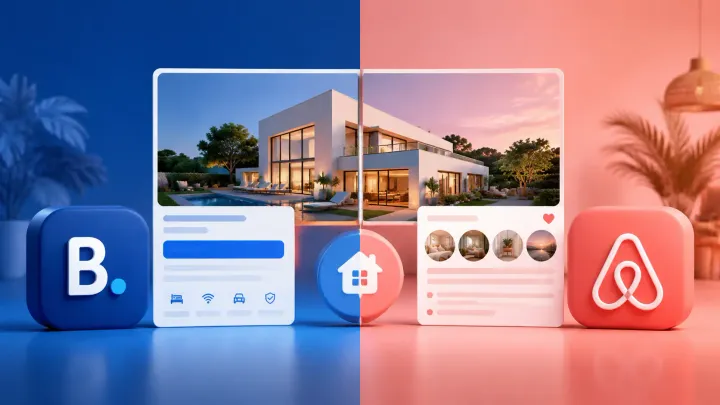
1. Booking.com guests filter and compare — they read your description to confirm a decision already narrowed by price, location, and star rating
2. Airbnb guests browse and imagine — they read your description to decide whether they want to stay somewhere they haven't compared elsewhere yet
3. Amenities work differently on each platform: Booking.com pulls them from checkboxes into separate filters, while Airbnb lets you explain them in prose
4. Copying the same description across both platforms leaves money on the table — the same property needs two different copy strategies
The Guest Intent Gap That Changes Everything You Write
The single biggest mistake hosts and hoteliers make with OTA listings is treating both platforms as the same audience.
On Booking.com, most guests arrive via a search with filters already applied — location, dates, price range, star rating. By the time they open your listing, they've already narrowed the field. They're reading your description to confirm a decision, not to discover you. Your copy needs to be efficient, accurate, and structured to match what the platform's algorithm surfaces.
On Airbnb, guests frequently browse without a specific property in mind. They scroll photos and read descriptions to build a feeling of the place. The listing needs to create desire, not just provide information. Copy that reads like a hotel spec sheet kills conversion on Airbnb.
Same property. Same amenities. Two completely different writing jobs.
How Booking.com Processes Your Description
Booking.com uses a structured field model. Your listing has a short description (typically 250–300 characters, shown in search results), a longer property description, individual room descriptions, and a separate facilities section populated by checkboxes — not prose.
The algorithm reads amenity completeness separately from your written description. Marking "Free WiFi" in the facilities checklist makes your listing appear in WiFi-filtered searches. Mentioning WiFi in the description text does not. This means your description characters are too valuable to spend on amenities that belong in checkboxes.
Use your Booking.com description for what the checkbox system can't capture: location context ("three-minute walk to the harbor, quieter than the main hotel strip"), what kind of guest fits the property well ("suited to business travelers — the desk setup works for a full workday"), and anything that differentiates your property from similar options at the same price point.
Keep sentences short and factual. Third-person phrasing ("The apartment features...") matches the platform's professional register. Avoid first-person narrative — it reads oddly within Booking.com's hotel-facing interface.
How Airbnb Uses Your Copy
Airbnb's listing structure is built for storytelling. You get a title (up to 50 characters), a summary section, "The Space" (your main description), "Guest Access," "Other Things to Note," and neighborhood context — each as a separate free-text field.
The title carries more weight on Airbnb than on Booking.com because it's what guests see while scrolling a map or a category grid. On Booking.com, property names tend to be functional ("Studio, City Centre"). On Airbnb, the title is the hook — it should name the most memorable quality of the property, not just its category ("Quiet garden flat, 5 min from the station").
Guests read Airbnb descriptions before they've fully decided. Your job in "The Space" section is to make the stay feel real before they've arrived. Use second person ("You'll have the terrace to yourself from 7am..."). Name specific things — the coffee machine brand, the blackout curtains, the sound of the neighbor's courtyard — rather than generic comfort language. The goal is that a guest reading the description can picture being there.
Optimize Your Listings Without Losing Sync Between Channels
When both your Booking.com and Airbnb listings are performing, availability needs to update across both the moment a booking lands. Smart Order's channel manager syncs inventory in real time so a reservation on one platform closes the room on the other automatically.
Amenities: Checkbox vs Prose
The practical difference in how amenities work on each platform shapes how much description space you should spend on them.
On Booking.com, amenities are almost entirely handled by the facilities checklist. The platform groups them into categories — bathroom, bedroom, kitchen, services, activities — and guests filter by them directly. A guest searching for "parking included" will only see your listing if parking is checked in the right facility field, regardless of whether you mention it in the description. Audit your facilities checklist thoroughly. Every unchecked box that applies to your property is a filter search you're invisible in.
On Airbnb, amenities are also checklist-driven for search, but the description lets you add context that the checkbox can't carry. A hot tub listed as an amenity becomes far more compelling as "The outdoor tub fits four and faces the garden — best used at night." Self-check-in is a feature worth describing in detail: "You'll get a unique door code 24 hours before arrival — no coordination needed." The checkbox gets you into the search; the description converts the browser.
One important note: don't repeat checkbox amenities in prose on Booking.com. You're writing for a reader who has already seen your facilities panel. Use that space for differentiation instead.
Tone: What the Platforms Expect and Reward
The tone difference between platforms isn't just stylistic — it reflects the underlying expectations of each audience.
Booking.com guests are often booking hotels, apartments, and guesthouses alongside each other in the same search session. The platform's visual language is transactional and comparison-oriented. Warm, personal copy feels out of place and can signal "not a professional property" rather than "thoughtful host." Stick to a clean, informative register. Accuracy and completeness matter more than personality.
Airbnb guests are frequently booking a specific type of experience — a countryside escape, an urban design flat, a family-friendly coastal property. They chose Airbnb partly because it offers something different from hotel inventory. Listings that read like hotel descriptions underperform. Personality, specificity, and a genuine voice outperform professional-sounding copy on Airbnb because they match why guests use the platform in the first place.
A quick illustration with the same property feature — a private rooftop terrace:
Booking.com version: "Private rooftop terrace with city views. Available to all guests. Access via internal staircase."
Airbnb version: "The rooftop is yours for the whole stay — best in the evening when the city lights come on and it's quiet enough to hear yourself think. Bring your own drinks; there's a small table and two folding chairs up there."
Both are accurate. One is written for confirmation. The other is written for desire.
What Happens When Both Listings Are Performing
Getting both descriptions right creates a new operational problem: two active channels generating bookings from different guest types, sometimes for the same dates.
Without a connected channel manager, a booking on Booking.com doesn't automatically close the availability on Airbnb. The room can be double-booked within minutes during a high-demand period. Managing this manually — logging into each platform to update availability after each reservation — scales badly once occupancy rises.
When both listings flow into Smart Order, a reservation from either channel updates the shared availability calendar immediately. Booking.com and Airbnb see the same real-time inventory. The channel performance report also shows ADR and booking volume per platform — so you can see whether your optimized Booking.com copy is generating better net revenue than Airbnb after commission, or whether the audience difference justifies pricing one platform higher than the other.
See Which OTA Listing Is Generating Better Net Revenue
Smart Order tracks ADR, booking volume, and channel performance across Booking.com and Airbnb in one dashboard — so you can compare results from both listings and adjust your strategy with real numbers.
FAQ
Does Booking.com rank listings based on description keywords?
Booking.com's ranking algorithm weighs multiple factors including review score, availability, price competitiveness, and photo quality. Description keywords have limited direct ranking impact compared to facility completeness and booking performance. Focus on your amenity checklist for discoverability, and use the description to differentiate for guests who are already viewing your listing.
How long should a Booking.com property description be?
Booking.com displays a short snippet (roughly 250–300 characters) in search results. The full description is visible on the property page. Keep the opening sentence strong enough to work as the snippet. The full description should be concise — two to four focused paragraphs that add context the photos and facilities panel don't cover.
Should I use first or third person in a Booking.com description?
Third person is the conventional register on Booking.com ("The apartment features..." / "Guests enjoy access to..."). First person is occasionally used but can read inconsistently alongside the platform's interface language. Airbnb is the appropriate place for first-person voice.
Can I use the same property title on Booking.com and Airbnb?
Technically yes, but it's not optimal. Booking.com titles tend to be functional and searchable ("2-Bedroom Apartment, Old Town"). Airbnb titles benefit from emotional specificity within the 50-character limit ("Quiet 2BR with rooftop city views"). Matching the title format to each platform's browsing behavior improves click-through from search results.
How often should I update my Booking.com property description?
Review your description when you add or remove amenities, when nearby landmarks or transport options change, and at the start of each main season if your property has seasonal characteristics. Descriptions rarely need monthly updates — amenity checklists need more frequent audits because new filters become available as Booking.com expands its search options.
Does Airbnb penalize listings that copy Booking.com descriptions directly?
Airbnb doesn't explicitly penalize duplicate OTA content, but copy optimized for Booking.com's transactional format consistently underperforms on Airbnb's browsing-oriented audience. The operational cost of rewriting is low; the conversion difference is often significant enough to justify it.