1. Many hotels need only two to five genuinely shifted direct bookings per month to cover a modest fixed booking-engine cost, but the answer depends on booking value and net commission saved.
2. Break-even bookings equal the all-in fixed monthly cost divided by the net saving per shifted booking, rounded up.
3. “Commission-free” does not mean cost-free. Include subscription, setup, website, payment, incentive, marketing, and integration costs that change because of the direct channel.
Commission free booking engine ROI is not measured by direct revenue alone. It is measured by the net distribution cost a hotel avoids after paying the costs required to win and process those direct reservations.
For an owner, the practical question is simple: how many reservations must move from an online travel agency (OTA) to the hotel website before the booking engine pays for itself? In a lean setup, the answer may be two or three bookings per month. In a high-cost setup with low booking values, it could be more than ten.
Use this calculator with figures from your OTA statements and software quote. Every dollar amount below is illustrative, not an industry benchmark.
What Commission-Free Really Means
A commission-free booking engine does not charge an OTA commission when a guest completes a reservation through the hotel’s own booking path. It may still have a monthly subscription, setup fee, website cost, payment fee, integration charge, or paid-marketing cost.
Do not automatically subtract the full direct payment fee. Subtract only the cost difference between the direct booking and the OTA booking it replaces. The comparison depends on your OTA payment model and provider.
This distinction prevents inflated commission free booking engine ROI. The calculation should compare two realistic acquisition paths for the same stay, not compare a paid OTA booking with a fictional direct booking that costs nothing.
The Break-Even Formula
Start with the net saving created when one reservation genuinely moves from an OTA to your direct channel:
Commission avoided per booking = average booking value × effective OTA commission rate
Net saving per shifted booking = commission avoided − incremental direct-booking costs
Then calculate the minimum volume:
Break-even direct bookings = all-in fixed monthly cost ÷ net saving per shifted booking
Round the answer up. A result of 2.1 requires three shifted bookings.
Use average booking value, not average daily rate (ADR). A two-night stay at a $180 ADR has a $360 room value. Use the commissionable value on the OTA statement because extras may be treated differently by contract.
Break-Even Direct Booking Scenarios
The following scenarios show why one universal ROI claim is unreliable. “Incremental direct cost” represents only costs that change per shifted booking, such as an extra direct discount, marketing cost, payment-cost difference, or engine transaction fee.
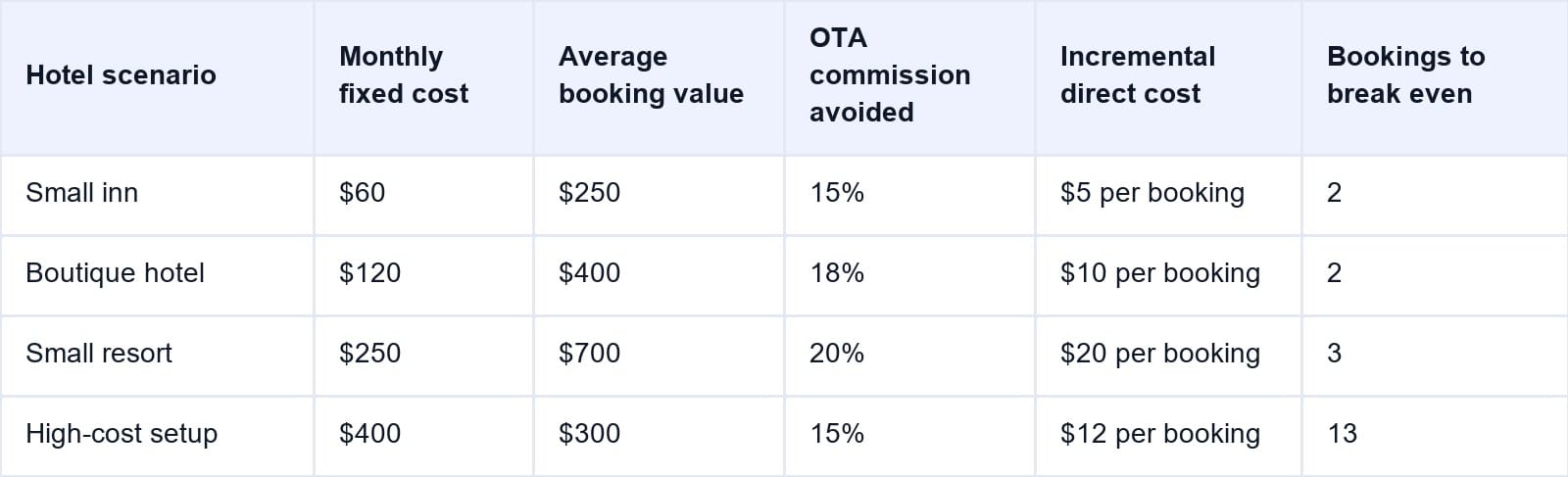
In the boutique-hotel scenario, the gross commission avoided is $72: $400 multiplied by 18%. After $10 of incremental direct cost, the hotel retains $62. A $120 fixed monthly cost is therefore covered after two shifted bookings because $124 exceeds the subscription.
The high-cost scenario behaves differently. A $300 booking at a 15% commission avoids $45. After $12 of direct cost, the net saving is $33. A $400 monthly setup needs 13 shifted bookings, not nine, because owners must calculate with net rather than gross savings.
Smart Order’s commission-free hotel booking engine connects website reservations to live PMS inventory. That makes the economic handoff traceable: a direct booking enters the operating calendar, availability updates, and the reservation source remains available for channel reporting.
Measure Direct Bookings Against Real Channel Cost
Connect direct reservations with PMS inventory and channel reporting so you can calculate break-even volume from verified bookings.
Calculate Monthly Booking Engine ROI
Breaking even answers whether savings cover cost. ROI shows how far the result moves beyond that point:
Monthly net benefit = shifted bookings × net saving per booking − fixed monthly cost
Monthly ROI = monthly net benefit ÷ fixed monthly cost × 100
Suppose the boutique hotel above shifts eight bookings. Net savings are $496: eight multiplied by $62. After the $120 fixed cost, monthly net benefit is $376. Monthly ROI is about 313%.
Commission free booking engine ROI changes when booking value, commission, incentives, cancellations, or paid traffic change. Keep the inputs attached so an owner can audit the result.
Add First-Year and One-Time Costs
A monthly comparison can ignore setup. Include website, migration, training, tracking, payment configuration, and integration work required to launch.
Choose a reasonable evaluation period and spread those one-time costs across it:
Adjusted monthly fixed cost = recurring monthly cost + one-time launch cost ÷ evaluation months
If recurring cost is $100 and launch work costs $1,200, a 12-month evaluation produces an adjusted monthly cost of $200. At $50 net saving per shifted booking, break-even is four monthly bookings during the first year. In month 13, it falls to two if no new setup cost appears.
This is the more useful commission free booking engine ROI number for a first-time implementation. For an engine already included in the PMS, use only the incremental cost of enabling and operating direct bookings. Do not charge the full PMS subscription to the engine if the hotel needs the PMS regardless.
Count Only Bookings the Engine Influenced
The hardest input is not commission rate. It is attribution. A reservation that would already have arrived by phone or email did not necessarily avoid OTA commission because of the new engine.
Separate direct bookings into three groups:
- Shifted bookings probably replaced an OTA reservation and create measurable acquisition-cost savings.
- Converted manual demand replaces phone, email, or inquiry handling; its value may be staff time and faster confirmation rather than OTA commission.
- Incremental bookings would not otherwise have happened; measure their contribution margin, not simply commission avoided.
Use a pre-launch baseline. Compare brand-search traffic, conversion, direct share, booking value, cancellations, and channel mix for comparable dates. Promo codes and source fields improve attribution.
Do not count every website reservation as a “new” direct booking. That overstates commission free booking engine ROI and makes future budget decisions less reliable.
Include Costs That Hide Behind “Free”
Read the software quote and payment agreement. A commission-free label can coexist with a subscription, per-room charge, payment markup, website plan, connector, support tier, or metasearch spend.
For each cost, ask whether it is fixed, variable, one-time, or already paid. Payment rates differ by market and transaction type; use the current rate card from your provider rather than copying a generic online figure. For example, Stripe publishes separate pricing for domestic, international, manually entered, and currency-converted payments.
Also value discounts and perks at cost, not menu price. A free breakfast may have a lower incremental cost than its advertised value, while a percentage room discount reduces revenue dollar for dollar.
Track the Result in Hotel Reports
A spreadsheet can approve the purchase, but connected reporting should verify the return. The reservation source, room revenue, discounts, cancellations, payment status, and stay dates need to remain consistent from booking to departure.
Use hotel reports and channel analysis to compare direct and OTA results by stay month, not only booking date. Review average booking value, cancellation rate, length of stay, and net channel cost. A direct channel with lower commission but heavy discounting is not automatically more profitable.
Run the calculation monthly for the first quarter. After that, a quarterly review may be enough unless software pricing, OTA terms, paid-media spend, or direct offers change.
When a Booking Engine Is Not Yet Worth It
Commission free booking engine ROI may remain weak when the property has almost no website traffic, no repeat guests, no direct-demand strategy, low booking values, expensive integration, or a website that performs poorly on mobile.
That does not mean the hotel should stay OTA-only forever. It means the engine needs a demand plan and an operational owner. Improve room content, mobile booking flow, brand search visibility, repeat-guest outreach, and rate presentation before assuming the software will create demand by itself.
An OTA can still deliver valuable incremental reach. The goal is not to remove every OTA booking. It is to keep the bookings that justify their acquisition cost while making direct booking easy for guests already looking for your property.
A 30-Day Owner Check
Before signing, rebuild the formula with your last three OTA statements and the vendor’s complete quote. After launch, test one direct reservation, modification, cancellation, refund, and reporting cycle.
At the end of 30 days, answer five questions:
- How many direct bookings were genuinely shifted, converted from manual demand, or incremental?
- What was the net saving per shifted booking after variable direct costs?
- Did the direct booking enter the PMS and update availability correctly?
- Did direct discounts or paid traffic consume more savings than expected?
- How many additional shifted bookings are needed to reach first-year break-even?
If the hotel cannot answer those questions from booking records and invoices, it is too early to claim a positive return.
Frequently Asked Questions
How many direct bookings make a commission-free engine worthwhile?
Divide all-in fixed monthly cost by the net saving per shifted booking and round up. A $120 cost with $62 net saving requires two bookings. A $400 cost with $33 net saving requires 13.
Should payment fees be subtracted from commission savings?
Subtract only the payment-cost difference created by moving the reservation direct. Depending on the OTA payment model, the hotel may already pay or indirectly absorb payment costs on the OTA booking.
Is every direct booking an OTA booking saved?
No. Some would have arrived by phone, email, or the previous website flow. Use source tracking and a pre-launch baseline to estimate which reservations actually shifted from an OTA.
Is a bundled booking engine free?
It may have no separate subscription or commission, but implementation, payments, website work, marketing, and staff time can remain. Use incremental costs instead of allocating the entire PMS price without justification.
How often should owners calculate ROI?
Review monthly during launch, then quarterly when the channel mix is stable. Recalculate whenever software fees, OTA commission, direct incentives, payment pricing, or advertising spend changes.
The Owner’s Decision Rule
A commission-free booking engine is worth it when verified net savings from influenced direct bookings exceed the full cost of operating the channel. The smallest reliable calculation uses four inputs: fixed cost, average booking value, effective OTA commission, and incremental direct cost.
Start with conservative attribution. Use net savings rather than gross commission, spread launch costs across the evaluation period, and keep OTAs where they deliver profitable reach. That produces a commission free booking engine ROI figure an owner can defend—not just a larger direct-booking count.