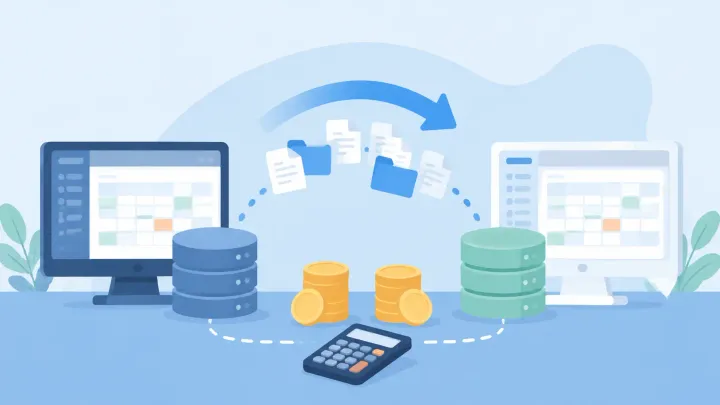
1. Hotel PMS data migration cost is rarely a single line item — it accumulates across five data categories: reservation history, guest profiles, rate plans, room types, and OTA channel mappings
2. The most expensive migration scenarios involve vendors who charge for data export AND receiving vendors who charge for import — paying twice for the same data to move once
3. Overlap subscription costs, staff retraining time, and OTA remapping downtime are migration costs that never appear in a vendor's migration quote
4. The best way to control migration cost is to clarify data portability and export format before signing the outgoing contract — not after you have decided to leave
Why Migration Costs Are Hidden Until You Are Already Committed
Hotel PMS data migration cost is easy to underestimate because it is invisible at the point of purchase. When you sign with a new platform, the migration cost feels like a future problem. When you decide to switch, the migration cost is suddenly real and largely non-negotiable.
The outgoing vendor has leverage. Your data is inside their system. Getting it out in a usable format — rather than a proprietary export that requires expensive conversion — depends on what they agreed to when you signed, which is usually not much. Most standard hotel PMS contracts do not guarantee export format, export timeline, or export cost.
Understanding the five data categories that carry migration costs — and what determines the cost of each — gives you the information you need to negotiate before you are committed, not after.
The 5 Data Categories and Their Migration Costs
1. Reservation History
Historical reservation records are the most valuable data in your PMS and often the most expensive to move. Guest booking patterns, revenue history, and stay records are what feed reporting and inform rate decisions in a new system.
Migration cost for reservation history depends on: how many years of records you want to import, whether the outgoing system exports in a standard format (CSV, JSON) or a proprietary schema requiring conversion, and whether the incoming system charges an import fee or does this as part of onboarding.
Typical cost range: $300 to $800 for a standard import of two to three years of reservation history at an independent property. Proprietary format conversion adds $200 to $600 in technical preparation. Some vendors do not import reservation history at all — you access historical records only through the old system or a read-only archive for a period after switching.
Ask the incoming vendor: what reservation history can you import, in what formats, and what does it cost?
2. Guest Profile Data
Guest profiles — names, contact details, stay history, preferences, loyalty notes, and any custom fields your staff has maintained — are the relationship layer your team has built over time. Losing this data means losing the context behind returning guests.
Export is the first hurdle. Some outgoing PMS platforms export guest data cleanly as a CSV with standard field mappings. Others export in formats with proprietary field names that require manual remapping before the incoming system can ingest them. GDPR adds a complication for EU guest data — confirm that the export process is compliant and that the receiving system's import procedure does not create a data residency issue.
Typical cost range: $150 to $500 for profile import, more if significant field remapping is required. If your current system does not have a guest data export function at your plan tier, you may need to upgrade temporarily just to access your own records.
Own Your Data From Day One
Smart Order provides full guest data export in standard formats at any plan level. No export fees, no proprietary lock-in — your guest records belong to you.
3. Rate Plans and Room Types
Rate plans and room type configurations are operational data — the structures that define how your property is sold across every channel. Moving them to a new PMS is not a simple import. It is a reconfiguration exercise that requires someone who understands your rate strategy to validate each entry.
Room types need to be rebuilt in the new system with matching names, descriptions, capacities, and availability rules. Rate plans — standard rates, derived rates, package rates, OTA-specific rates, promotional rates — need to be recreated and reviewed for accuracy before going live.
This category has no standard import format. Even if your outgoing vendor exports a rate plan list, the incoming system will not simply ingest it. Budget for staff time rather than a vendor fee: reconfiguring rate plans and room types for a 30-room property with six room categories and 10 to 15 active rate plans typically takes 8 to 15 hours of operational work from someone who knows the rate structure well.
4. OTA Channel Mappings
Every OTA connection needs to be remapped when you switch PMS systems. The new PMS channel manager uses different room type IDs and rate plan codes than the old one. Until the mapping is correctly rebuilt in the new system and tested, your OTA availability is either offline or unreliable.
OTA remapping is where migration creates operational cost beyond the vendor invoice. Downtime on channel connections during the switch window means reduced distribution, which means lost bookings. The connection rebuild process for Booking.com, Agoda, Expedia, and Airbnb typically takes two to five business days per channel when done correctly, including testing sync behavior before going fully live.
Some PMS vendors include OTA remapping assistance in the onboarding fee. Others hand you documentation and expect your team to complete the process. Clarify this scope before signing — the difference between guided remapping and self-service remapping is material for a property with six to eight active OTA connections.
5. Historical Reporting Data
Historical revenue reports, occupancy trends, and channel performance data held inside the old PMS may not migrate at all. Most incoming systems will import reservation records — from which they can reconstruct some reporting — but they cannot replicate the exact reporting views, date filters, and channel breakdowns your team has been using.
Plan for a reporting gap period of one to three months while the new system accumulates its own data. If you need historical reporting for ownership review or bank reporting, export that data from the old system in full before your contract ends. Some vendors charge for data retention after cancellation — confirm how long historical access persists post-termination and whether that access costs anything.
Where Double-Payment Happens
The most common form of double-payment in a hotel PMS switch is the overlap subscription period. Most hotels cannot cut over from one system to the other in a single day. A two to four week parallel-running period — where both systems are active while the team trains on the new one — means paying two subscriptions simultaneously.
For a switch with a 30-day notice period on the outgoing contract and a 14-day go-live timeline on the incoming system, the overlap cost is one to two months of the old subscription plus the first month of the new one.
The second form of double-payment is data preparation labor. If the outgoing vendor's export requires cleaning, reformatting, or field remapping before the incoming vendor can import it, your team pays in hours — or you pay a third party to prepare the data. This cost is real even when neither vendor charges a named migration fee.
How to Negotiate Migration Costs Before You Sign
The time to address migration costs is when you are signing with any PMS — outgoing or incoming — not when you are trying to leave.
Before signing with any hotel PMS vendor, confirm in writing:
- On the outgoing side: What does a full data export cost, what formats are available, how long does access to historical data persist after cancellation, and is there a termination notice requirement that extends the subscription past your intended switch date?
- On the incoming side: What data categories can you import, in what formats, what does import cost per category, and what OTA remapping support is included in the onboarding fee?
A vendor that answers all of these questions clearly before you sign is demonstrating the operational transparency you should expect once you are live. A vendor that defers data portability questions to "after you are set up" is creating a future leverage point.
Hotel PMS Data Migration Cost FAQs
What does hotel PMS data migration typically cost?
Total hotel PMS data migration cost for an independent property typically ranges from $500 to $2,500 depending on data volume, export format, import fees, and OTA remapping support. The range reflects whether both vendors charge separately for export and import, and how much manual data preparation is required between the two systems.
Can I take my reservation history when I switch hotel PMS systems?
Usually yes, but the format and cost depend on the outgoing vendor's export capability. Standard formats like CSV can typically be imported into most incoming systems. Proprietary export formats require conversion work that adds time and cost. Confirm export format and cost before signing any PMS contract.
How long does OTA remapping take when switching hotel PMS systems?
OTA channel remapping typically takes two to five business days per major channel, including testing. A property on six OTA channels should plan for a one to two week remapping window where channels are rebuilt and tested before going fully live on the new system. Some incoming vendors include guided remapping in their onboarding fee — confirm this scope before signing.
What is the overlap cost when switching hotel PMS systems?
Overlap cost is the period when both the old and new PMS subscriptions run simultaneously during transition. Most switches carry a two to four week overlap, meaning one to two months of the old subscription cost is paid in addition to the first month of the new system. Minimizing this window requires a clear go-live timeline agreed with the incoming vendor before giving notice to the outgoing one.
What guest data can I move to a new hotel PMS?
Most hotel PMS platforms can export guest names, contact details, and stay counts. Custom profile notes, loyalty status, and preference fields vary — some export cleanly, others require manual remapping. GDPR requires that any transfer of EU guest data be handled under appropriate legal basis and data transfer mechanisms. Confirm the outgoing vendor's GDPR-compliant export process before initiating a migration.
Transparent Migration — No Export Fees, No Lock-In
Smart Order provides full data export at any plan level with no termination fees and month-to-month flexibility. Switching in or switching out should never cost you your own data.