
1. “Hotel PMS transaction fee” is not a standard term. It may describe a software fee, booking charge, payment-processing cost, or another percentage tied to reservation value.
2. Identify the trigger, calculation base, payer, refund treatment, and invoice owner before comparing percentages.
3. Measure every charge against net booking revenue and contribution profit, not only the PMS subscription price.
4. A low monthly plan can become expensive as booking or payment volume grows, while a higher fixed plan may be easier to forecast.
A hotel PMS transaction fee can quietly change the economics of a software contract. The problem is not only the percentage. The same label may refer to a reservation created in the PMS, money collected through a payment service, a direct booking, or a distribution charge.
Those events are different and should not be combined. To understand which charges affect profit, trace each fee from the guest's booking source through payment and settlement, then compare the hotel's retained revenue after every deduction.
What Is a Hotel PMS Transaction Fee?
A hotel PMS transaction fee is a variable charge connected to activity recorded or completed through hotel software. Depending on the contract, the trigger could be a confirmed reservation, a successful card payment, a booking-engine conversion, or another billable event.
The phrase alone does not reveal who charges it. A PMS vendor, payment processor, booking platform, or integration provider may each invoice a transaction-related cost. It also does not reveal the calculation base. The fee might apply to room revenue, taxes, add-ons, deposits, the amount collected, or a fixed number of transactions.
Ask the vendor to replace “transaction fee” with a complete sentence: who charges what amount, when, against which value, and what happens after a cancellation or refund. That sentence is far more useful than a headline percentage.
Five Charges Hotels Commonly Mix Together
The categories below may appear in one connected booking workflow, but they buy different services and belong in different parts of the profit calculation.
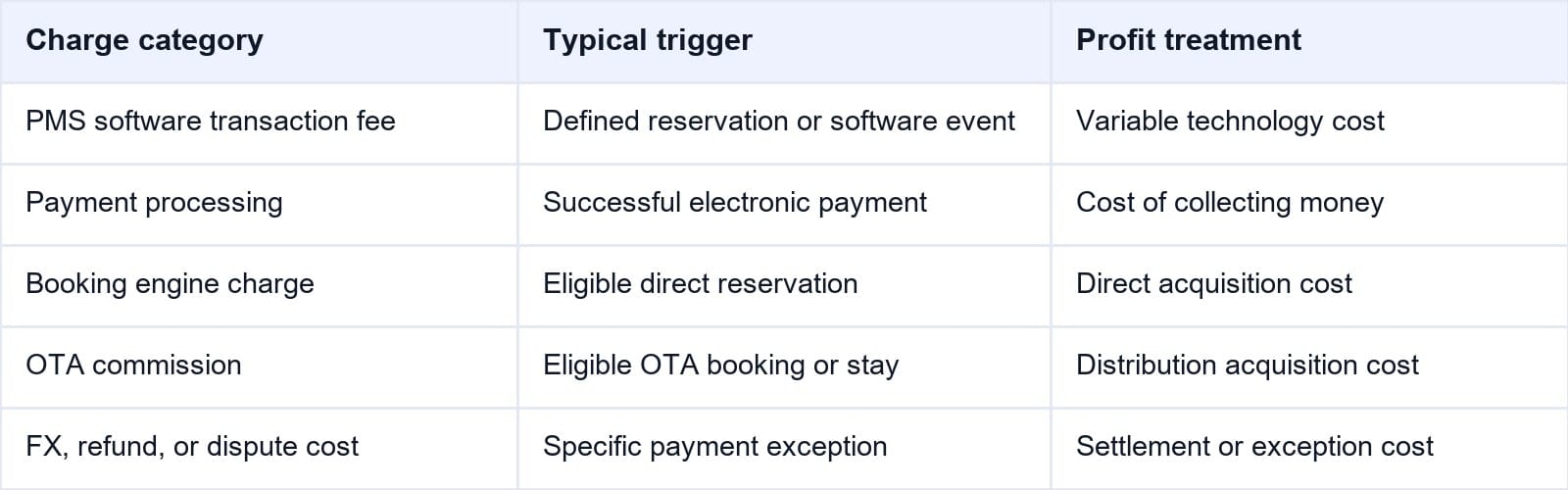
The most important distinction is between software use and movement of money. A reservation can enter the PMS without an online payment. A card payment can be processed for an OTA, direct, walk-in, or phone booking. If a contract charges for both events, the hotel must model both lines.
OTA commission should also remain separate. It pays for access to demand through a distribution channel, whereas a hotel PMS transaction fee pays for software activity defined in the PMS agreement. Combining the two hides which channel or tool is responsible for the margin reduction.
Smart Order's connected workflow makes it easier to follow the reservation source, payment record, and reported revenue together. That operational context helps a hotel investigate a cost without treating every deduction as the same fee.
See the Booking and Revenue Flow Clearly
Bring reservation sources and operating records into one workflow so your team can compare gross booking value with the revenue retained after external charges.
Which Transaction Charges Affect Profit Most?
Every mandatory charge reduces profit, but percentage-based fees become more important as revenue grows. A fixed monthly subscription stays predictable. A variable fee rises with the value or number of eligible reservations even when the hotel does not add rooms, users, or features.
Payment-processing costs can be large in total because they apply whenever the hotel collects eligible electronic payments. They are a cost of moving money rather than a pure software cost. Card type, payment method, country, currency conversion, manual entry, disputes, and refund rules can change the effective rate.
Booking-related fees deserve a channel-level view. A direct reservation may avoid OTA commission but still carry website marketing, booking technology, and payment costs. It can remain more profitable than an OTA booking, yet “direct” should never be treated as automatically free.
Event fees matter less frequently but can be expensive when unmanaged. Chargebacks, failed settlements, currency conversion, instant payouts, refunds, and manual payment handling may not appear in the standard percentage shown on a pricing page.
Calculate the Effective Transaction Cost
Use annual volume rather than one sample reservation. The basic calculation is:
Effective transaction cost = total variable booking and payment charges ÷ eligible booking revenue × 100
Then calculate the full technology cost:
Annual PMS-related cost = subscription + required modules + variable software fees + payment costs + implementation and integration costs
Consider a hypothetical independent hotel comparing two proposals against $300,000 of eligible annual booking revenue. Plan A costs $150 per month plus a 0.6% variable software charge. Its annual software total is $1,800 plus $1,800, or $3,600. Plan B costs $260 per month with no equivalent variable software line, for $3,120 annually.
Plan A looks $110 cheaper each month, but costs $480 more at that revenue level. The break-even point changes if eligible revenue falls, the fee excludes some bookings, or other required modules differ. This is why the hotel must model the exact contract rather than assuming fixed or variable pricing is always better.
Do not mix payment processing into the example unless both proposals use the same payment method and fee schedule. Otherwise, compare software economics first and payment economics second, then combine them in the final total.
Test the Fee Against Contribution Profit
Revenue is not profit. A $500 reservation may include tax, breakfast, cleaning, or another component that does not contribute equally to room margin. If a fee applies to the entire booking value, its effect can be larger than the headline rate suggests.
Start with room and ancillary revenue, then subtract discounts, distribution commission, transaction charges, payment costs, and variable operating expenses. The remaining contribution shows what the booking adds before fixed hotel costs.
This comparison can change channel decisions. A higher-cost channel may still be valuable when it produces incremental demand on nights that would otherwise remain empty. A lower-fee source may be less attractive if it creates cancellations, manual reconciliation, or support work that is not visible on the invoice.
Use reports and analysis to separate booking sources and revenue periods. When the source and amount are visible, management can attach the correct external costs and compare net performance instead of relying on gross revenue alone.
Read the Contract Before Comparing Percentages
A quoted rate is incomplete until the hotel understands its scope. Ask for written answers to these questions:
- What exact event triggers the charge: reservation, modification, payment, settlement, stay, or payout?
- Which value is used: room revenue, total booking value, taxes, add-ons, deposit, or amount collected?
- Does the charge apply to OTA, direct, walk-in, phone, imported, and manually entered reservations?
- Is there a fixed charge in addition to the percentage, and are minimum monthly fees involved?
- What happens after cancellation, partial refund, full refund, no-show, dispute, or failed payment?
- Which company invoices the fee, and where can the hotel reconcile it to reservation and settlement records?
Also check whether the rate changes at renewal or after a volume threshold. A promotional price can distort the first-year comparison if the standard rate applies once the hotel has committed its workflows and guest payment process.
Avoid Double Counting the Same Booking
One guest stay can create several legitimate costs: acquisition, software, payment collection, currency conversion, and an exception such as a dispute. The goal is not to call every charge unfair. It is to ensure each charge appears once under the correct owner.
Build a reservation-level audit for a small sample from each source. Start with the gross amount, identify the channel manager source, match the payment in the payment solution, and reconcile the amount settled to the bank. Record every deduction between those points.
Repeat the audit for a direct booking, an OTA booking, a walk-in payment, a refund, and an international card. These cases reveal whether the pricing model affects all revenue equally or only specific paths.
The audit also exposes duplicate assumptions. For example, staff may attribute a processor charge to the PMS because it appears beside a PMS payment record. Recording the vendor and invoice source prevents that error.
Reduce Fee Leakage Without Hurting Conversion
The cheapest payment or booking path is not useful if guests abandon it or staff cannot operate it reliably. Cost reduction should preserve a smooth booking and payment experience.
Begin by removing avoidable duplication. Do not pay separate tools for the same reservation handoff when one connected workflow is sufficient. Review whether optional instant payouts, currency services, premium fraud products, or unused integrations are delivering measurable value.
Then improve channel mix with evidence. Use a booking engine to capture direct demand while continuing to use OTAs where they generate profitable incremental stays. Compare net contribution by source rather than moving every booking toward one channel by policy.
Finally, negotiate with annual evidence. Bring eligible revenue, transaction count, average booking value, card mix, dispute frequency, refund volume, and growth projections. Providers can evaluate a clear volume profile more effectively than a general request for a lower rate.
Compare Hotel Revenue After Every Deduction
Connect booking sources with reservation and revenue records, then evaluate each channel and payment path using the costs that actually apply.
FAQ About Hotel PMS Transaction Fees
Are PMS transaction fees the same as payment-processing fees?
Not necessarily. A PMS fee relates to a billable software event defined by the PMS contract. A processing fee relates to collecting or moving money. They may appear in one workflow but should be modeled separately.
Do transaction fees apply to every reservation?
It depends on the agreement. Some charges apply only to eligible bookings, payment methods, or sales channels. Confirm the trigger and exclusions in writing.
Are refunded payment fees returned?
Policies vary. A hotel may refund the guest while retaining some original processing or currency costs. Review the provider's current refund terms and model normal cancellation behavior.
How should a hotel compare a fixed plan with a variable plan?
Calculate both over 12 months using expected eligible revenue and transaction volume. Add required modules and keep payment costs consistent before comparing the totals.
What metric best shows the profit impact?
Use net contribution per reservation and effective transaction cost as a percentage of eligible revenue. Review both by booking source, payment path, and month because the mix changes over time.