1. A hotel channel manager syncs your availability, rates, and restrictions across every OTA in real time — so guests always see accurate listings, and OTAs rank you higher for it.
2. Hotels listed on multiple channels consistently achieve 30–40% higher occupancy than single-channel properties.
3. Rate parity inconsistencies trigger automated penalties from Booking.com and Expedia — a channel manager prevents them.
4. When a channel manager is built into your PMS, reservation data flows into reporting without manual exports or cross-platform reconciliation.
What a Hotel Channel Manager Actually Controls
When a guest visits Booking.com and searches for hotels in your city, three things determine whether your property appears — and how high. Availability accuracy, rate consistency, and listing reliability. A hotel channel manager controls all three.
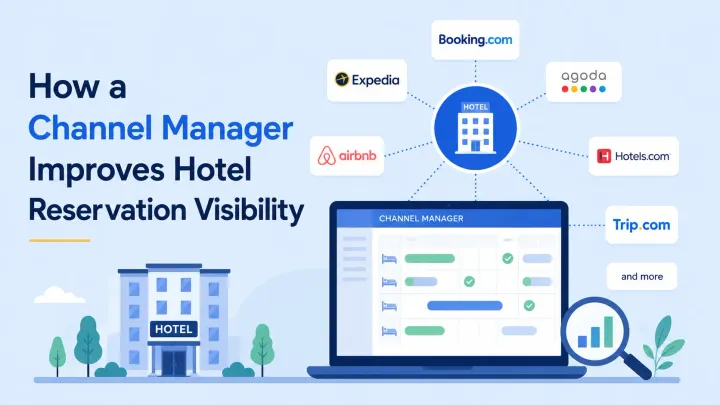
At its core, a channel manager connects your hotel's inventory to every online travel agency (OTA) you're listed on — Booking.com, Expedia, Agoda, Trip.com, Airbnb — and pushes updates in real time. When you sell a room, every connected channel closes that availability within seconds. When you adjust your nightly rate, every platform reflects it simultaneously. When you block dates for a private event, the restriction applies everywhere at once.
Without a channel manager, each of those actions requires you to log into every OTA separately. At two channels that's inconvenient. At five it's a full-time job. And the gap between your update and the OTA's display is where double bookings and rate inconsistencies happen.
Real-Time Sync: The Direct Link to OTA Ranking
OTA algorithms rank hotels based on several factors. Pricing competitiveness and review scores get most of the attention. But technical reliability — specifically, how accurately and quickly your availability data updates — is a ranking signal that most hotel operators underestimate.
When your hotel accepts a booking and then cancels it because the room was already sold on another platform, Booking.com registers that as a reliability failure. Do it repeatedly and your listing drops in search results. The same applies to availability discrepancies: if a guest tries to book a room that your OTA listing shows as available but your system has already sold, the OTA treats that as an inventory error and adjusts your ranking accordingly.
A hotel channel manager eliminates both problems. Every booking that confirms on one OTA triggers an instant availability update on all others — via direct API connections, not scheduled syncs with 15–30 minute delays. Your listing stays accurate, your cancellation rate stays low, and your OTA ranking reflects that reliability.
More Distribution Channels, More Guests Find You
The simplest visibility argument for a hotel channel manager is distribution reach. A guest who searches for hotels in your destination on Expedia can only book your property if you're listed there. If you're only on Booking.com, that guest doesn't find you at all.
The practical challenge is that managing active listings on five or more OTAs manually — updating calendars, rates, and minimum-stay rules across each platform after every booking — is not realistic. It's the primary reason most independent hotels stick to one or two channels and leave occupancy on the table.
A channel manager removes that constraint. Adding a new OTA connection doesn't add operational overhead. You manage rates and availability once, from your central dashboard, and every connected platform updates automatically. For hotels targeting both domestic and international travelers, this means being present on Booking.com for European guests, Agoda and Trip.com for Asian markets, and Expedia for US travelers — simultaneously, without a proportional increase in administrative work.
Rate Parity and Why OTAs Penalize Inconsistency
Most hotels know rate parity matters. Fewer understand exactly how OTAs enforce it.
Booking.com and Expedia use automated crawlers that monitor your rates across every distribution channel, including your own website. When they detect that you're offering a lower rate elsewhere — even by a small margin — they can suppress your listing in search results, add a "you can find this cheaper elsewhere" warning to your page, or reduce your placement in promotional campaigns.
A channel manager enforces rate parity automatically. When you change a rate in your central system, every connected OTA reflects the update simultaneously. You don't manually reconcile prices across platforms. You don't discover a rate discrepancy three days after it went live. The system maintains consistency as a default — not as a manual task you have to remember.
This matters beyond compliance. Consistent pricing builds guest trust. A traveler who sees your hotel priced at €120 on Booking.com and €140 on your own website doesn't book — they abandon the search. Rate parity isn't just an OTA requirement; it's a conversion factor.
How a Hotel Channel Manager Works With Your PMS
A hotel channel manager that operates as a standalone tool creates an integration problem. Your Property Management System (PMS) holds the authoritative record of reservations, room assignments, and guest data. Your channel manager controls what OTAs see. When these systems communicate through a third-party connection — or, worse, when staff manually transfer data between them — errors accumulate.
The most effective setup is a hotel channel manager that's built directly into your PMS. When a reservation confirms on Booking.com, it appears in the same dashboard where your front desk manages check-ins and your revenue manager tracks occupancy. The revenue data updates in real time. You can see which OTA generated each booking, compare channel performance by month, and identify which platforms drive your highest ADR — without exporting a spreadsheet or logging into each OTA's extranet.
Smart Order integrates the channel manager, PMS dashboard, booking engine, and reporting into one system. A reservation from Agoda triggers the same dashboard update as a walk-in. Your room availability, revenue figures, and channel performance all live in one place — updated the moment any booking confirms.
Connect All Your OTA Channels in One System
Smart Order's built-in hotel channel manager syncs Booking.com, Airbnb, Agoda, and Trip.com in real time — with reservations flowing directly into your PMS dashboard.
What to Look for in a Hotel Channel Manager
Not every hotel channel manager is built the same way. These three criteria determine whether a platform actually improves your reservation visibility or just adds another tool to manage.
Real-Time Two-Way API Connections
The connection type is not a technical detail — it's the operational foundation. Direct API connections push availability and rate updates to OTAs within seconds of any change. iCal-based connections sync on a schedule, typically every 15–30 minutes. For a hotel running at high occupancy, that delay is long enough for a double booking to occur during a peak weekend. Confirm that every OTA integration uses a direct two-way API before committing to any platform.
OTA Coverage That Matches Your Markets
A channel manager is only as useful as the OTAs it connects to. Most independent hotels need Booking.com and Expedia as a minimum. Properties targeting Asian travelers need Agoda and Trip.com. Hotels running on Airbnb for short-term stays need that connection as well. Verify the specific OTA list — not the total number of "supported channels," which often includes low-traffic platforms that don't contribute meaningful bookings.
Native Integration With Your PMS
Standalone channel managers introduce a sync layer between your distribution and your operations. Every additional integration point is a potential failure point. A channel manager built into your PMS eliminates that layer entirely — reservations, availability, and revenue data all operate from the same system without a third-party bridge.
Hotel Channel Management Built Into Your PMS
Smart Order connects to every major OTA with real-time two-way sync — no third-party bridge, no manual reconciliation, one flat per-room rate.
FAQ
How does a hotel channel manager improve OTA ranking?
OTA algorithms factor in inventory accuracy and reservation reliability when ranking hotel listings. A channel manager maintains real-time availability across all connected platforms, which reduces cancellations caused by double bookings and prevents inventory discrepancies. Both of these improve your standing with OTAs like Booking.com and Expedia, which translates directly to higher placement in search results.
What is the difference between a hotel channel manager and a PMS?
A Property Management System (PMS) is the operational core of your hotel — it manages reservations, room assignments, guest data, payments, and reporting. A channel manager connects your hotel to OTA platforms and keeps availability and rates synchronized in real time. They serve different functions, but work best when integrated into a single system so reservation data flows directly from OTA booking into your operational dashboard without manual steps.
Does a hotel channel manager help with direct bookings?
Yes, indirectly. By managing OTA distribution efficiently, a channel manager frees your front desk from manual platform updates and gives your revenue team accurate data on which channels perform best. Many hotels use that insight to reduce reliance on high-commission OTAs over time and shift more bookings to their direct channel. Some all-in-one platforms include a direct booking engine alongside the channel manager, allowing guests to book without OTA commission.
How many OTAs should a hotel connect to?
Most independent hotels benefit from connecting to three to five OTAs that match their primary guest markets. For European-focused properties, Booking.com and Expedia are the starting point. Properties attracting Asian travelers should add Agoda and Trip.com. More channels increase visibility but also increase the importance of reliable real-time sync — without a channel manager, each additional OTA multiplies your manual workload.
What happens to OTA rankings if I don't use a channel manager?
Without a channel manager, manual calendar updates create availability delays across your OTA listings. During high-demand periods, those delays result in double bookings or availability errors that OTA algorithms register as reliability failures. Over time, repeated errors lower your placement in search results on platforms like Booking.com, reducing your visibility to travelers even if your pricing and reviews are competitive.