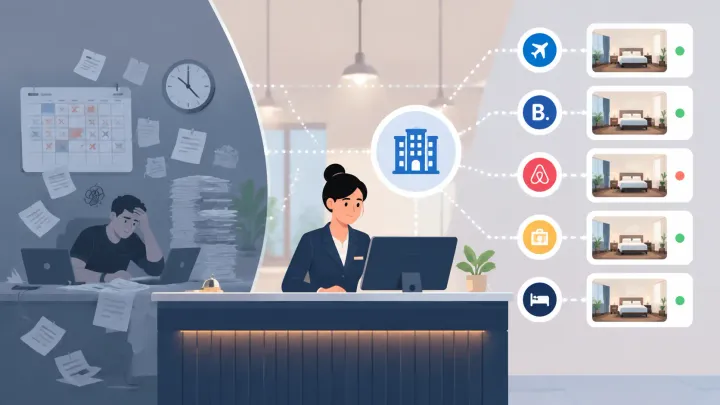
1. Multi OTA hotel operations become a manual burden without a central system for channel setup, rate changes, restrictions, and reporting
2. The solution is not fewer channels — it is a defined process for each operational layer, supported by a channel manager
3. Rate updates, restrictions, and stop-sell rules should be set once and pushed everywhere — managing them platform by platform is a liability
4. Reporting from multiple OTAs without aggregated data means your distribution decisions are based on incomplete information
Running your property on Booking.com, Agoda, Airbnb, and Expedia simultaneously is not the problem. The problem is managing four separate systems as if they were four separate jobs.
Every hotel that connects to multiple OTAs without a structured process ends up in the same place: rate updates half-done, restrictions applied on one platform but not another, and reporting that tells you what sold but not why. This article builds the process layer by layer — channel setup, rate management, restrictions, and reporting — so that multi OTA hotel operations stay manageable as you add channels.
Why Multi OTA Hotel Operations Default to Manual
The setup pattern is familiar. A hotel connects to Booking.com first, then Agoda, then Airbnb. Each platform has its own extranet, its own login, its own format for entering rates and restrictions. In the beginning, managing them one at a time feels fine.
The workload scale comes later. A long-weekend promotion means logging into three platforms and entering the same rate override three times. A last-minute minimum stay change for a peak period means opening three extranets and checking that each one saved correctly. A cancellation means re-opening inventory on every channel before the browse window closes.
The fix is not fewer OTAs — it is a structured operational process that reduces each task to a single action, executed once, applied everywhere.
Step 1: Channel Setup — Build the Foundation Before Going Live
Multi OTA hotel operations fail most often at setup: rooms mapped inconsistently, rate plans configured differently per channel, restriction defaults left at OTA-generated values. These gaps are expensive to correct after bookings arrive.
Room Mapping: Get It Right Once
Every OTA uses its own terminology and structure for room types. Before connecting a new channel, define a master room type list in your PMS or channel manager. Each physical room category — standard double, deluxe twin, suite — should have a canonical name, capacity, and rate base that gets applied consistently across all connected platforms.
When room mapping is done at the PMS level and pushed to OTAs, a change to a room type updates everywhere at once. When it is done manually per platform, any future change requires updating every extranet individually.
Rate Plan Configuration
Most hotels run multiple rate plans: best available rate, advance purchase, non-refundable, and promotional rates. Before activating channels, define which rate plans apply to which channels and in what relationship.
A non-refundable rate at 90% of BAR should be exactly that on every channel. Rate plan consistency is the foundation of rate parity — configure it at setup, not after guests have already seen the inconsistency.
Restriction Defaults at Setup
Every OTA auto-applies restriction defaults at connection — rarely optimized for your property. Before your first booking arrives, review and set:
- Minimum length of stay for your peak periods
- Stop-sell dates for already-committed inventory
- Advance purchase windows for your non-refundable rate
- Closed-to-arrival and closed-to-departure rules for calendar-adjacent high-demand nights
Setting these at connection means the channel behaves as intended from day one.
Step 2: Rate Changes Across Multiple Channels
Rate management is where multi OTA hotel operations generate the most manual work — and where the most revenue is lost when the process breaks down.
How Manual Rate Updates Break Down
The failure pattern is consistent. A rate decision gets applied to one or two channels before something else demands attention. By the time the remaining channels are updated, the rate window has passed. A guest who sees your room at $110 on Booking.com and $95 on Agoda for the same dates will book the cheaper rate — and may wonder why the pricing is inconsistent. Rate drift across OTAs is both a revenue problem and a trust problem.
A Rate Update Process That Scales
The working model for multi OTA hotel operations is: rate changes are entered once, into a single system, and distributed to all connected channels automatically.
This requires a channel manager with real-time OTA integration. When you set a rate in your central system, it pushes to every connected platform in seconds — no extranet logins, no inconsistencies from entering the same number in five different interfaces.
For properties without this, the minimum viable alternative is a rate update checklist: before any rate change is considered applied, every connected OTA must be checked off. This does not solve the speed problem, but it reduces the drift that comes from partially completed updates.
Sync Rate Changes to Every OTA Instantly
Smart Order's built-in channel manager pushes rate updates to Booking.com, Agoda, Airbnb, and more in real time — from one system, no manual steps required.
Step 3: Restrictions — Stop-Sell, Minimum Stay, and Close-Out Rules
Restrictions are one of the most underused tools in hotel revenue management, largely because applying them manually across multiple platforms creates enough friction that many hotels skip them entirely.
What Restrictions Are and When to Use Them
Restrictions control how and whether a room can be booked for specific dates:
- MinLOS (Minimum length of stay): Prevents single-night bookings on high-demand dates
- Stop-sell: Closes a room or rate plan when inventory is committed
- Closed-to-arrival (CTA): Blocks new check-ins on housekeeping-heavy dates
- Closed-to-departure (CTD): Prevents departures on specific dates to support stayovers
- Advance purchase window: Restricts a discounted rate to bookings made a defined number of days ahead
Used correctly, restrictions protect high-margin dates and reduce operational complexity. Used inconsistently — applied on some channels but not others — they create availability gaps that damage both revenue and OTA search rankings.
Applying Restrictions Without Opening Every Extranet
The operational standard for multi OTA hotel operations is central restriction management. A MinLOS rule for a holiday weekend should be set once and pushed to every connected OTA simultaneously — verified in one place, not checked across five extranets.
For properties managing restrictions manually, the practical rule is this: if you cannot apply a restriction consistently to every active channel within ten minutes, you are applying it partially — which is often worse than not applying it at all.
Step 4: Reporting Across Multiple OTAs
Multi OTA hotel operations without consolidated reporting tell you what sold — not which channels are growing, which are underperforming relative to commission cost, or where your rate decisions are landing.
What to Track Across Channels
For each OTA channel, the operational minimum is:
- Booking volume by channel: Reservations per platform per period
- Revenue contribution by channel: Total room revenue booked through each OTA
- ADR by channel: Whether each platform produces bookings at your target rate
- Cancellation rate by channel: Channels with high cancellation rates warrant restriction adjustments
- Commission cost by channel: Net revenue after OTA fees, not gross booking value
Tracked weekly or monthly per channel, these numbers give you the data to expand on channels that perform and pull back from those that cost more than they return.
Building a Reporting Rhythm Without Manual Data Pulls
Each OTA's reporting lives inside its own extranet. Pulling the numbers across five platforms and reconciling them takes hours.
A channel manager with reporting integration consolidates this — booking volume, revenue, and channel performance flow into one dashboard from all connected OTAs. For properties without this, a simple shared spreadsheet with a fixed weekly template creates the consistent view that makes channel-level decisions possible.
What Multi OTA Hotel Operations Look Like With a Channel Manager in Place
Without a central system, the daily workflow looks like this: a team member opens multiple extranets, checks overnight bookings, updates availability on channels that do not sync automatically, fixes rates missed in yesterday's update, and checks messages across three inboxes. This repeats throughout the day.
With a channel manager: a booking arrives and availability closes everywhere in seconds. A rate change is entered once and distributes automatically. A MinLOS restriction is set in one place and applied to every connected channel. Reporting consolidates into a single view.
The channel manager removes the execution overhead. Your team still makes the decisions — the system handles the repetitive task of applying them everywhere.
Smart Order's cloud PMS includes a built-in channel manager that connects directly with Booking.com, Agoda, Airbnb, Trip.com, and other major OTAs. Rate updates, availability sync, and restriction management all operate from one system. Visit www.smartorder.ai to see how Smart Order handles multi OTA hotel operations for independent hotels.
Manage All Your OTAs From One System
Smart Order's built-in channel manager syncs rates, availability, and restrictions across Booking.com, Agoda, Airbnb, and more — in real time, from one place.
Multi OTA Hotel Operations FAQ
What is the biggest operational risk when managing multiple OTAs manually?
Overbooking is the most visible risk — a room booked on one platform before availability closes on others. The less visible risks are rate inconsistency, restrictions applied on some channels but not others, and reporting blind spots. All four compound as channel count increases.
Do I need a channel manager to run multiple OTAs?
At two channels, manual management is survivable. At three or more, the synchronization complexity — availability, rates, restrictions, and reporting across every platform — becomes difficult to manage without a central system. Most properties that switch to a channel manager report a significant reduction in staff hours spent on extranet tasks.
How should I structure rate plans across multiple OTA channels?
Define your rate plan hierarchy in your PMS or channel manager and push it to OTAs from there. Each rate plan (BAR, non-refundable, advance purchase, promotional) should have a consistent relationship to your base rate across all connected channels. This is the only scalable approach to rate parity as channel count grows.
What restrictions should every hotel apply when going live on a new OTA?
At minimum: a MinLOS for your peak periods, stop-sell dates for inventory already committed, and an advance purchase window for your non-refundable rate. Review the OTA's default settings before your first booking — defaults are almost never optimized for your property.
How do I report on OTA channel performance without logging into every extranet?
A channel manager with integrated reporting pulls booking volume, revenue, ADR, and commission cost from all connected OTAs into one view. For properties without this, a fixed weekly spreadsheet — one row per OTA, same fields each week — creates a consistent basis for channel-level decisions.