Self Check-In for Small Hotels Without a 24-Hour Front Desk (2026 Guide)
A 14-room guesthouse cannot staff a desk from midnight to six. Most don't, and most handle it badly — a lockbox with a code that never changes, or a phone number that wakes the owner at 1am. This guide covers what self check-in actually involves for a small property, the four workable models, what it costs, and which questions to ask before buying anything.
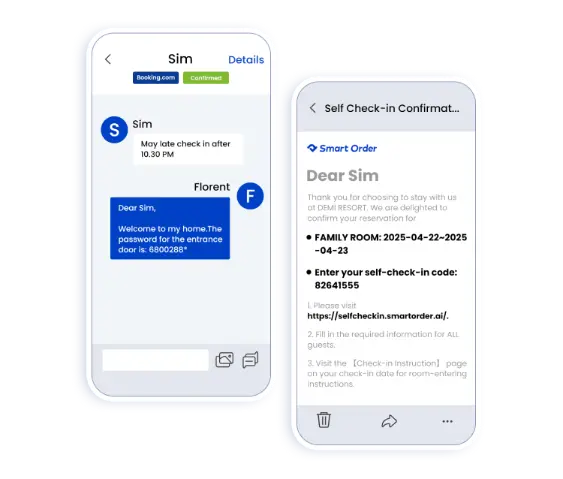
Smart Order is our own product. We have put our facts and our competitors' side by side from published sources, but you should read this as a vendor's comparison, not an independent one.
What is a hotel self check-in system?
Self check-in is the set of tools that lets a guest complete arrival without a staff member present. It usually has three parts, and they are often sold separately.
Identity and paperwork — collecting the guest's details, ID or passport scan, signature and any legally required registration, typically before arrival rather than at the door.
Payment — taking the balance, deposit or city tax without someone standing at a terminal.
Access — getting the guest into the building and their room. This is the part that needs hardware: a kiosk that dispenses a key card, a smart lock that opens to a code, or a mobile key on the guest's phone.
A system that does the first two but not the third has not removed the need for someone to be there. That distinction is the single most common source of disappointment in this category.
Why do small hotels go front-desk-less?
The obvious reason is cost — overnight cover for a small property is rarely justified by the volume of arrivals. But the reasons operators actually give tend to be different.
Late arrivals stop being a problem. A guest whose flight lands at 23:40 is a scheduling crisis under a staffed model and a non-event under self check-in.
The owner stops being on call. For owner-operated properties this is usually the real motivation.
Check-in stops competing with everything else. At a small property the person checking someone in is often also the person answering the phone and handling a housekeeping issue.
It is measurable. Mews, which publishes figures for its kiosk product, reports a three-minute average time to complete check-in and states that 30% of reservations are checked in via kiosk. Those are that vendor's own numbers for its own product, but they give a sense of what a mature deployment looks like.
The front-deskless models
Model 1: The conventional front desk
Worth naming as the baseline. Staff present, keys handed over, payment taken in person. It remains the right answer for properties with a restaurant, concierge expectations, or enough arrivals to justify the cover. Self check-in is not a universal upgrade.
Model 2: The lobby kiosk
A terminal in the lobby handles identity, payment and key issue. The guest still comes to a fixed point in the building, but no staff member has to be there.
Kiosks suit properties with a real lobby and a reliable power and network position for the hardware. They are the most familiar model to guests and the most visible reassurance that the property is legitimate. The tradeoff is cost and footprint: a kiosk is physical hardware that must be bought, sited and maintained, and it still needs a key-card encoder to be useful.
Model 3: Mobile check-in with a smart lock
The guest completes everything on their phone before arrival and opens the door with a code or a digital key. No lobby hardware at all.
This is usually the cheapest path for a small property and the most flexible — it works for scattered apartments and buildings with no lobby. The cost sits in the locks, which must be bought per door, and in compatibility: not every lock works with every PMS.
Model 4: The hybrid
Mobile check-in for guests who complete it in advance, with a kiosk or a staffed window as fallback. In practice most properties end up here, because some guests will not complete a pre-arrival flow and some arrivals go wrong.
Plan for the fallback before you plan for the happy path. The question "what happens when a guest arrives at 2am and the code doesn't work" has to have an answer that is not "the owner's mobile".
How self check-in works with your PMS
Self check-in is only as good as its connection to the property management system. The reservation has to be the source of truth, or you get a guest holding a valid code for a room that was reassigned.
The sequence that works: the reservation exists in the PMS · the guest completes identity and payment pre-arrival against that reservation · the PMS assigns a room · access credentials are issued for that specific room and valid only for the stay dates · the lock or kiosk honours them · the PMS marks the guest arrived and the room occupied, so housekeeping sees it.
Two integration details decide whether this is reliable. Are credentials time-bound to the stay? They should expire at checkout without anyone revoking them. And does room status flow back? If the PMS does not know the guest arrived, your housekeeping board is wrong by morning.
Vendors differ sharply in how specific they are about the hardware end. Mews publishes explicit lock compatibility — ASSA ABLOY Vingcard and Vostio, and Salto Space — with wallet-based keys requiring Vostio NFC locks. eviivo names 33 Lock and 4Suites among its smart-lock partners. Cloudbeds and RoomRaccoon describe door-lock connections and digital keys without naming a supported lock brand. Smart Order offers Smart Access integration covering key cards and smart locks but likewise does not publish the brands it supports.
If you already own locks, this is the first question to ask any vendor, and you want the answer in writing before you buy.
What does self check-in cost for a small hotel?
Three separate lines, and vendors rarely present them together.
The PMS capability. Whether self check-in is included in your plan or sits on a higher tier. Smart Order includes self check-in within its Professional plan at no extra cost, alongside housekeeping and multi-calendar; Professional is $5 per room per month with a five-room minimum. Elsewhere the pattern varies — Mews includes its kiosk from the entry tier but places Digital Key on the Advanced tier as a separate Marketplace add-on, while RoomRaccoon includes online check-in on all four of its plans.
The access integration. Smart Order prices key card and smart lock integration at $1 per room per month each. Treat any per-room software fee as recurring and multiply by your room count before comparing.
The hardware. Locks and kiosks are a capital purchase and the largest line by a wide margin. None of the vendors reviewed here states that its subscription price includes the physical locks — treat hardware as a separate capital line unless a vendor says otherwise in writing.
A realistic exercise: take your room count, multiply by the per-room software fees, add the PMS plan, and treat hardware separately with its own payback period. A ten-room property on Smart Order Professional with smart lock integration would be running $49 per month for the plan — a graduated volume discount begins at ten rooms — and $10 per month for the integration — with the locks themselves a separate purchase.
How do you evaluate a self check-in solution?
Ask which lock brands are supported, by name. "Works with smart locks" is not an answer. If the vendor cannot name models, assume compatibility is unproven for yours.
Check whether it is in your plan or above it. Self check-in is frequently a higher-tier feature. Confirm the tier before you price the hardware.
Test the failure path. Ask what the guest does at 2am when the code does not work, and what the property does when the internet is down. A system without a credible fallback transfers the 1am phone call rather than removing it.
Confirm room status writes back. Ask specifically whether a self check-in marks the room occupied in the PMS and whether housekeeping sees it.
Check your legal obligations. Several jurisdictions require guest registration or passport data, and some require it in a specific format. Verify that the pre-arrival flow satisfies your local rule before assuming it does.
Ask whether guests can opt out. Some will. Some should — a first-time guest with a language barrier and heavy luggage is not a self-service candidate.
Where I stand
Self check-in is oversold as a staffing replacement and undersold as a scheduling fix. It will not let a small property run with fewer people; the work moves rather than disappears, into pre-arrival messaging, exception handling and lock administration. What it does reliably is decouple arrivals from staffed hours, which for an owner-operated property is worth more than the headcount argument.
If you are starting, start with Model 3. Mobile check-in with smart locks costs least, requires no lobby, and can be piloted on two rooms before you commit the building. Add a kiosk only if guests visibly struggle or your arrival volume justifies the hardware.
And be skeptical of any comparison — including the cost framing above — that quotes software fees without the locks. The subscription is the small number.
Frequently asked questions
How much does self check-in cost for a small hotel?
Budget three lines: the PMS tier that includes self check-in, any per-room integration fee for key cards or smart locks, and the hardware itself. Smart Order includes self check-in within its Professional plan, with key card and smart lock integration at $1 per room per month each. Physical locks and kiosks are always a separate capital purchase.
Does self check-in work with any PMS?
No. The PMS has to issue access credentials tied to a specific reservation and room, and receive the arrival status back. Many platforms in this category publish no self check-in capability at all, so confirm it exists in your plan before planning around it.
Do I still need a front desk?
For most small properties, occasionally. The realistic model is hybrid: self check-in for guests who complete pre-arrival, with a fallback for those who don't. Plan the fallback first.
Is guest data safe at a self check-in kiosk?
It depends on where the data is stored and who can reach it, not on the kiosk. Ask where identity documents are held, for how long, who can retrieve them, and whether that satisfies your local data protection rules.
What happens if a guest arrives and the system is down?
This is the question to ask every vendor, and the one least often answered on a product page. You want a documented offline path — a mechanical override, a staff-issued code, or a reachable on-call number — and you want it before go-live, not after the first incident.
Can self check-in handle my legal guest registration?
Sometimes, and the requirements are local. Some jurisdictions require passport capture, some a specific report format, some submission to a police or tourism authority. Verify the specific obligation for your location against what the pre-arrival flow actually collects and submits.
How long does a self check-in rollout take?
The software side is usually days. The hardware side is the constraint: locks have to be ordered, fitted and paired per door, and that scales with room count. Pilot on two rooms before committing the building.