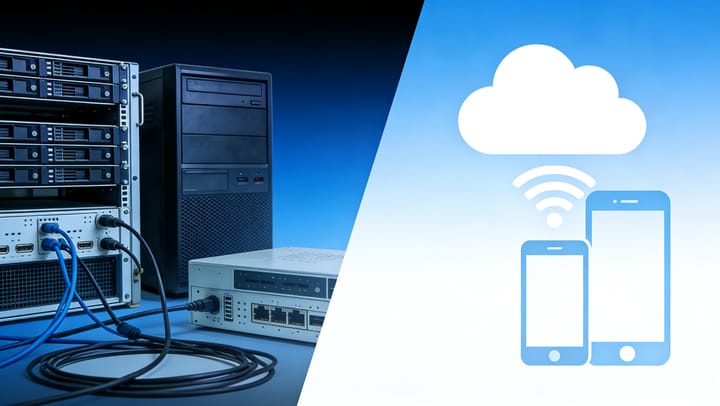
If you're evaluating a property management system for your hotel, you've likely come across two distinct categories: traditional on-premise PMS and cloud-based hotel PMS applications. Both handle the core functions of reservation management, check-in and check-out, and reporting. But the way they're built, deployed, and maintained is fundamentally different — and those differences have real consequences for how you run your property.
This article breaks down what separates a cloud hotel PMS application from a traditional system, which setup works better for different types of properties, and what to consider before making a decision.
What Is a Traditional Hotel PMS?
A traditional hotel PMS — also called an on-premise PMS — is software installed directly on local servers inside your property. The system runs on hardware you own and maintain, and all data is stored on-site.
Traditional PMS systems were the standard for decades, particularly in large hotels and resort chains. They offered robust functionality, deep customization, and the reassurance of having all data stored internally. They were designed for an era when internet connectivity was unreliable and cloud infrastructure didn't exist.
The trade-off: traditional systems come with significant upfront costs, require dedicated IT support, and are tied to a physical location.
What Is a Cloud Hotel PMS Application?
A cloud hotel PMS application runs on remote servers hosted by the software provider. Instead of installing software on local machines, you access the system through a web browser or mobile app. Data is stored and backed up in the cloud, not on hardware at your property.
Cloud PMS solutions have become the dominant choice for independent hotels, boutique properties, and growing hospitality operators over the past decade. They typically require no upfront hardware investment, update automatically, and can be accessed from anywhere with an internet connection.
Key Differences: Cloud PMS vs Traditional PMS
1. Deployment and Infrastructure
Traditional PMS requires physical servers installed at the property. This means purchasing server hardware, setting up a local network, and keeping that infrastructure running. If a server fails, the system goes down until it's repaired.
A cloud hotel PMS application eliminates this entirely. There is no on-site hardware to purchase or maintain. The provider handles all server infrastructure, redundancy, and uptime. If one server experiences an issue, traffic automatically routes to another — with no impact on your operations.
2. Cost Structure
Traditional PMS comes with a large upfront cost. Licensing fees, server hardware, installation, and staff training can run into tens of thousands of dollars for a mid-size property. Ongoing costs include hardware maintenance, IT staff, and periodic software upgrade fees.
Cloud PMS operates on a subscription model — typically billed monthly or annually, often per room. There's no large upfront investment. Costs are predictable, and smaller properties pay only for what they use. For independent hotels and boutique operators, this is often a decisive advantage.
3. Accessibility and Remote Management
Traditional PMS is tied to the local network. Staff must be on-site to access the system. If you want to check reservations while traveling or manage a property remotely, you're either out of reach or dependent on complex VPN setups.
Cloud PMS is accessible from any device with a browser and internet connection — a laptop at home, a tablet at the front desk, or a phone while offsite. For owners who manage multiple properties or travel frequently, this flexibility isn't a minor convenience. It fundamentally changes how the business can be run.
4. Updates and Maintenance
Traditional PMS updates require manual installation — often involving system downtime, IT coordination, and additional licensing costs. Major version upgrades can take days and are often deferred because of the disruption involved. The result: many hotels run outdated software for years.
Cloud PMS updates deploy automatically in the background. You log in the next morning and new features are already available. There's no installation process, no downtime, and no separate fee for upgrades. The system you have today is always the latest version.
5. Integration with OTAs and Third-Party Tools
Traditional PMS systems were built before the era of API-driven connectivity. Integrating with OTAs like Booking.com or Airbnb, payment gateways, or revenue management tools often requires expensive middleware or custom development. Connectivity is limited and integrations are slow to update.
Modern cloud hotel PMS applications are built API-first. They connect natively with major OTAs, channel managers, payment processors, and reporting tools. Smart Order's cloud PMS, for example, connects directly with Booking.com, Agoda, Airbnb, and Trip.com — syncing availability and rates in real time without manual intervention.
6. Data Security and Backup
Traditional PMS data lives on local servers. If the hardware fails, is damaged, or is lost in a fire or flood, that data may be unrecoverable unless a manual backup process was in place. Security depends on the property's own IT policies.
Cloud PMS providers handle data security, encryption, and automated backups at the infrastructure level. Data is replicated across multiple data centers, meaning a hardware failure at one location doesn't affect availability. For most independent hotels, cloud storage is more secure than anything they could implement internally.
7. Scalability
Scaling a traditional PMS typically means buying more hardware and potentially new licenses. Adding a second property requires a second installation. The infrastructure grows linearly with costs.
Cloud PMS scales without infrastructure changes. Adding rooms, staff accounts, or entirely new properties is handled through your account settings. The underlying infrastructure expands automatically. This makes cloud PMS the natural choice for growing operators managing multiple properties.
Side-by-Side Comparison
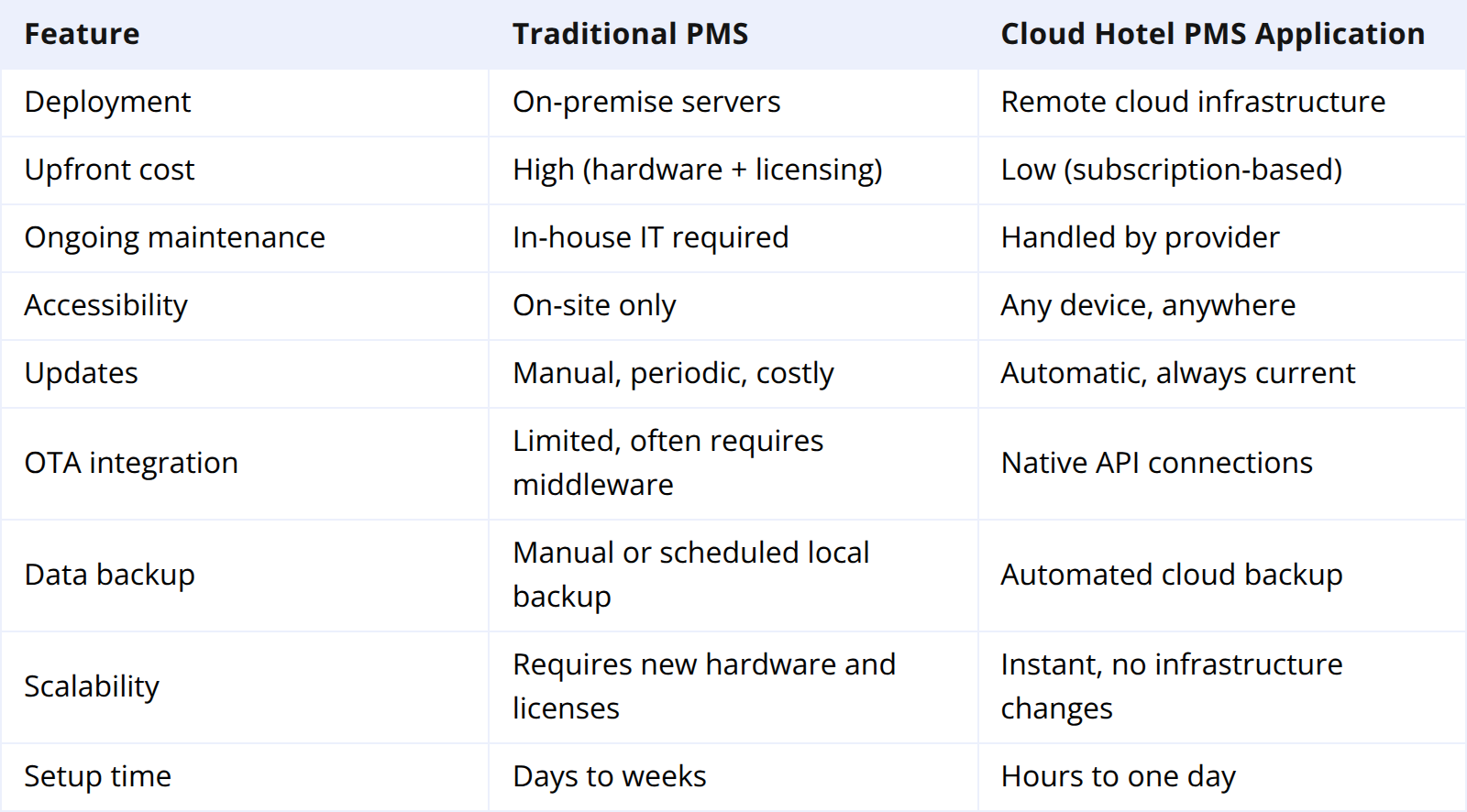
When a Traditional PMS Still Makes Sense
There are scenarios where an on-premise system remains relevant. Very large luxury hotels with complex, deeply customized workflows sometimes maintain traditional PMS for the control it offers over data and system behavior. Properties in locations with unreliable internet may also need a system that continues functioning offline.
But for the vast majority of independent hotels, boutique properties, guesthouses, and growing hospitality operators, cloud is the better fit. The cost, accessibility, and integration advantages are simply too significant to ignore.
What to Look for in a Cloud Hotel PMS Application
Not all cloud PMS products are built the same. When evaluating options, focus on these factors:
- Channel manager integration: Direct connections to Booking.com, Airbnb, Agoda, and other OTAs — not third-party middleware
- Real-time availability sync: When a booking comes in, all channels update instantly to prevent overbooking
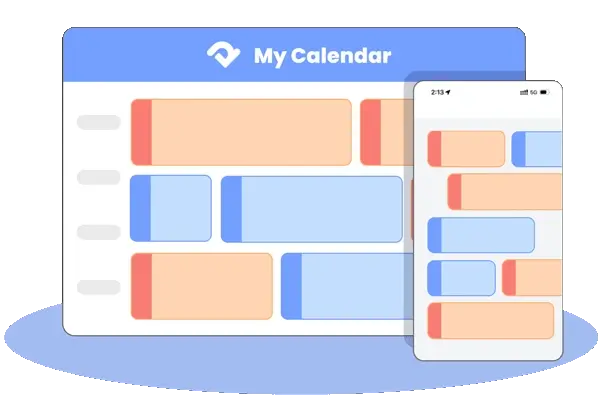
- Centralized reservation dashboard: All bookings from all sources in a single calendar view
- Mobile access: Full functionality from a phone or tablet, not just a desktop
- Pricing and rate management: Ability to update rates across all channels from one place
- Payment tools: Built-in payment links or direct integration with payment processors
- Onboarding speed: Able to get operational within a day, not weeks
FAQ
Can a cloud PMS work without a stable internet connection?
Cloud PMS requires internet access to function. However, most providers design for redundancy — if your main connection drops briefly, cached data often keeps the interface usable for short periods. For properties in areas with frequent outages, a backup internet connection (such as a mobile hotspot) is recommended.
Is switching from a traditional PMS to a cloud PMS disruptive?
The transition takes some planning, but a well-structured migration is not highly disruptive. Most cloud PMS providers offer onboarding support to import existing reservations and set up OTA connections. Many properties complete the switch in a single day, with a short validation period afterward to confirm everything is syncing correctly.
Are cloud PMS systems secure enough for guest data?
Reputable cloud PMS providers invest heavily in data security — encrypted connections, role-based access controls, automated backups, and compliance with data protection standards. For most independent hotels, cloud PMS offers stronger security than self-managed on-premise servers.
How much does a cloud hotel PMS application cost compared to traditional PMS?
Traditional PMS involves large upfront costs that can reach tens of thousands of dollars for a mid-size hotel, plus ongoing IT and maintenance expenses. Cloud PMS typically runs on a per-room monthly subscription, often starting under $10 per room per month, with no hardware investment required. Smart Order offers a free plan for basic operations and paid tiers starting at $5.00 per room per month.
Does a cloud PMS support multiple properties?
Yes. Cloud PMS platforms are built with multi-property management in mind. You can oversee reservations, occupancy, and rates across all your properties from a single account without separate installations at each location.
Looking for a cloud hotel PMS that connects your reservations, OTA channels, and operations in one place? Visit our PMS product to learn how Smart Order helps independent hotels and growing operators replace both spreadsheets and legacy systems.