1. For an independent hotel, the implementation budget should cover more than a vendor fee: internal labor, data preparation, training, testing, equipment, third-party connections, and a go-live reserve all matter.
2. A simple new property may use a $500-$1,500 planning allowance, while a typical 10-50 room hotel replacing an existing system may reserve $1,500-$5,000. These are budgeting scenarios, not universal vendor prices.
3. Complex migrations should be estimated from a work breakdown rather than a room-count average.
Hotel PMS implementation cost is easy to misunderstand. A proposal may show an onboarding or implementation charge, but that line is only one part of what it takes to launch a property management system successfully.
An independent hotel must also prepare operating rules, clean reservation data, train employees, test connected systems, and protect the go-live period from disruption. Smart Order does not charge an implementation fee, yet those practical launch activities still deserve a budget.
Implementation Fee and Implementation Cost Are Different
An implementation fee is money paid to the PMS provider for onboarding or professional services. Hotel PMS implementation cost is broader: it is the total value of cash expenses and staff time used to move from the current workflow to stable live operation.
That distinction prevents two budgeting errors. First, a $0 vendor fee should not be treated as a zero-effort launch. Second, a large implementation fee should not be assumed to include every device, integration, migration task, or employee hour.
Use three columns in the project budget: vendor charges, third-party charges, and hotel-controlled costs. Some vendor implementation charge is $0. The hotel-controlled column may still include paid staff time, temporary coverage, equipment, or a contingency chosen by management.
What Hotel PMS Implementation Includes
Implementation turns an empty account into a reliable operating system for the property. For most independent hotels, the work covers six connected areas.
Property and Workflow Configuration
The hotel defines room types, physical rooms, occupancy rules, taxes, fees, cancellation policies, rate plans, user roles, payment steps, and essential reports. This is where management decides how the new system should support daily operations instead of copying every workaround from the old one.
Data Preparation and Migration
Future reservations, guest profiles, balances, source information, and operational notes may need to be cleaned, exported, entered, or imported. The project scope should say which records move, which stay archived, and who validates the result.
Distribution and Direct Booking Connections
Hotels selling through OTAs must map rooms, rate plans, restrictions, and availability correctly in the channel manager. A direct-sales launch also needs the booking engine configured with the right rates, policies, confirmation flow, and payment behavior.
Staff Training
Training should follow roles. Front desk employees practice reservations, check-in, payments, room moves, and check-out. Managers focus on configuration, exceptions, reporting, and access control. A short hands-on rehearsal is more valuable than asking every employee to study every feature.
Testing and Cutover
Before launch, test direct and OTA bookings, changes, cancellations, payments, refunds, room status, user permissions, and reports. Reconcile live inventory before switching off the old workflow, then monitor reservations and balances closely during the first days.
Smart Order keeps the software implementation fee at $0, allowing the property to direct its launch budget toward the hotel-specific work that actually needs attention.
Start Your PMS Implementation Without a Vendor Fee
Configure your hotel in Smart Order and build the launch plan around your rooms, rates, team, booking sources, and operating workflow.
A Practical Hotel PMS Implementation Budget
The ranges below are planning allowances for hotel-controlled launch work, not quoted market prices. Use the profile closest to your property, then replace every allowance with your actual wage rates, device needs, data volume, and third-party quotes.
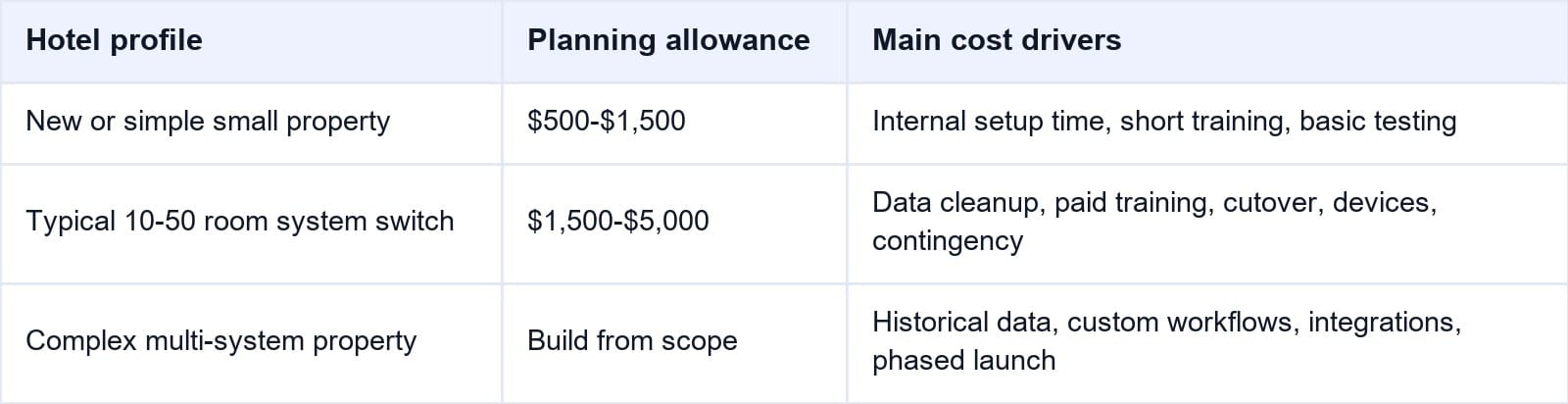
A new property with clean information and existing devices may need little cash beyond paid preparation time. A hotel switching systems must normally reconcile future reservations and protect a live cutover. A property with locks, POS, accounting, payments, or several custom workflows should not rely on a generic room-count estimate.
Do not add the monthly PMS subscription to this table. Keep implementation cost and recurring software cost separate, then combine them when calculating the first-year total.
Calculate the Budget With Your Own Labor Rates
The most useful hotel PMS implementation cost formula is:
Implementation budget = vendor fee + third-party fees + internal project labor + staff training labor + devices and network work + contingency
Consider a 25-room hotel replacing spreadsheets and a basic reservation tool. Management estimates 18 project-lead hours at $28 per hour, 12 data-preparation hours at $24, four employees receiving four paid training hours at $18, and 12 testing and go-live hours at $22. The property also reserves $350 for devices or network adjustments and $400 for outside services and contingency.
The calculation is $504 + $288 + $288 + $264 + $350 + $400, for a $2,094 planning budget. With Smart Order, the PMS implementation-fee line remains $0. This example is not a price quote; it shows how to expose costs that disappear when management counts employee time as free.
If staff can complete preparation during normal low-demand hours without overtime or replacement coverage, the incremental cash cost may be lower. The hours still matter because they affect the launch schedule and operational capacity.
Costs That Change the Budget Most
Room count matters, but complexity changes the budget faster. Historical data is expensive to clean when fields are inconsistent. Many rate plans and OTA mappings increase testing. Custom door locks, accounting, POS, or payment workflows introduce other vendors and support responsibilities.
The implementation budget also rises when a hotel tries to launch every module on one date. A phased rollout can reduce risk: establish the core front desk workflow first, connect the required distribution paths, then add lower-priority automation after reservations and balances are stable.
Hardware is another variable. A cloud PMS avoids a local server project, but a hotel may still choose new tablets, computers, printers, scanners, payment terminals, key encoders, or stronger Wi-Fi. Only include equipment required for day-one operation; separate optional upgrades from implementation essentials.
Reduce Implementation Cost Without Cutting Readiness
Cost control should remove rework, not remove testing. Independent hotels can keep the project lean by making decisions before configuration begins.
- Name one internal owner who can approve rooms, rates, policies, permissions, and the cutover schedule.
- Clean future reservations and active guest data before importing anything; archive information that does not need to be live.
- Train each role on its day-one tasks and provide a short reference for common exceptions.
- Connect systems one at a time and record who supports each connection if an issue occurs.
- Choose a lower-demand launch window and keep the old records accessible for reconciliation.
- Review reservations, balances, room availability, and core reports and analysis every day during the first week.
Self-service configuration can lower external charges, but it should not mean guessing. If the team cannot validate taxes, payments, channel mapping, or financial data confidently, budget for qualified help in that specific area rather than purchasing a vague all-purpose package.
Build a Budget Around Deliverables, Not Labels
Before accepting any PMS proposal, request a launch scope that names the deliverable, owner, completion date, price, and acceptance test. “Onboarding included” is not enough to show whether data migration, OTA mapping, training, or go-live support is covered.
The same rule applies when the implementation fee is $0. Assign hotel-side ownership for the property build, data approval, staff readiness, test results, and final cutover. A zero-fee launch succeeds because the work is organized, not because the work disappears.
Smart Order removes the separate PMS implementation fee, helping independent hotels avoid an upfront software charge. The property can start with core operations, configure the workflow, and spend only where its own data, team, equipment, or external connections require it.
Build Your Independent Hotel Launch Plan
Start with a $0 Smart Order implementation-fee line, then budget transparently for the people, data, testing, and optional connections your property needs.
FAQ About Hotel PMS Implementation Cost
Does Smart Order charge a PMS implementation fee?
No. Smart Order does not charge a PMS implementation fee. Hotels should still plan the internal time and any optional external resources needed to prepare data, configure operations, train staff, test workflows, and go live.
The only exception applies to properties signing up via the REDnote channel: per REDnote platform regulations, an additional implementation surcharge will be required for this dedicated integration pathway.
What is normally included in PMS implementation?
The work commonly includes property configuration, data preparation or migration, integrations, staff training, workflow testing, cutover, and early post-launch checks. The exact responsibility split varies by hotel and provider.
How long does implementation take for an independent hotel?
A simple new property can move faster than an operating hotel with live reservations and several connections. Build the schedule from data volume, decision availability, training needs, integrations, and testing rather than promising a fixed number of days from room count alone.
Should internal staff time be counted as a cost?
Yes. Even when employees work within normal schedules, those hours use operational capacity. Count them to set a realistic timeline and identify whether overtime, temporary coverage, or delayed tasks may create cash expense.
Is the cheapest implementation always the best choice?
No. A low budget is useful only if rooms, rates, reservations, payments, access, and connected inventory work correctly at launch. Cutting duplicate work and unnecessary scope is sensible; skipping validation creates avoidable operating and revenue risk.