1. Hotel PMS pricing should be reviewed as a 12-month total cost, not just a monthly subscription.
2. Ask vendors about setup, channel manager access, booking engine fees, payment processing, support, contracts, data migration, and future growth costs before signing.
3. The best quote is not always the cheapest quote. It is the one with the fewest surprises once your property starts using the system every day.
Hotel PMS pricing can look clear on a vendor page and become confusing during implementation. The monthly fee may be only one part of the cost. Setup, channel manager access, payment processing, support, integrations, and contract terms can all change what you actually pay.
That is why hotels should not evaluate a Property Management System (PMS) by headline price alone. Before you sign, you need to know what the system costs in real operating conditions.
Use this hotel PMS pricing checklist before your next demo or vendor call.
Why a Hotel PMS Pricing Checklist Matters
Most PMS vendors price around a simple unit: room count, property count, feature tier, or custom quote. That structure is not the problem. The problem is that different vendors include different things in the base price.
One quote may include channel manager, booking engine, and reporting. Another may include only reservation management.
If you compare only the first monthly number, you can choose the wrong system. The better approach is to ask the same pricing questions to every vendor, then compare the full answer.
The goal is to know what you are buying.
The 12 Questions to Ask Before You Sign
These questions are designed for the stage after you have shortlisted vendors but before you accept a proposal.
1. What exactly is included in the base subscription?
Start here. Ask whether the base plan includes reservation calendar, room management, guest profiles, housekeeping, reporting, channel manager, booking engine, payment tools, and user accounts.
If the answer is vague, request a feature-by-feature list.
2. Is pricing per room, per property, per user, or custom?
The pricing model affects future cost. A per-room model scales with inventory. A per-property flat rate may be cheaper for larger properties.
Ask how the bill changes if you add 10 rooms, a second property, or more staff users.
3. Are setup or onboarding fees required?
Some PMS vendors charge a one-time setup fee for account configuration, room types, rate plans, staff training, and go-live support.
Ask what onboarding includes and whether extra training sessions cost more.
4. Does the price include channel manager access?
For most hotels, a PMS without channel management is incomplete. OTA rates and availability need to sync in real time.
Ask whether channel manager access is included and whether each OTA channel has a separate fee.
5. Is the booking engine included?
A direct booking engine lets guests book through your own website. Some PMS platforms include it. Others charge a monthly add-on or setup fee.
Ask whether the booking engine is included and whether direct bookings carry any commission.
6. How is payment processing priced?
Payment processing is often separate from PMS pricing. Ask whether you must use the vendor's processor, whether card fees are marked up, and whether payment links or deposits carry extra charges.
Payment fees scale with booking volume, so small differences matter in high-occupancy months.
7. Are integrations included or billed separately?
Your PMS may need to connect with revenue management, accounting, CRM, smart locks, guest messaging, POS, or metasearch tools.
Ask for the cost of every integration you expect to use.
8. What support is included in the plan?
Support has real operational value. If OTA sync breaks before a busy weekend, slow support can cost more than the subscription.
Ask whether support is available by chat, email, or phone; what hours are covered; and whether priority support requires a higher plan.
9. What contract length is required?
Some PMS vendors offer month-to-month billing. Others require annual or multi-year contracts.
Ask about minimum term, renewal rules, cancellation notice, and early termination fees.
10. What happens to my data if I leave?
You need access to reservations, guest records, financial records, and reports if you switch systems later.
Ask what data can be exported, in what format, and whether the vendor charges a data retrieval fee.
11. How does pricing change as my property grows?
Your first quote may fit your current operation but fail as you add rooms, properties, users, channels, or modules.
Ask for example pricing for your current property, your expected size in 12 months, and a multi-property scenario if relevant.
12. What is the full 12-month total cost?
End with the only number that really matters: total cost for the first year.
Ask the vendor to combine subscription, setup, channel manager, booking engine, integrations, support, and required payment-related fees into one 12-month estimate.
A Simple Vendor Comparison Table
Use one table for every PMS vendor you evaluate. Keep it simple enough that you can fill it during or immediately after the demo.
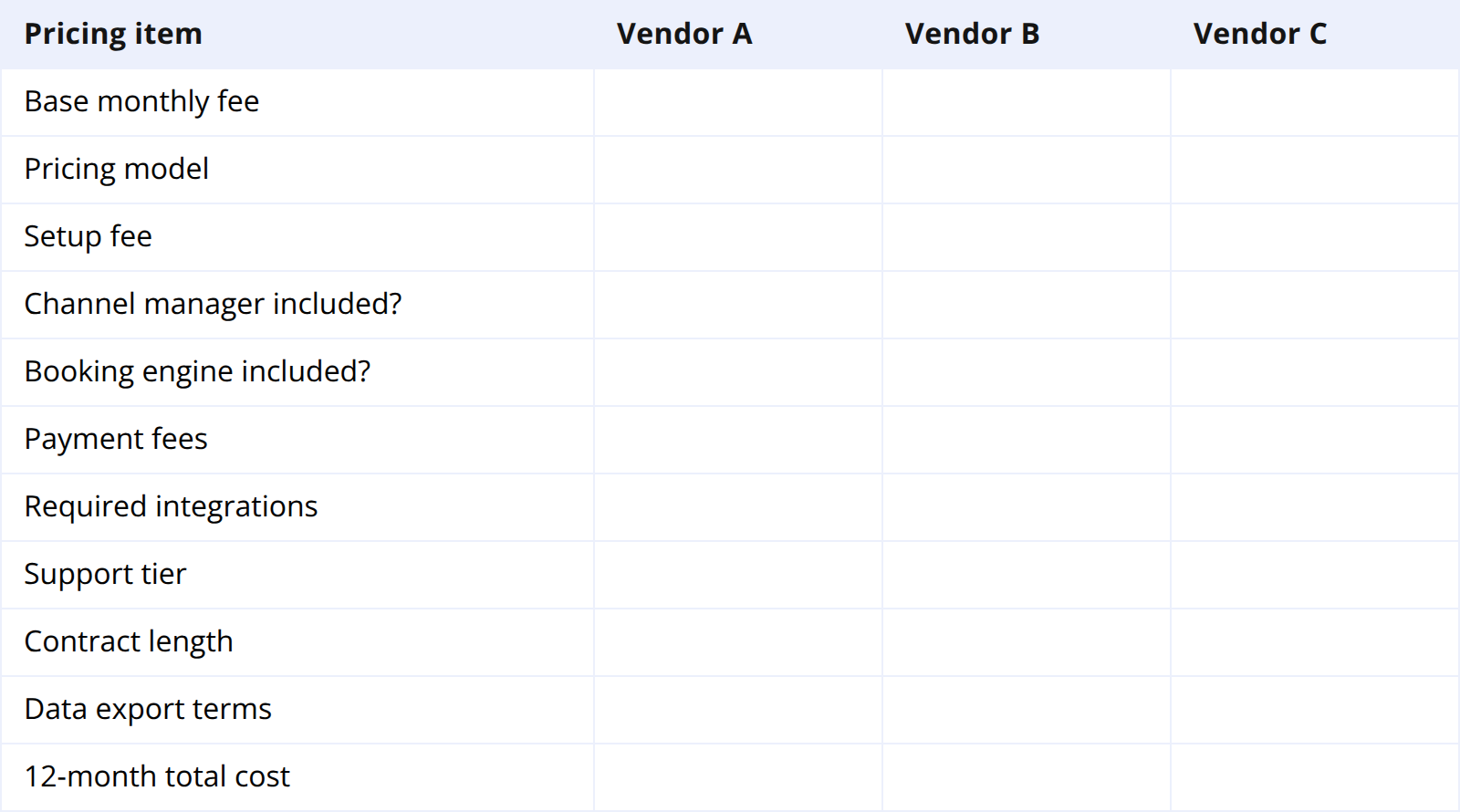
The point is to stop comparing incomplete quotes.
Red Flags in Hotel PMS Pricing
Some pricing issues are not deal-breakers, but they should slow you down.
Be cautious when a vendor avoids written pricing, cannot explain the base plan, charges separately for every operational module, or requires a long contract before you can test the workflow.
Also watch for pricing that scales against your success. If core PMS cost rises with booking revenue or every direct booking carries a commission, your best months become your most expensive software months.
Transparent pricing means you can understand the cost before your team depends on the system.
How Smart Order Keeps PMS Pricing Predictable
Many independent hotels do not need enterprise complexity. They need front desk tools, OTA sync, direct booking, reporting, and mobile access.
Smart Order is built around that problem. The PMS, channel manager, booking engine, and reporting tools work together in one system.
For small and mid-size properties, predictable pricing matters because margins are sensitive.
Compare PMS Pricing With Fewer Surprises
Smart Order combines PMS, channel manager, booking engine, and reporting in one connected system, helping hotels understand their true software cost before they commit.
FAQ About Hotel PMS Pricing
What is usually included in hotel PMS pricing?
Standard hotel PMS pricing usually includes reservation management, room status, guest profiles, basic reporting, and user access. Channel manager, booking engine, payment tools, integrations, and advanced support may be included or billed separately depending on the vendor.
What hidden fees should hotels ask about?
Ask about onboarding fees, channel connection fees, booking engine fees, payment processing markups, integration fees, support upgrades, extra user fees, data export charges, and early termination fees.
Is monthly PMS pricing better than an annual contract?
Monthly pricing gives more flexibility, especially for small hotels testing a system. Annual contracts can be fine if the vendor is proven and pricing is discounted, but cancellation and renewal terms should be clear before signing.
Should hotels choose the cheapest PMS?
Not automatically. The cheapest PMS can cost more if it lacks channel management, booking engine access, support, or reporting. Compare the total 12-month cost and operational fit, not only the base subscription.
How do I compare PMS quotes fairly?
Ask each vendor the same 12 pricing questions and request a written 12-month total cost. Include all required modules, setup fees, integrations, support, and payment-related fees.
Final Takeaway
Hotel PMS pricing should be evaluated before the contract, not after the first invoice. Ask direct questions, request written answers, and compare full-year cost instead of the first monthly number.
A good PMS should make operations clearer. Its pricing should do the same.