Key Takeaways
- Vrbo offers five standard cancellation policy options — Relaxed, Moderate, Firm, Strict, and No Refund — plus seasonal overrides for peak periods.
- If you cancel a confirmed reservation, Vrbo can charge up to 100% of the booking amount as a penalty fee, now expanding to international properties in 2026.
- Submit a waiver within 10 days of cancellation to avoid penalties in qualifying situations — most hosts don't know this window exists.
- Policy changes only affect future bookings. Existing reservations always honor the policy active at time of booking.
What Is the Vrbo Cancellation Policy?
The Vrbo cancellation policy defines what refund a guest receives when they cancel, and what penalties apply when a host cancels. These are two separate rule sets — and confusing them is one of the most common (and costly) mistakes hosts make.
- Guest-initiated cancellations are governed by the policy you choose for your listing.
- Host-initiated cancellations are governed by Vrbo's own enforcement policy, regardless of what you've set for guests.
How the Vrbo Cancellation Policy Works
When a guest books, they agree to your policy upfront. Your cancellation terms always override anything in a private rental agreement — if there's a conflict, Vrbo's platform rules win.
One detail that generates frequent disputes: service fees are non-refundable unless the guest cancels within 24 hours of booking and at least 30 days before check-in. Make sure your listing description sets this expectation clearly so it doesn't land in your inbox as a complaint.
Why Vrbo Cancellation Policies Matter for Hosts
Your policy choice affects more than refund math. It directly shapes:
- Booking conversion — Flexible policies lower the barrier to booking, especially for travelers planning far ahead.
- Search visibility — Vrbo's algorithm factors in your cancellation history. Even one unwaived host cancellation can drop your ranking.
- Premier Host status — Vrbo requires a 0% cancellation rate. One slip and you lose the badge — and the visibility that comes with it.
Vrbo Cancellation Policy Options in 2026
Vrbo offers five standard templates. Here's what each means in practice:
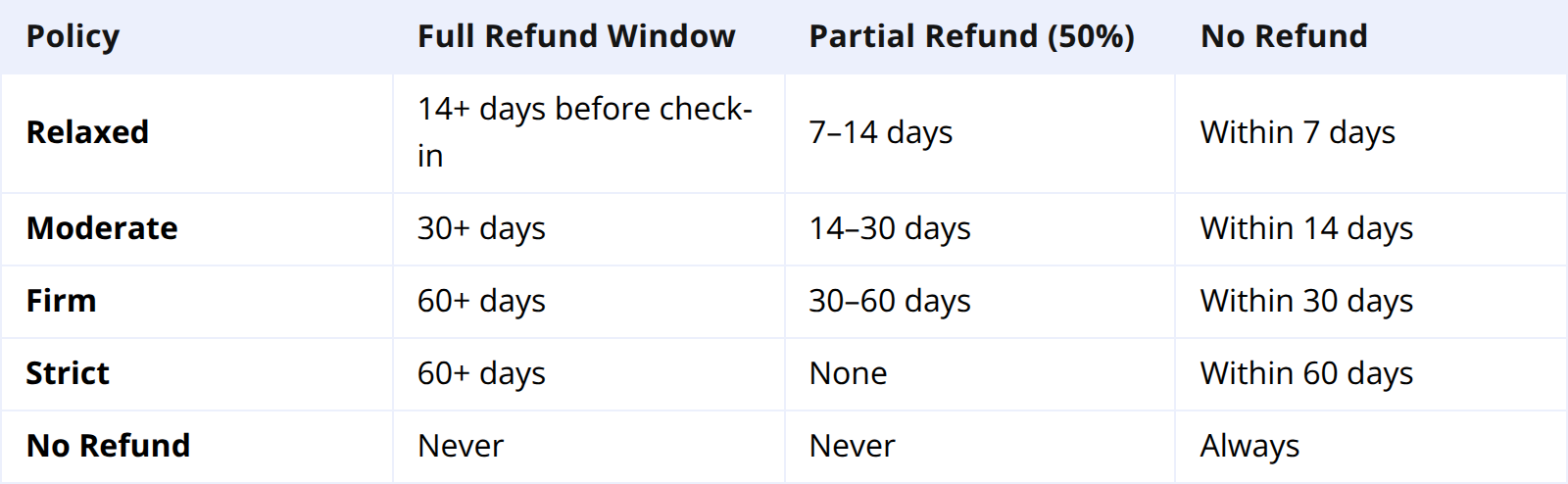
- Relaxed (Recommended by Vrbo) Guests receive a full refund if they cancel at least 14 days before check-in. If they cancel between 7 and 14 days out, they get 50% back. Cancellations within 7 days of check-in receive no refund.
This is Vrbo's default recommendation. It works well for hosts in competitive markets where booking volume matters more than locking in any single reservation. - Moderate Full refund for cancellations 30 or more days before check-in. A 50% refund applies between 14 and 30 days out. No refund inside 14 days. The Moderate policy offers a reasonable middle ground. Guests still have a meaningful window to change plans without losing everything, and hosts get decent protection against close-in cancellations.
- Firm Guests receive a full refund only if they cancel 60 or more days before check-in. Between 30 and 60 days out, they receive 50%. No refund within 30 days. The Firm policy makes sense for longer stays, remote properties that are difficult to rebook, or peak-season dates where last-minute availability fills fast regardless.
- Strict A full refund is available only when a guest cancels 60 or more days before check-in. After that window closes, there is no refund at all — even a cancellation 61 days out gets 100%, but 59 days out gets nothing. This is meaningful protection for high-value bookings. The trade-off is that some guests, particularly those booking far in advance, will choose a more flexible listing instead.
- No Refund All bookings are non-refundable at the moment of confirmation. No refund under any circumstances (outside of Vrbo's Extenuating Circumstances Policy, which can override host-selected terms). This policy tends to work in destination markets where demand is high and your listing has strong reviews. For newer listings or in price-sensitive markets, it can suppress bookings significantly.
Seasonal Cancellation Policies Beyond these five templates, Vrbo allows hosts to set seasonal policies that apply stricter or more flexible terms for specific check-in date ranges. A seasonal policy overrides your standard policy based on the guest's check-in date — not the date they booked.
Custom Refunds Vrbo also allows hosts to issue custom refund amounts, as long as the custom refund equals or exceeds what your policy would normally require. You can be more generous than your policy — you just can't offer less.
Vrbo Host Cancellation Policy and Penalties
This is the part most hosts underestimate. Canceling a confirmed reservation isn't just awkward — it has real financial consequences.
What Happens If a Host Cancels a Vrbo Reservation
When Vrbo determines you're responsible for a cancellation, expect:
- A cancellation fee (see below)
- A 7-day listing suspension — your property can't accept new bookings during this period
- Loss of Premier Host status if your cancellation rate rises above 0%
- A calendar block covering the original reservation dates
- A drop in your search ranking
You can also be held responsible for cancellations you didn't technically initiate — double-bookings, denying entry to a confirmed guest, or asking a guest to cancel on your behalf all count as host cancellations under Vrbo's policy.
Vrbo Host Cancellation Fees in 2026
For US properties, the fee structure is already in place. Starting this year, it's expanding internationally:
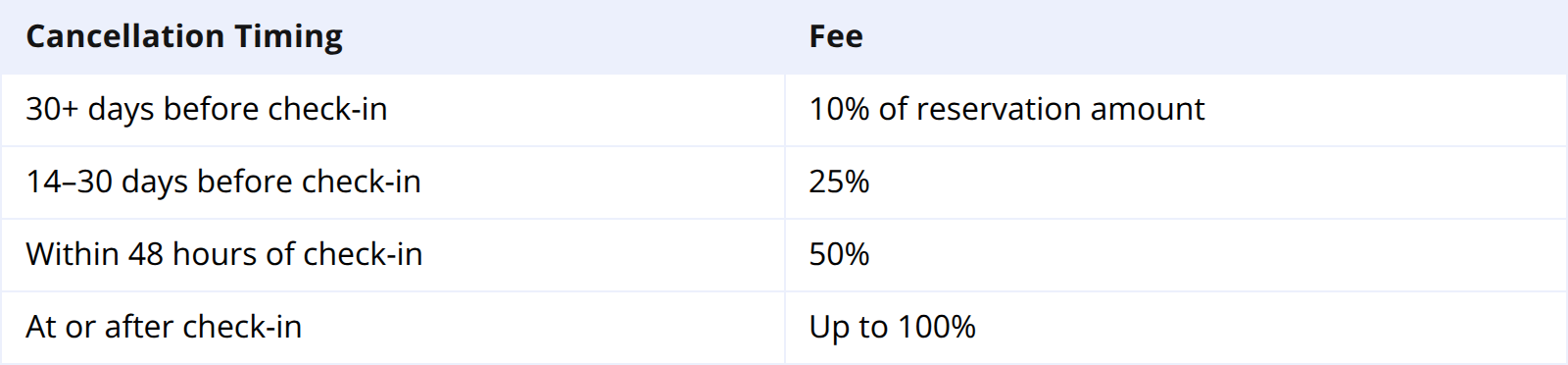
Minimum fee: $50 USD (or local equivalent). No maximum. The fee is calculated on the base rate plus mandatory fees like cleaning. From April 2, 2026, applicable taxes are added on top.
International rollout timeline:
- Canada & Mexico: April 14, 2026
- EMEA: April 28, 2026
- United Kingdom: May 12, 2026
- Australia, Japan, New Zealand, Singapore: May 26, 2026
- All other regions: June 9, 2026
If you manage properties outside the US and haven't factored this in yet, now is the time.
When Vrbo May Waive Cancellation Penalties
Vrbo will consider waiving penalties — but you must submit a waiver request within 10 days of the cancellation. Miss that window and the fee sticks.
Valid grounds for a waiver:
- A qualifying extenuating circumstance (natural disaster, declared health emergency, government travel ban)
- Guest violated house rules or planned an unauthorized event
- A property emergency making the space uninhabitable
- A Vrbo platform error caused the cancellation
- The guest failed to pay by the due date
- Suspected fraud on the booking
Approval isn't guaranteed, but submitting is always worth it. The alternative is paying a fee that could represent a significant portion of your annual income on that property.
How to Choose the Best Vrbo Cancellation Policy for Your Property
When to Use a Flexible Vrbo Cancellation Policy
Go with Relaxed or Moderate if:
- Your listing is new and still building reviews — flexibility reduces booking hesitation.
- You're in a saturated market with many similar properties nearby.
- You target families or groups who book months ahead but want the option to adjust.
- Your goal is consistent occupancy over maximizing any single booking's value.
When a Strict Vrbo Cancellation Policy Makes Sense
Firm, Strict, or No Refund works better if:
- You have high-demand peak dates (holiday weeks, major local events) where rebooking a last-minute vacancy is realistic.
- You require minimum stays of 7 nights or longer — a cancellation on a two-week booking 20 days out is a significant loss.
- Your calendar routinely fills 3–6 months in advance regardless of policy.
Balancing Revenue and Booking Conversion
A practical approach that works for many hosts: run a flexible base policy year-round, then layer a seasonal policy on your highest-demand windows. This gives you broad booking appeal without leaving peak revenue unprotected.
Start with Moderate or Relaxed, track your cancellation patterns over one full season, then tighten selectively. Don't apply a strict policy everywhere just because you had one bad cancellation experience — look at where and when cancellations actually occur before making changes.
How to Set or Change a Vrbo Cancellation Policy
Steps to update your policy:
- Log in to your Vrbo host account
- Navigate to your listing → Property → Rules & Policies
- Select the Cancellation Policy tab
- Choose your new policy and click Save
For seasonal policies, set date ranges through your Calendar settings.
Critical reminder: changes apply to new bookings only. Guests who booked under your previous policy keep those original terms. If you're mid-season with active reservations, changing your policy won't affect a single booking already confirmed.
If you use a PMS or channel manager, verify that your cancellation policy syncs correctly to Vrbo after any update. Mismatches between your PMS and Vrbo's platform are a common source of guest confusion and disputes.
Best Practices for Managing Vrbo Cancellation Policies
Be explicit in your listing
Don't bury your policy in fine print. A one-sentence callout in your property description — "This property follows a Firm cancellation policy — full refunds require 60 days' notice" — eliminates most expectation mismatches before they become problems.
Reinforce it at booking
A brief, friendly post-booking message that references your cancellation terms takes 30 seconds to send and prevents a lot of painful conversations later.
Never ask guests to cancel for you
Vrbo will assign the cancellation to you anyway, and it's a policy violation on top of the financial penalty.
Know the 10-day waiver window
If you ever need to cancel for a legitimate reason, act immediately. Don't wait to see if the situation resolves — submit the waiver first, then handle logistics.
Revisit your policy before each peak season
A policy that made sense last year might need adjusting based on how your market has shifted or how your booking patterns have evolved.
Vrbo Cancellation Policy FAQ
Can hosts create custom Vrbo cancellation policies?
No. In 2026, Vrbo requires all hosts to choose from their five standardized templates. This ensures clarity for guests and allows Vrbo’s automated systems to handle refunds without manual intervention.
Do guests get a full refund on Vrbo?
It depends entirely on the host's selected policy and the timing. Under a "Relaxed" policy, a guest can get a 100% refund if they cancel 14 days before check-in. Under a "No Refund" policy, they get nothing. Note that Vrbo’s service fee is often non-refundable after a certain grace period.
Is Vrbo cancellation policy different from Airbnb?
Yes. While both use tiered systems, the specific day counts and refund percentages differ. Airbnb’s "Firm" policy, for instance, has different triggers than Vrbo’s "Firm" policy. Always double-check the specifics if you cross-list your property.
Can Vrbo cancellation policies change after booking?
No. The policy active at the time of booking is a binding contract. Neither the host nor the guest can unilaterally change the terms for that specific stay after the reservation is confirmed.
What is the most flexible Vrbo cancellation policy?
The "Relaxed" policy is the most flexible, allowing for a full refund up to 14 days before stay and a 50% refund up to 7 days before check-in.
Can a host cancel a Vrbo reservation without penalty?
Only in very specific cases involving "Extenuating Circumstances" like natural disasters or serious property damage. Documentation is always required to avoid fees and ranking drops.
What is the difference between Moderate and Firm Vrbo cancellation policies?
The primary difference is the timeline. "Moderate" allows a full refund up to 30 days before stay, whereas "Firm" requires 60 days for a full refund. "Firm" is essentially a more protective version of "Moderate" for the host.