In the dynamic world of hotel and vacation rental management, leveraging technology is no longer a luxury—it’s a necessity for survival and growth. For property managers, navigating the suite of available software tools can be daunting, with two acronyms standing at the forefront: PMS and Channel Manager. Often mentioned in the same breath, these systems serve distinct but deeply interconnected purposes. Confusion between them is common, leading to operational inefficiencies, missed bookings, and unnecessary costs. This article aims to demystify these critical platforms, providing a clear, comprehensive breakdown of what each one does, how they work together, and why understanding their unique roles is fundamental to running a streamlined and profitable hospitality business.
So, what is the core difference between a PMS and a Channel Manager?
A Property Management System (PMS) is the central command center for your daily operations, handling reservations, guest profiles, billing, and front-desk tasks. A Channel Manager is a dedicated distribution tool that automatically syncs your room availability and rates across all online booking sites like Booking.com, Airbnb, and Expedia. In essence, the PMS manages what happens inside your business, while the Channel Manager manages how you sell outside on the web. To build a robust tech stack, you need to understand the specific function of each and how they integrate to form a powerful hospitality engine.
What Is a PMS (Property Management System)?
A PMS (Property Management System) is the central system used to run daily hotel or short-term rental operations. It acts as the operational “brain” of a property, storing guest data, managing reservations, tracking room status, and handling payments.
In practical terms, a PMS connects front desk tasks, back-office management, and guest information into one system. When a guest books a room, checks in, extends their stay, or checks out, all related actions are recorded and updated in the PMS.
Core functions of a modern PMS usually include:
- Reservation and calendar management
- Guest profiles and stay history
- Check-in and check-out workflows
- Room status and housekeeping coordination
- Rate and availability control
- Invoicing, payments, and financial reports
For small hotels, motels, and vacation rentals, a cloud-based PMS replaces manual spreadsheets, paper logs, and disconnected tools. For larger properties, it provides standardized processes and data consistency across departments.
A PMS is not just a booking tool. It is designed to support daily operations, staff efficiency, and long-term business decisions.
Why Do Hotels and Hosts Need a PMS?
Running a property without a PMS quickly leads to operational friction. As booking volume grows, manual processes become error-prone and time-consuming.
A PMS helps solve several real problems faced by hotel managers and hosts:
Operational efficiency
Staff no longer need to switch between notebooks, Excel files, and multiple systems. A PMS centralizes tasks and reduces repetitive work, allowing teams to focus on guests rather than administration.
Data accuracy
Guest details, stay dates, and payments are stored in one place. This reduces the risk of missed reservations, billing mistakes, or room assignment conflicts.
Better guest experience
Faster check-in, fewer errors, and personalized service are direct results of having accurate guest data. Returning guests can be recognized, preferences can be noted, and issues can be resolved more quickly.
Scalability
What works for five rooms rarely works for twenty or fifty. A PMS allows properties to grow without increasing operational chaos or staffing costs at the same rate.
Financial visibility
Daily revenue, occupancy, average daily rate, and other performance metrics are easier to track when data is automatically collected and reported.
Without a PMS, property managers often spend more time fixing problems than improving operations. The system creates structure, consistency, and predictability in day-to-day management.
What Is a Channel Manager?
A channel manager is a tool that connects your property to multiple online booking channels and keeps availability, rates, and restrictions synchronized in real time.
Online travel agencies (OTAs) such as Booking.com, Expedia, Agoda, and Airbnb operate independently. Without a channel manager, each platform must be updated manually whenever a room is booked, canceled, or repriced.
A channel manager acts as a bridge between your inventory and these channels. When a booking comes in from one platform, availability is instantly updated across all connected channels.
Typical channel manager functions include:
- Real-time availability synchronization
- Centralized rate and restriction management
- Automatic booking imports from OTAs
- Overbooking prevention
- Channel performance insights
The channel manager focuses on distribution, not internal operations. It does not manage guest check-in, housekeeping, or billing on its own.
Why Do Properties Need a Channel Manager?
Selling rooms on multiple channels increases visibility and revenue potential, but it also increases complexity.
A channel manager addresses key distribution challenges:
Overbooking risk
Manual updates almost always lead to delays. Even a few minutes of lag can result in double bookings during high demand periods. A channel manager eliminates this risk by syncing inventory instantly.
Time savings
Instead of logging into each OTA separately, managers update prices and availability once. This can save hours every week, especially for properties using three or more channels.
Pricing control
Rate parity and promotional strategies are easier to manage when all channels are controlled from one dashboard. Seasonal changes and last-minute adjustments can be applied consistently.
Revenue optimization
By being present on multiple platforms, properties can capture demand from different markets. A channel manager makes multi-channel selling manageable rather than stressful.
For any property relying on online bookings, a channel manager is no longer optional. It is a foundational tool for modern distribution.
PMS vs Channel Manager: The Key Difference
The difference between a PMS and a channel manager lies in scope and purpose.
- A PMS manages internal operations: guests, rooms, staff workflows, and finances.
- A channel manager manages external distribution: availability and rates across booking channels.
They serve different roles but are deeply connected. A booking created by a channel manager must be handled by the PMS. Likewise, changes made in the PMS must be reflected on booking channels.
Using them separately often leads to data gaps, sync delays, or duplicated work.
Why an All-in-One PMS With Built-in Channel Manager Makes Sense
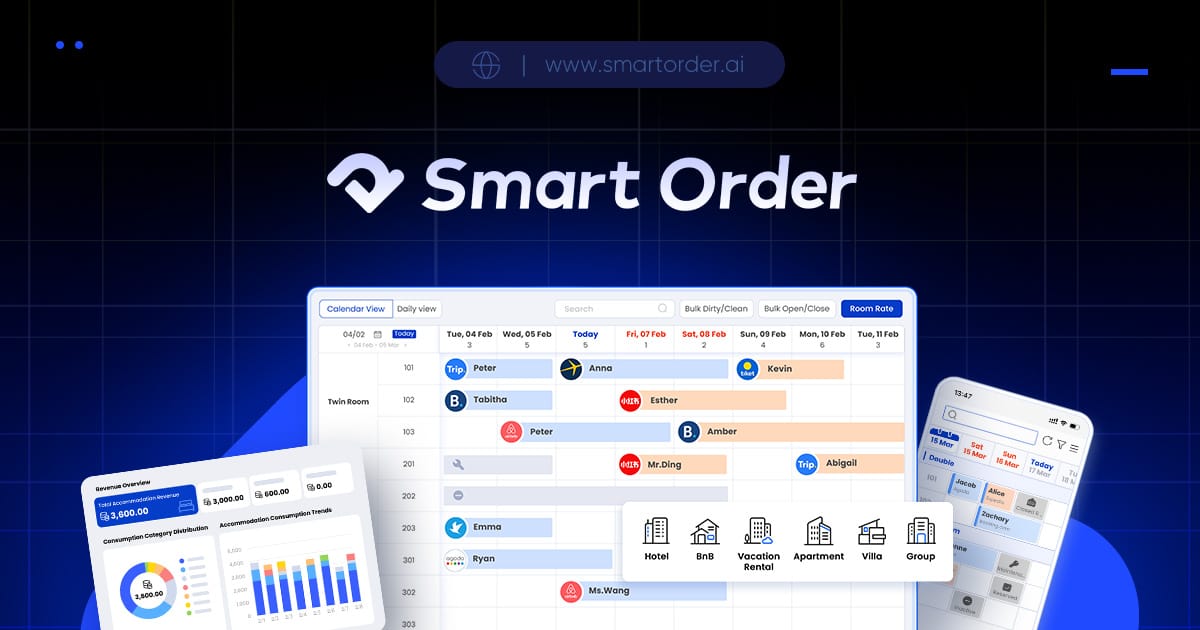
Smart Order PMS
Powerful all-in-one PMS for hotels & B&Bs. Centralize operations, boost direct bookings, and sync OTAs in real-time. Trusted by 200K+ properties.
Smart Order is an all-in-one PMS that includes a fully integrated channel manager. This means operations and distribution are handled within one unified system.
Key advantages include:
- No data silos between systems
- Faster synchronization and fewer errors
- One login, one dashboard, one source of truth
- Lower software and integration costs
Instead of connecting multiple tools and troubleshooting sync issues, managers can run their property from a single platform designed to work as one system.
The goal is not to add more features, but to remove unnecessary complexity.
Conclusion
Understanding the difference between a PMS and a channel manager is essential for making the right technology decisions.
A PMS focuses on running the property smoothly from the inside. A channel manager focuses on selling rooms efficiently across online platforms. Both are critical, but neither works at its best in isolation.
For modern hotels and short-term rental operators, an all-in-one PMS with an integrated channel manager offers a simpler, more reliable way to manage operations and distribution together.
When systems work together, teams spend less time managing tools and more time improving guest experience and revenue performance.