
Introduction
Choosing the right online travel agency (OTA) can shape how successful your property is. For hosts, the question is rarely “Which OTA is the biggest?” but rather which OTA actually works best for my property type.
Hotels and vacation rentals operate very differently. Guest expectations, pricing models, cancellation rules, and booking behavior are not the same. Yet many hosts list their properties on OTAs without understanding that these platforms were not built for everyone equally.
Some OTAs were designed for traditional hotels. Others were created specifically for short-term rentals. This difference affects visibility, commission costs, booking volume, and daily operations.
In this guide, we’ll explain how the OTA market is divided, compare the best OTAs for hotels and vacation rentals, and help you decide which platforms make sense for your business.
Understanding the OTA Market for Hotels and Vacation Rentals
The OTA market is not a single ecosystem. It is divided by accommodation type.
Originally, OTAs focused almost entirely on hotels. Over time, vacation rentals entered the market and reshaped traveler demand. Instead of one universal booking platform, hosts now operate in two overlapping but very different systems.
Hotel-focused OTAs
These platforms were built around hotel operations:
- Nightly pricing
- Daily availability updates
- Front-desk workflows
- Standard room types
- Short stays
Examples include Booking.com, Expedia, and Agoda.
Vacation rental platforms
These platforms were designed for short-term rentals:
- Entire homes or apartments
- Weekly pricing options
- Cleaning fees
- Flexible house rules
- Direct host–guest communication
Examples include Airbnb and Vrbo.
Many OTAs now accept both property types, but their core systems still favor their original audience. Understanding this distinction helps hosts avoid choosing the wrong channel.
Best OTAs for Hotels
Booking.com — Best OTA for Independent Hotels
Booking.com remains the strongest OTA for hotels worldwide.
It performs well for:
- Independent hotels
- Boutique hotels
- Urban and business properties
- Properties with flexible cancellation options
Why hotels succeed on Booking.com:
- Strong global brand recognition
- High-intent travelers
- Daily rate-based pricing
- Wide reach across Europe and North America
However, competition is intense. Hotels must manage pricing carefully and maintain strong review scores to remain visible.
Expedia Group — Best for City and Chain Hotels
Expedia Group includes multiple brands such as Expedia, Hotels.com, and Orbitz.
It works well for:
- Mid-size hotels
- Chain-affiliated properties
- Hotels targeting U.S. travelers
Expedia often attracts guests who compare multiple sites before booking. Loyalty programs and package bookings can increase exposure but may reduce pricing control.
Agoda — Strong for Asia-Pacific Hotel Distribution
Agoda is especially effective for:
- Hotels in Southeast Asia
- Properties targeting international travelers
- Rate-sensitive markets
Its aggressive pricing strategy can increase bookings, though hotels should monitor parity closely.
Best OTAs for Vacation Rentals and Short-Term Rentals
Airbnb — Best OTA for Vacation Rentals
Airbnb remains the leading platform for short-term rentals.
It is ideal for:
- Apartments
- Villas
- Homestays
- Unique properties
Strengths include:
- Massive global audience
- Host-focused tools
- Flexible cancellation models
- Strong mobile booking behavior
Airbnb guests expect personal experiences rather than hotel-style service. For traditional hotels, this mismatch can reduce conversion.
Vrbo — Best for Entire-Home Rentals
Vrbo specializes in full-home vacation rentals.
It works best for:
- Family-friendly homes
- Weekly stays
- Leisure destinations
Unlike Airbnb, Vrbo avoids shared spaces, which simplifies guest expectations but limits property variety.
Booking.com for Vacation Rentals — Is It Worth It?
Booking.com now lists millions of vacation rentals.
Benefits include:
- Access to hotel-focused travelers
- High international exposure
- Instant booking without guest screening
Challenges include:
- Less flexibility with house rules
- Higher cancellation rates
- Guests expecting hotel-style service
For many hosts, Booking.com works best as a secondary channel rather than a primary one.
Hotels vs Vacation Rentals on OTAs — Key Differences
Although OTAs may appear similar, hotels and vacation rentals perform differently across platforms.
Inventory type and guest expectations
Hotel guests expect:
- Daily housekeeping
- Front-desk support
- Predictable services
Vacation rental guests expect:
- Privacy
- Space
- Flexible check-in
- Local experience
When expectations do not match the platform, negative reviews often follow.
Pricing models
Hotels usually rely on:
- Dynamic daily rates
- Revenue management systems
- Rate parity strategies
Vacation rentals often use:
- Weekend pricing
- Weekly discounts
- Cleaning and service fees
Not all OTAs support both models equally well.
Cancellation policies
Hotels benefit from:
- Free cancellation visibility
- Short booking windows
- High rebooking potential
Vacation rentals face:
- Longer stays
- Higher cleaning costs
- Greater revenue loss from cancellations
OTA cancellation rules can strongly impact profitability.
Commission structures
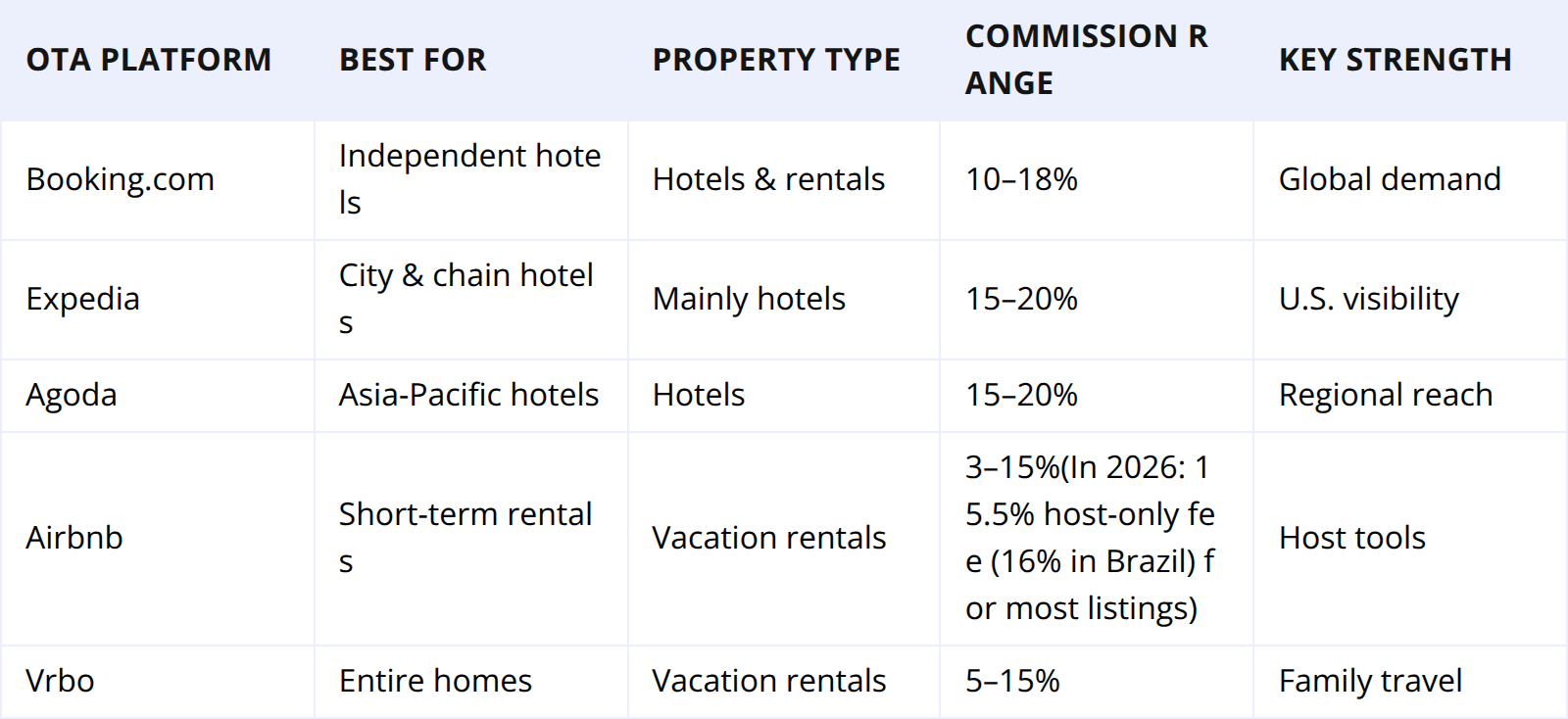
Typical commission ranges:
- Booking.com: 10–18%
- Expedia: 15–20%
- Airbnb: 3–15% depending on fee model
- Vrbo: 5–15%
Understanding fee structures is essential when comparing real net revenue.
Ranking and visibility
OTA ranking is influenced by:
- Price competitiveness
- Availability
- Cancellation flexibility
- Review quality
- Conversion rate
Hotels and vacation rentals often perform differently under the same algorithm.
OTA Comparison Table for Hosts
Which OTA Should You Choose as a Host?
Best OTA for small hotels
Small hotels typically perform best with:
- Booking.com as the primary channel
- Expedia as secondary distribution
- Direct booking website support
These platforms align with hotel guest behavior and pricing logic.
Best OTA for vacation rental hosts
Vacation rental hosts usually benefit from:
- Airbnb as the main channel
- Vrbo for longer stays
- Booking.com for additional exposure
The right mix depends on location, stay length, and target guest type.
Using multiple OTAs without double bookings
Relying on one OTA limits visibility. Using several increases bookings but also increases complexity.
Without proper synchronization, hosts risk:
- Double bookings
- Rate inconsistencies
- Manual errors
This is where distribution technology becomes essential.
How Channel Managers Help Hotels and Vacation Rentals Succeed on OTAs
Channel managers connect your property to multiple OTAs from one dashboard.
They allow hosts to:
- Sync calendars in real time
- Update prices instantly
- Prevent double bookings
- Manage inventory centrally
- Maintain rate parity
For both hotels and vacation rentals, channel managers reduce workload and improve distribution efficiency. As OTA strategies grow more complex, automation becomes a necessity rather than a luxury.
Conclusion
There is no single best OTA for every host.
The right platform depends on your property type, location, guest profile, and operational model. Hotels generally perform better on Booking.com and Expedia, while vacation rentals thrive on Airbnb and Vrbo.
Understanding how OTAs differ — not just in size, but in structure — helps hosts choose smarter distribution strategies. When combined with the right technology and pricing approach, OTAs can remain a powerful source of bookings rather than a costly dependency.
FAQs
Which OTA is best for hotels?
Booking.com is generally the best-performing OTA for independent and boutique hotels due to its global reach and hotel-focused system.
Which OTA is best for vacation rentals?
Airbnb remains the leading platform for short-term rentals, especially for entire homes and unique properties.
Can hotels list on Airbnb?
Yes, but performance varies. Hotels without apartment-style units may see lower conversion rates.
Can vacation rentals use Booking.com?
Yes. Many hosts use Booking.com as a secondary channel, though cancellation policies require careful management.
Should hosts use more than one OTA?
In most cases, yes. Multiple channels increase exposure, but proper calendar synchronization is essential to avoid operational issues.