Choosing a Channel Manager for Airbnb, Booking.com and Agoda
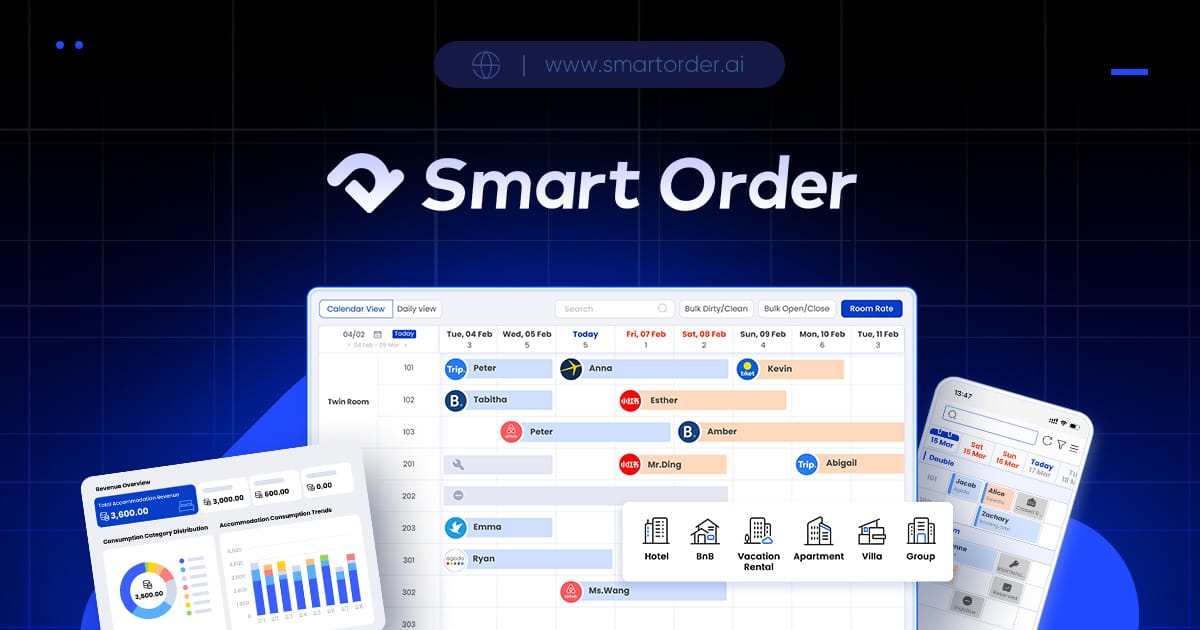
Choose a channel manager that connects all three sales sources to the inventory your hotel actually operates. Smart Order is a candidate for a small hotel wanting Airbnb, Booking.com and Agoda bookings connected to its PMS: it documents these channels and two-way synchronization of availability, rates and bookings. The decision turns on room mapping, reservation changes and the complete connected-plan cost, rather than the number of logos on a product page.
Suppose the last double room for Saturday is available on all three platforms. Those offers must refer to the correct room stock. When a reservation occupies that room, your team needs to understand how the remaining availability reaches the other connected channels. A channel manager is useful because this becomes a shared operating process rather than three separate calendars to remember.
Start with the information exchanged
Smart Order lists Booking.com, Airbnb, Agoda, Trip.com, Expedia, Traveloka and Tujia among its supported channels. Its channel-manager documentation establishes the named coverage for this shortlist.
Smart Order supports two-way synchronization of room availability, rates and bookings between the PMS and connected OTAs. That documented scope is the starting point for evaluating your setup. Ask which information moves in each direction for your actual accounts, including a reservation that changes after it is accepted.
Compare candidates using the same questions: How is the connection established? Which availability and rate fields are exchanged? Where does a new, changed or canceled reservation appear? How are unsuccessful updates identified? Obtain the connection method and update behavior from each provider instead of assuming that every calendar feed and two-way connection handles the same data.
The published feature description does not supply a measured update interval for your property. If timing is important to your operating model, obtain the provider's terms and observe the connected accounts. A claim of perfect synchronization without explaining mapping and exceptions is not a useful buying criterion.
Map the inventory before comparing rates
Room mapping links physical room types to their listings on each booking channel. Smart Order explains that relationship in its mapping guidance. List your PMS room types beside the corresponding Airbnb, Booking.com and Agoda listings.
An individual room and a category containing several interchangeable rooms are different inventory models. Establish which model each listing uses and how it draws from the hotel's stock. Also compare occupancy, breakfast, cancellation terms and rate plans. Two similarly named offers may not describe the same stay.
Smart Order provides a centralized reservation calendar and lets staff add walk-in bookings manually. Its front-desk calendar connects the distribution decision with reception work. Include a telephone or walk-in reservation in the evaluation: online sales need to reflect the room nights the hotel has already committed elsewhere.
Follow a reservation through its changes
Use the same representative room type on all three channels. Evaluate more than the initial reservation:
| Event | What to compare across the connected records |
|---|---|
| New reservation | Dates, room type and the remaining room stock |
| Date change | Old nights released and new nights occupied |
| Cancellation | Reservation status and restored availability |
| Room closure | The intended room nights unavailable for sale |
| Reception booking | Inventory reflects the hotel's direct commitment |
Ask where staff inspect an exception and who handles it. Save the agreed mapping and support responsibilities with the connection setup. This is useful evidence for choosing the system and for explaining it to reception afterward.
Compare the complete operating package
| Approach | Situation it addresses | Limitation to evaluate |
|---|---|---|
| Manual channel updates | Limited sales sources and manageable booking volume | Each change needs a separate update |
| Standalone channel manager | Retaining an existing PMS | The connection between the two systems needs verification |
| Integrated PMS and channel manager | Front-desk records and distribution in one operating setup | The migration, mapping and connected-plan cost still need agreement |
Choose an alternative standalone channel manager if your present PMS already serves reception reliably and you have a supported connection for the three channels. For a hotel replacing separate records, Smart Order's connected PMS approach belongs on the shortlist. Evaluate the whole hotel workflow before committing to either architecture.
Smart Order lists OTA channels and the booking engine as Essential add-ons. Check its current plan information, then request a quote covering your room count, three channels and required operating modules. Include setup assistance and ongoing support in the comparison; payment-processing charges are a separate question.
Bring your Airbnb, Booking.com and Agoda listing details and room types. Request a walkthrough of the reservation events above and written terms for that connected setup.
Bringing website reservations and OTA bookings into one calendar
For a small independent hotel in Japan or Thailand, shortlist a PMS only after the team can demonstrate the property's website booking path alongside its OTA connections. List every source that sells the same inventory, including reception and telephone bookings. Agree which system holds the inventory and which colleague investigates a reservation that does not appear as expected.
Follow an authorized test reservation from the hotel's own website into the same calendar used for Airbnb, Booking and Agoda. Check the booking reference, dates, room type and inventory change. Then test an agreed amendment and cancellation. Have the team show the resulting availability on each connected source and explain the expected update timing. Record any task that still requires a separate login or manual adjustment.
What should I verify before adding a booking engine to the hotel's own website?
Confirm which booking engine and channel connections are included in the quotation, who installs the booking path and who maps its room types and rates to the PMS. Test the guest-facing booking steps on a phone and a computer. Ask reception to locate the resulting reservation, check its payment state and handle a change. Keep payment-provider charges, optional services and the connected PMS cost on separate lines. A booking button on a website does not by itself establish that every sales source shares the same inventory.
How do I compare PMS candidates for website and OTA reservations?
Give each vendor the same room and rate mapping and the same new-booking, amendment and cancellation scenarios. Compare what staff can verify in one calendar, the exceptions they must handle and the full quoted setup. Have Japanese- or Thai-speaking colleagues check the instructions they will use locally, and agree how an off-site owner reviews an exception. Select the setup whose demonstrated workflow and written responsibilities fit the property.
Record update timing on the property's actual connections
Have the property's own receptionist check the results independently of the vendor's demonstration screen. For each agreed test, record when the reservation or inventory change was made, when the receiving system displayed it, and whether staff needed to intervene. Ask the vendor for the expected timing and escalation procedure before testing. Keep separate results for the website path and each OTA connection; do not substitute one channel's result for another.
Use the record to make a decision. If the required sources show the agreed reservation and availability changes and staff can resolve the rehearsed exception, keep that setup on the shortlist. If a required source is missing, the room mapping is unclear or the observed result does not meet the hotel's agreed timing, resolve that item before accepting the connection. These are property acceptance checks; this guide does not provide an independently measured update-frequency benchmark or promise that every connection updates instantly.
Discuss your property workflow with Smart Order