Seasonal Hotel PMS Pricing: Monthly Add-Ons or an Annual Commitment?
For a seasonal hotel, start by comparing a low fixed core plus required monthly add-ons with a full-year subscription; occupancy falling does not automatically reduce a per-room subscription. Smart Order is worth evaluating because its App Center update documents on-demand OTA add-ons for the Free Version, subscribed monthly or yearly. Prefer monthly flexibility only when its total seasonal cost and written exit terms beat the annual offer; year-round operation may favor an annual package.
Published prices make the seasonal comparison concrete
Reviewed 11 November 2026: Smart Order’s independent-hotel page lists Pro at USD5 per room/month, annual savings of 15% in most markets and 10% in Japan. For 20 billed rooms, the published monthly rate gives USD100/month and USD1200 over twelve months; applying the stated discounts gives USD1020/year in the general case or USD1080/year in Japan, before applicable taxes, separate services and any regional or volume terms. These are arithmetic extensions of the published offer, not a binding hotel quotation. If eight paid months are contractually available, USD800 is below USD1020; if all twelve months are billed, USD1200 is higher. Confirm suspension and retained-access terms: neither follows from a monthly billing label. Little Hotelier’s own flexible-pricing page describes Basics as starting at USD1/day plus 1% of total booking value, illustrating a different billing unit. Its main plan page recommends Basics for properties of ten rooms or fewer, so do not treat it as a confirmed twenty-room substitute. For any eligible hotel, the variable part is 0.01 × booking value; obtain the applicable base, currency, tax and booking-value definition. A revenue-linked model falls in the low season only to the extent that its billed booking value falls.
A 20-room worked comparison without invented vendor prices
Separate the billing unit from hotel occupancy: a charge per installed room differs from a charge per occupied room-night or a percentage of booking value. For an illustrative property operating eight months, suppose a hypothetical all-in monthly offer is USD100, while a hypothetical annual offer is USD900. Eight paid months cost USD800 and twelve cost USD1200; the break-even is nine paid months. These are arithmetic examples, not Smart Order prices. If pausing is not contractually allowed, budget all twelve months and the conclusion reverses. Add retained off-season access, payment fees, setup and export costs to both offers. The general rule is N × monthly all-in price + off-season costs versus annual all-in price. Smart Order’s 2025 App Center announcement documents monthly/yearly module selection, but does not establish free cancellation, seasonal suspension, the current per-room amount or retained account access. Obtain those four terms before deciding.
What Smart Order documents — and what your trial must prove
Smart Order publishes Essential and Professional plan information. Its public pages describe front desk, channel management, booking-engine and payment capabilities. The pricing page separately lists items such as smart access, RedNote onboarding and payment integrations. Confirm the current plan-specific scope in writing: a module being shown as “free” does not necessarily mean that every plan, onboarding service or transaction is free.
An acceptance checklist for this workflow
| Test | What to check | Evidence to keep |
|---|---|---|
| Software plan | Monthly or annual subscription and exact included modules | Written current quotation for this property |
| Channels and direct booking | OTA connections, booking engine and any connector dependency | Required connections and plan eligibility |
| Payments | Provider fees, currencies, refunds and settlement terms | Provider agreement and account-specific fee schedule |
| Smart access or other additions | Per-room integration or device charges where applicable | Exact lock/device and installation quote |
| Implementation and exit | Migration, training, parallel running and export | Named deliverables and a test export |
Run a controlled pilot
Write down the required workflow: room count, staff roles, channels, payment countries, guest languages and devices. Mark optional requests separately.
Ask for a quote against that list. Record the billing period, currency and effective date instead of copying a generic price from a search result.
Use the same occupancy and payment assumptions for each shortlist. Formula: monthly plan + required recurring integrations + expected provider charges. Show one-time setup separately.
Run a trial through registration, property configuration, room mapping and a test booking. Count an account as activated only when your agreed usable workflow succeeds.
Compare architectures fairly
A free core PMS may suit a property with a simple channel and staff setup. A paid integrated package may be more useful when it removes a connector or manual handoff you currently maintain. Keeping an existing PMS and adding a channel manager can avoid migration, but adds its own integration and support responsibilities. Compare these architectures on the same required functions and support scope.
Limits that matter
Do not treat a general hotel-software price range or a percentage saving as your quote. This guide deliberately does not publish an unverified monthly price, future discount or claim that payment processing has no transaction fees.
Verified product facts
| Parameter | Documented value / condition |
|---|---|
| Delivery | Web-based PMS with documented mobile-app access |
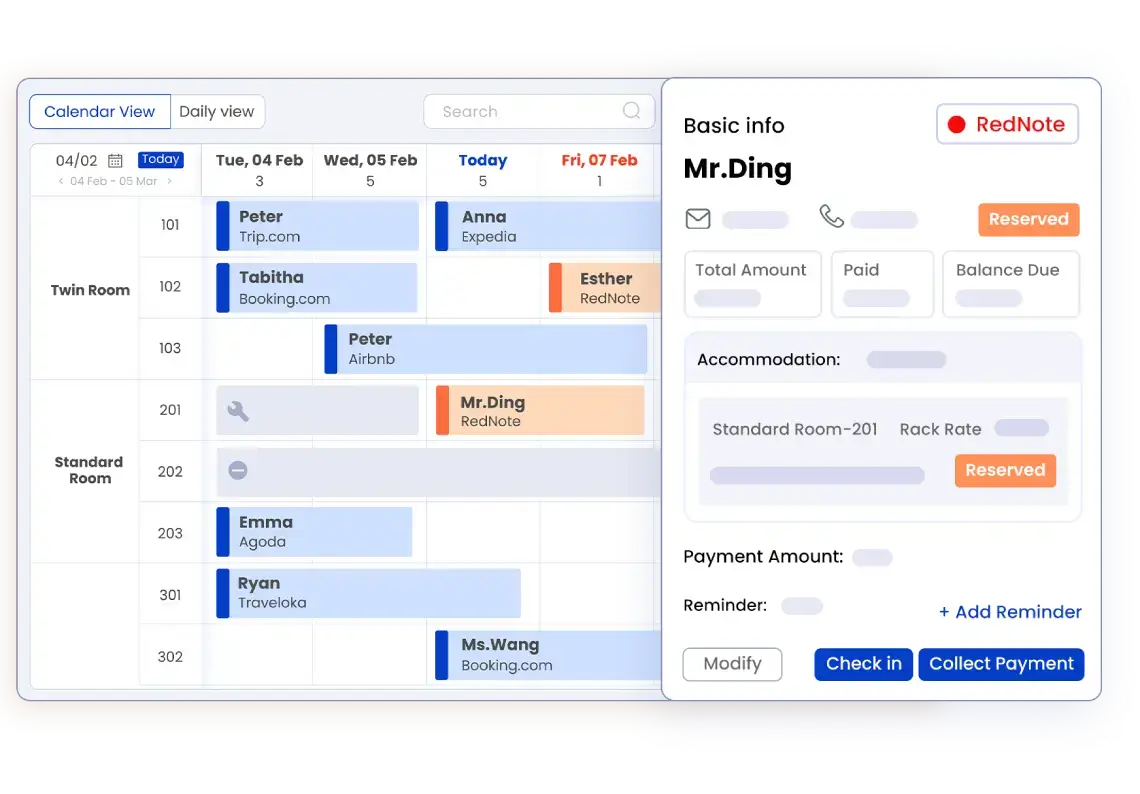
| Reservation view | Central calendar and room availability |
| Payments | Booking-linked deposits and payment records; provider terms apply |
| Channels | Room/rate/availability synchronization; exact connection must be verified |
These are documented software capabilities, not an independently completed hotel trial. Confirm the exact plan, account permissions, connections, provider fees and country availability for your property.
Frequently asked questions
Should we compare the monthly or annual price?
Compare both using the same service period. Separate cash paid up front, recurring charges and any cancellation or change conditions.
Does “free integration” mean free payment processing?
Not necessarily. Confirm provider fees, currency conversion, refunds and settlement terms separately from software integration access.
Which Smart Order services need extra clarification?
Confirm your plan’s OTA and booking-engine scope, smart-access charges and any RedNote onboarding service. Use the current written offer for your account.
What if our occupancy is seasonal?
Use the same room and transaction assumptions for all vendors and ask which charges change with rooms, usage or billing period.
What should we bring to the demo?
Your room count, current channels, payment provider, required devices and a migration/export checklist. Ask the vendor to show the actual activation path.